

The University of the Arts Singapore, usually shortened to UAS, changed how students in Singapore can study the arts at degree level. Before it existed, the two main arts institutions, LASALLE College of the Arts and the Nanyang Academy of Fine Arts (NAFA), offered diplomas and degrees in partnership with overseas universities. UAS brings them together under a Singapore university that awards its own degrees.
If you are a secondary school, JC or polytechnic student thinking about a creative career, or a parent trying to understand the options, this guide explains how the alliance works, what routes are available, how admission differs from other universities and how to think about fees. Programme lists, entry requirements and fees are set by the institutions and can change, so always check the UAS, LASALLE and NAFA websites for current details.
What the UAS Alliance Is
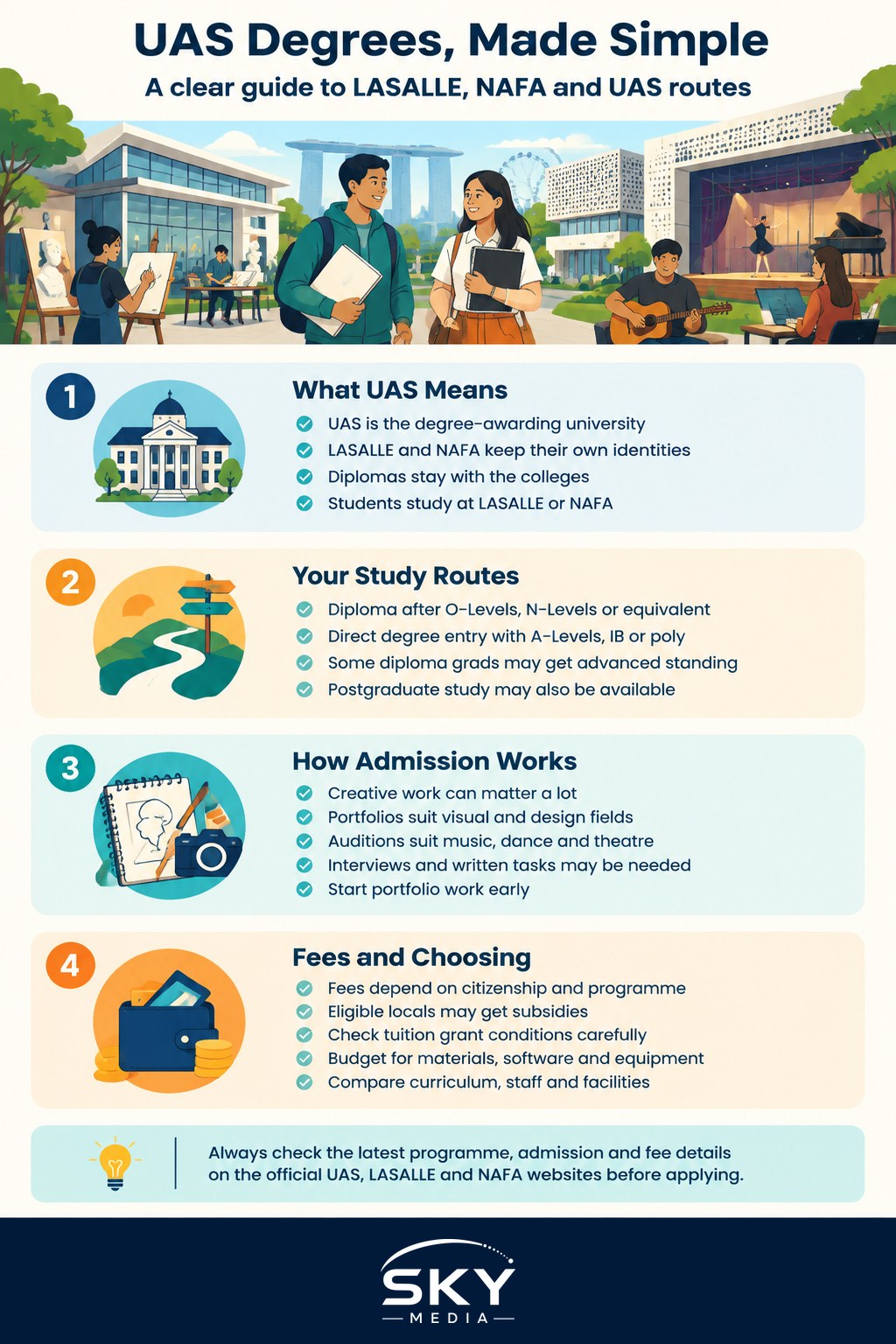
UAS is set up as an alliance. LASALLE and NAFA remain as distinct colleges with their own campuses, teaching staff, histories and characters. UAS sits above them as the degree-awarding university.
In practice, this means:
- Degrees are awarded by UAS. Students on degree programmes study at either LASALLE or NAFA, but their degree is conferred by the University of the Arts Singapore.
- Diplomas stay with the colleges. LASALLE and NAFA continue to offer their own diploma programmes, which remain a common entry point for students coming from secondary school.
- Each college keeps its identity. LASALLE is known for contemporary arts, design and media, and NAFA for a strong grounding across fine art, music, dance, theatre and design with roots in Nanyang art traditions. Programme offerings overlap in some areas and differ in others.
The government recognised the arts colleges as part of the publicly funded higher education landscape, which affects fees for eligible students. For background on how arts study compares across levels, our guide to studying the arts in Singapore gives the wider picture.
Degree and Diploma Routes
There are two main ways in, and many students move from one to the other.
| Route | Who it suits | What to expect |
|---|---|---|
| Diploma at LASALLE or NAFA | Students after O-Levels, N-Levels or equivalent who want hands-on arts training | Practical, studio-based learning with a focus on technique and building a portfolio |
| Degree through UAS (direct entry) | Students with A-Levels, an IB Diploma, a polytechnic diploma or equivalent | Deeper study of practice and theory, research and a final project or major work |
| Degree through UAS after an arts diploma | Diploma graduates who want to continue in their field | Possible entry with advanced standing, depending on the programme and your diploma |
| Postgraduate study | Graduates and working creatives | Master’s level study, depending on what UAS and the colleges offer at the time |
Whether a diploma graduate can skip part of a degree depends on the specific programme and how closely the diploma matches it. Check this with the admissions office rather than assuming. If you are weighing the general trade-offs, read our guide to choosing between a diploma and a degree.
Fields typically include fine art, design (such as communication, interior, product and fashion design), film and animation, music, dance, theatre and arts management. Exact programme names change, so use the official programme lists.
How Portfolio and Audition Admission Works
Arts admissions differ from most university applications. Grades matter, but your creative work often counts for a great deal. Expect some combination of:
- Portfolio submission: For visual arts, design, film and similar fields. This usually means a selection of your best and most recent work, plus sketchbooks or process work showing how you develop ideas.
- Audition: For music, dance and theatre. You may be asked to perform prepared pieces and respond to tasks on the day.
- Interview: A conversation about your work, interests and reasons for choosing the programme.
- Written component: Some programmes ask for a personal statement or short written response.
Tips for building a strong portfolio:
- Quality over quantity. A smaller set of strong, varied pieces beats a large collection of similar work.
- Show your process. Sketches, drafts and experiments help assessors see how you think.
- Match the programme. A design portfolio should show problem-solving and visual communication; a fine art portfolio can be more exploratory.
- Follow the brief exactly. Each programme publishes its own requirements on format, size and number of pieces.
- Start early. Building a portfolio takes months, not weeks, especially alongside exams.
Application windows and audition dates are published on the college and UAS websites each year. Missing a deadline can mean waiting a full year, so note them early.
Fees and Financial Support
Fees depend on your citizenship, the programme and whether it is a diploma or degree. Because the arts institutions are now part of the publicly funded system, eligible Singapore Citizens and Permanent Residents may receive government subsidies, often through a tuition grant that comes with conditions such as a service obligation for non-citizens. International students generally pay higher fees.
Since fees and grant conditions are reviewed regularly, do not rely on figures you see in forums or older articles. Instead:
- Check the current fee schedule on the UAS, LASALLE or NAFA website for your exact programme
- Read the conditions of any tuition grant before accepting it
- Ask about bursaries, scholarships and financial assistance offered by the colleges
- Consider whether you can use CPF Education Scheme funds or Edusave, and check the rules with the CPF Board or MOE
Also budget for materials. Art and design students often spend on supplies, printing, equipment and software, and music students may need instruments or lessons. Ask current students or open house staff what a typical year involves.
Choosing Between LASALLE and NAFA
Many students apply to both, but it helps to visit before deciding.
- Attend open houses and graduation shows to see student work.
- Look at the faculty, as lecturers’ own practice shapes the teaching.
- Compare the curriculum module by module, not just the programme title.
- Think about location and facilities, including studios, workshops, performance spaces and equipment access.
- Talk to current students and alumni about workload, culture and career outcomes.
International students and those from China should check how their previous qualifications are assessed for entry. Our guide to verifying Chinese qualifications in Singapore may help with documents.
Is a UAS Degree Right for You?
A UAS degree suits students who are committed to developing a creative practice and want the depth that degree study brings, from research to critical writing to a major final work. A diploma may suit those who want to start working sooner or test their interest first. Both routes can lead to creative careers in design studios, media companies, performing arts, education and freelance practice.
The University of the Arts Singapore gives local students a homegrown degree path in the arts that did not exist before. Start your research early, build your portfolio steadily and check every detail with the institutions directly.
Official sources: Ministry of Education (MOE)
Further reading: Fashion Design Courses in Singapore: How to Choose