
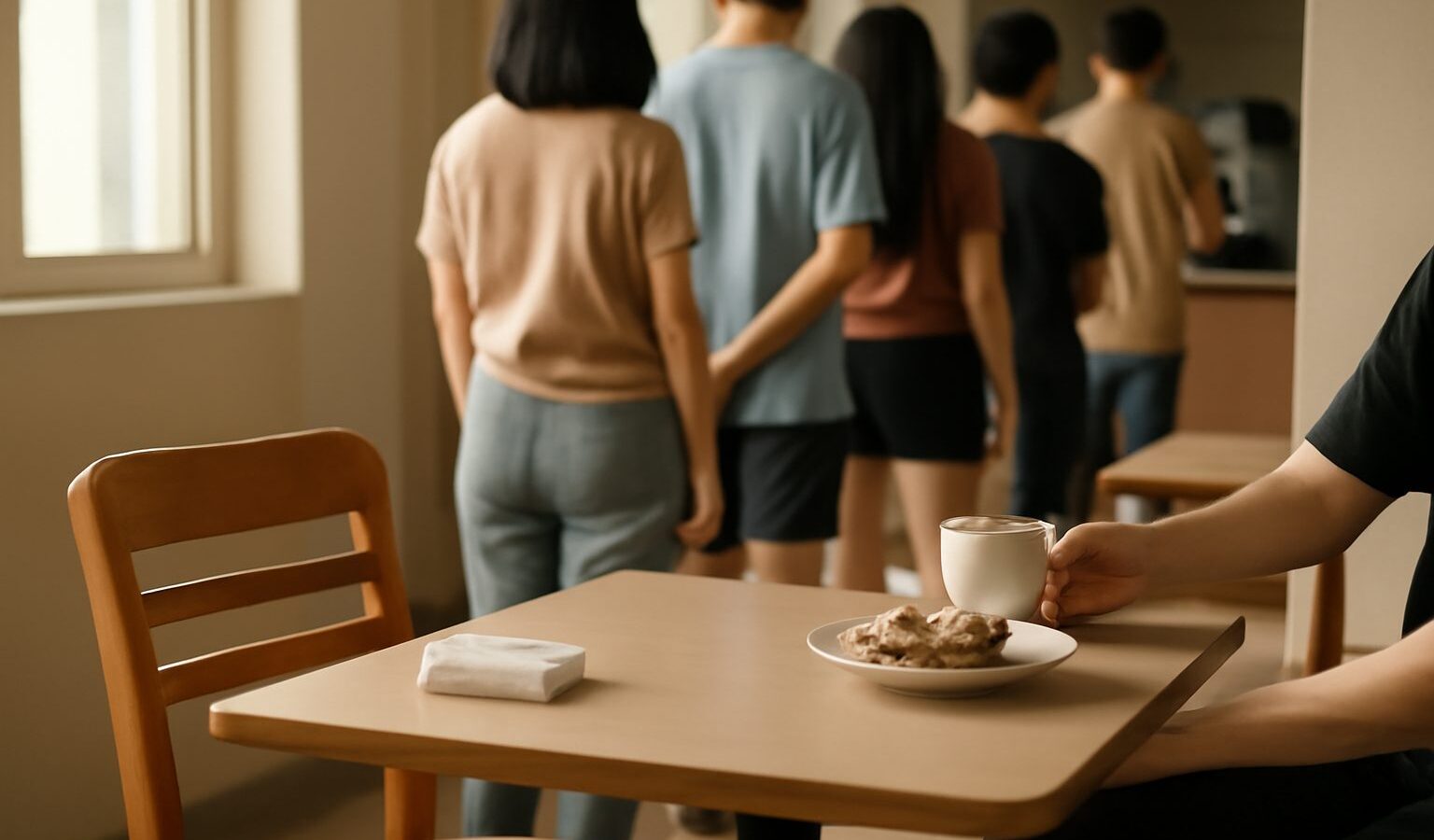
One of the first small mysteries you notice after arriving is a packet of tissues sitting alone on a hawker-centre table, or an umbrella hooked over an empty chair, with nobody in sight. You have just met chope culture Singapore style. To “chope” is local slang for reserving something, most often a seat, and understanding this quiet custom will save you from an awkward standoff over lunch and help you feel at home much faster. Alongside choping, Singapore runs on a deep respect for orderly queues, and once you learn the unspoken rules you will find daily life smoother and friendlier.
What Choping a Seat Actually Means
At a busy hawker centre or food court, seats are scarce during peak hours, so locals stake a claim before they buy food. The standard tool is a humble packet of tissues placed on the table; an umbrella, a name card, a small water bottle or a lanyard works too. Once an item is down, that seat is understood to be taken, and people will walk past it to look elsewhere.
The logic is practical. You cannot order and hold a table at the same time when the stalls have their own long lines, so choping lets one person secure seats while the group fans out to buy laksa, chicken rice and drinks. A few pointers for newcomers:
- Use a cheap, low-value item. A packet of tissues is the classic choice precisely because nobody will take it.
- Chope only what your group needs, and only when you are genuinely about to eat. Blocking a big table for one person during a lunch rush is frowned upon.
- Clear your tissues and tray when you leave, so the next person can sit.
- If you are unsure whether a seat with an item is really taken, it is fine to ask a nearby person, “Excuse me, is this seat taken?”
Not everyone loves the custom, and you will occasionally see gentle online debates about whether choping is fair. Treat it as a widely accepted convenience rather than an ironclad law, and stay gracious if there is ever a mix-up.
Why Queues Matter So Much Here
Singapore takes queueing seriously, and joining the back of a line is treated as basic courtesy rather than a suggestion. You will see neat, patient queues at bus stops, taxi stands, MRT platforms, cashier counters, clinics and government service centres. Cutting in, or “queue jumping”, is one of the fastest ways to draw cold stares or a firm word.
For a newcomer from the mainland, the contrast can feel striking. In many busy Chinese cities, crowds press forward and you learn to hold your ground; here, the expectation flips to orderly turns and personal space. Neither approach is wrong, they simply suit different environments, and adapting to the local rhythm is part of settling in. When in doubt, find the end of the line and wait. If a queue is unclear, a polite “Is this the queue for the counter?” sorts it out quickly.
Queues also appear for popular food and product launches. Singaporeans will happily line up for an hour for a famous bak chor mee stall, a new bubble-tea outlet, a bakery drop or a limited sneaker release. Joining a food queue is a normal weekend activity, and the wait is part of the fun. A few etiquette notes: do not save spots for large groups who have not arrived, keep the line moving, and have your order or payment ready when you reach the front.
Escalators, Trains and Everyday Etiquette
Public-transport manners are where courtesy becomes most visible, and getting them right instantly marks you as considerate. The MRT and bus systems are run under the Land Transport Authority, and the norms below are widely followed rather than heavily policed, though eating and drinking on trains can attract a fine.
- Let passengers off first. Stand to the sides of the train doors and wait for people to exit before you board. Rushing in blocks everyone.
- Move to the centre. Walk into the middle of the carriage so others can board; do not cluster at the doors.
- Give up priority seats. Reserved seats are for the elderly, pregnant women, those with young children and anyone who needs them. Offer your seat if you see someone who could use it.
- Keep noise down. Use earphones, and keep phone calls short and quiet.
- Mind the escalator. Many commuters stand on one side to leave a path for those walking, though official advice sometimes encourages standing on both steps for safety during crowds. Follow the flow of the people around you and do not block the whole width.
- Bag on your lap or the floor. During crowded periods, take your backpack off so it does not knock others.
None of this requires perfection. Locals are forgiving of honest newcomer slip-ups, and a quick “sorry” goes a long way.
China Versus Singapore: A Quick Etiquette Map
The table below lines up common situations with the local expectation, so you can navigate your first few weeks with confidence.
| Situation | Local etiquette in Singapore |
|---|---|
| Finding a seat at a hawker centre | Place a tissue packet to chope, then buy food; clear it when you leave |
| Someone left tissues on a table | Treat the seat as taken; look elsewhere or politely ask |
| Boarding an MRT train or bus | Queue at the sides, let passengers off first, then board |
| Standing on an escalator | Keep to the flow around you and leave room for others to pass |
| A long line for a famous food stall | Join the back, wait your turn, have your order ready |
| Priority or reserved seat | Offer it to the elderly, pregnant or those with children |
| Waiting at a counter or clinic | Form or join a single orderly queue, no cutting in |
Blending In With Grace
The thread running through all of this is consideration for the person next to you. Choping, queueing and train manners are less about strict rules and more about a shared agreement to keep a dense, busy city pleasant for everyone. As a newcomer, you do not need to master every nuance overnight. Watch what people around you do, mirror it, and be quick to apologise and adjust if you get something wrong. Locals notice and appreciate the effort, and small courtesies open doors to warmer conversations.
Give it a few weeks and choping a seat with a tissue packet or instinctively finding the end of a queue will feel completely natural. That is the moment Singapore starts to feel less like a place you are visiting and more like home.
Explore more
Ready to put chope culture into practice over a plate of local food? Read our friendly walkthrough on how to order at a hawker centre, then take the next step and learn about making local friends beyond the Chinese community so these everyday customs become shared moments rather than solo puzzles.