

Ramadan is the month when Muslims fast from dawn to sunset, and each evening the fast is broken with a meal called iftar. In Singapore, many mosques hold a community iftar mosque gathering during Ramadan, and some actively welcome neighbours of other faiths to join. If you are new to Singapore, or simply curious, this can be one of the warmest ways to understand a tradition that is part of everyday life here.
This guide explains how a mosque iftar and bubur lambuk distribution usually work, what to wear, when to arrive and how to take part as a respectful guest. Practices vary from mosque to mosque, so treat this as general guidance and check with the mosque you plan to visit.
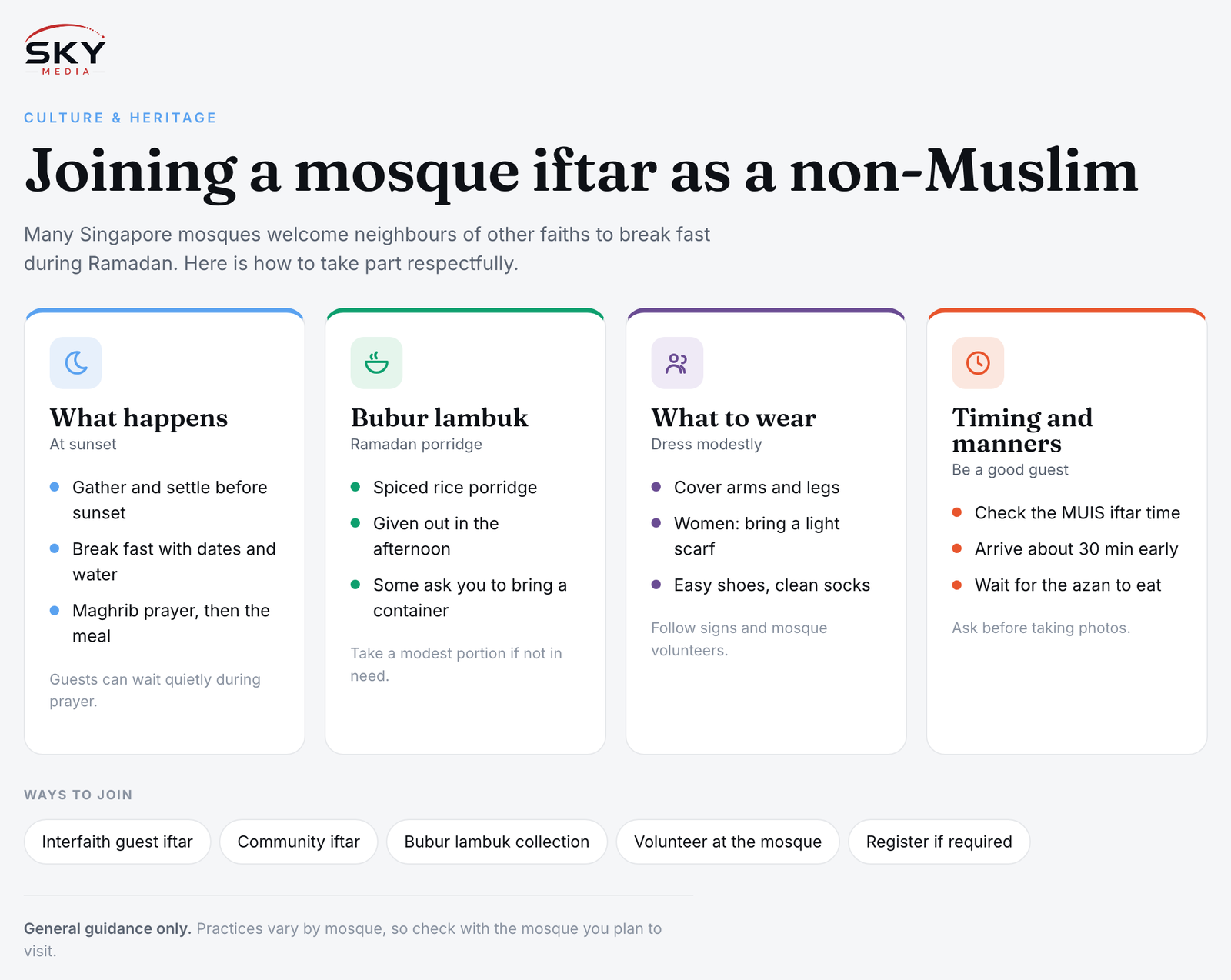
What Happens at a Mosque Iftar
Iftar takes place at sunset, at the time of the Maghrib prayer. The exact time shifts a little each day and is published in advance by the Islamic Religious Council of Singapore (MUIS), the body that administers mosques here.
A typical community iftar at a mosque often follows this pattern:
- Gathering before sunset. People arrive and settle in, often seated on mats or at long tables in a hall or covered area.
- Breaking the fast. When the call to prayer (azan) is heard, people break their fast, traditionally with dates and water.
- Maghrib prayer. Many worshippers then go to pray. Guests are not expected to join and can wait quietly.
- The main meal. After prayers, a fuller meal is usually served, often rice with dishes such as curry, along with drinks.
Some mosques also hold interfaith or community iftar events specifically designed for guests, with a short talk explaining Ramadan and time to ask questions. These are especially welcoming for first-timers.
Bubur Lambuk: The Ramadan Porridge
During Ramadan, many mosques in Singapore cook and give out bubur lambuk, a spiced rice porridge usually made with meat, herbs and spices. It is often prepared in large pots by volunteers and distributed in the afternoon so families can take it home for iftar.
Distribution is generally open to the public, including non-Muslims, though practice varies. Some mosques ask people to bring their own containers to reduce waste. Quantities may be limited, so arriving early or checking the mosque’s notices helps. If you are not in need, it is considerate to take only a modest portion, or to leave it for others.
Some people also volunteer to help cook or distribute bubur lambuk. If you are interested, contact the mosque directly to ask whether they accept volunteers and what they need.
How Different Ways of Joining Compare
There are several ways a non-Muslim can take part in iftar. Here is a comparison to help you choose.
| Way to join | What it involves | What to check first | Best for |
|---|---|---|---|
| Interfaith or guest iftar event | An organised session with a short talk and a shared meal | Registration, start time, dress guidance | First-timers who want explanations |
| Regular community iftar at a mosque | Joining the congregation as they break their fast | Whether the mosque welcomes walk-in guests | Visitors who already have a Muslim friend to accompany them |
| Bubur lambuk collection | Collecting porridge in the afternoon | Distribution times, container policy | People who want a simple, brief experience |
| Volunteering at the mosque | Helping cook, pack or serve | Whether volunteers are needed and any briefing | Those who want to contribute and meet the community |
What to Wear and How to Behave
Mosques are places of worship, so modest dress is expected. General guidance:
- Cover up. Wear loose clothing that covers your arms and legs. Long trousers or long skirts are best.
- Head covering for women. Women are often asked to cover their hair inside the prayer area. Some mosques provide scarves or robes for visitors, but bringing a light scarf of your own is a good idea.
- Shoes off. Shoes are removed before entering carpeted prayer areas. Wear shoes that are easy to slip on and off, and clean socks.
- Follow directions on space. Some areas are reserved for prayer or separated for men and women. Follow signs and the guidance of mosque staff or volunteers.
When it comes to behaviour:
- Wait for the signal. Do not start eating or drinking before the azan is called, even if food is already laid out. Your hosts will have been fasting all day.
- Eat with your right hand if eating by hand, as is common practice in many Muslim communities.
- Keep your voice low, especially during prayers.
- Ask before taking photos. Avoid photographing people at prayer, and check whether photography is allowed.
- Help tidy up. Offer to help clear your plate or space. Hosts usually appreciate the gesture.
Questions are welcome at most guest events. Asking politely about fasting, prayer or the meaning of Ramadan is a good way to show genuine interest.
Timing and Practical Tips
Arriving on time matters, because iftar runs to the minute of sunset.
- Check the iftar time for that day, published by MUIS and many mosques.
- Arrive early, around half an hour before sunset is a sensible buffer, so you can settle in before the azan.
- Register if required. Guest iftar events often need advance sign-up because food is prepared for a set number of people.
- Consider fasting for part of the day if you want to share the experience. This is optional, and nobody will expect it of you.
- Bring a small contribution if you would like to, such as dates or fruit, but ask first. Some mosques also accept donations towards iftar meals through official channels.
Why Taking Part Matters
Singapore’s harmony is built partly on small, everyday encounters between communities. Sharing a meal as the fast is broken is one of the most personal of these. Many non-Muslims who attend an iftar remember the welcome long after Ramadan ends.
If you would like to learn more about mosques before your visit, our guide to the mosques of Singapore gives useful background. For other ways to mark the month, see how to plan an iftar outing in Singapore, or, if you are inviting friends to break fast with you, hosting iftar at home without overspending.
Frequently Asked Questions
Do I need to fast to join a mosque iftar as a non-Muslim? No. Fasting for part of the day is optional if you want to share the experience, and nobody will expect it of you. Guests are also not expected to join the Maghrib prayer, and can wait quietly until the main meal.
Can I just walk in to a mosque iftar without registering? Not always. Guest iftar events often need advance sign-up because food is prepared for a set number of people, and a regular community iftar may not welcome walk-in guests. Contact the mosque first to ask about registration and dress guidance.
Can I take photos at a mosque iftar? Ask before taking any. Check whether photography is allowed, and avoid photographing people at prayer. Keep your voice low as well, especially during prayers, and follow signs and the guidance of mosque staff or volunteers.
Is it appropriate to bring a gift when invited to a mosque iftar? A small contribution such as dates or fruit is a kind gesture, but ask the mosque first. Some mosques also accept donations towards iftar meals through official channels, so you can check how they prefer to receive support.
Can I volunteer at a mosque during Ramadan as a non-Muslim? Some people help cook or distribute bubur lambuk. Contact the mosque directly to ask whether they accept volunteers and what they need. Ask too about any briefing, and check the timing so you can arrive well before sunset.
Further reading: How Korban Works at Singapore Mosques and How to Take Part · Visiting a Mosque in Singapore Respectfully