

Every year around Hari Raya Haji, mosques across the island become a hive of quiet, careful activity. Korban (also written qurban or qurbani) is the ritual sacrifice of livestock carried out by Muslims in remembrance of the Prophet Ibrahim’s willingness to sacrifice his son, and his readiness to submit to God. Korban in Singapore looks a little different from how it is done in countries with open farmland: space is limited, food safety rules are strict, and almost all livestock has to be imported. This guide explains how the system works, from registering your intention to the moment the meat reaches families who need it.
If you are new to the festival itself, start with the wider picture of Hari Raya Haji and the Mosques of Singapore guide, then come back here for the practical details.
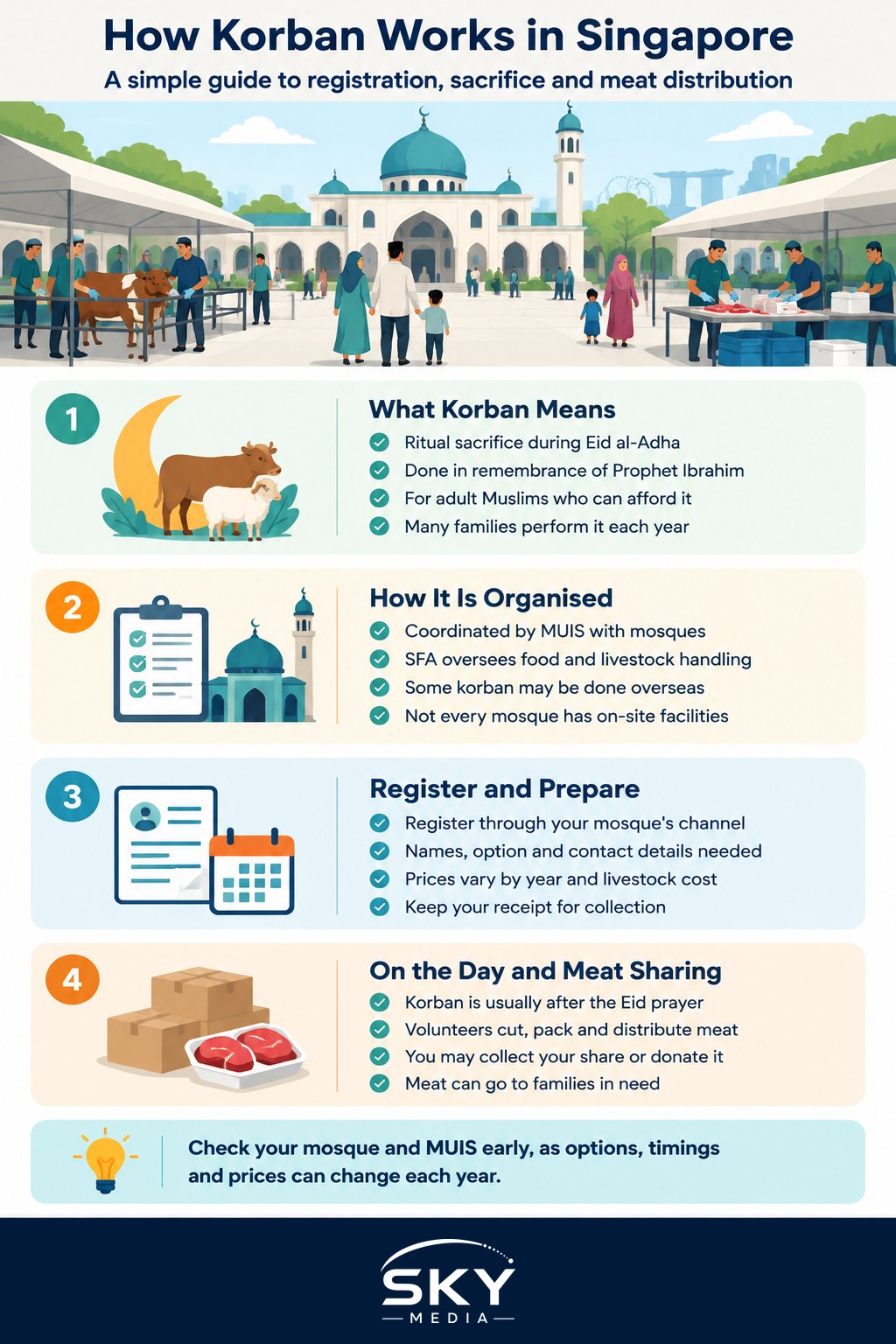
What Korban Means and Who Performs It
Korban is performed during the days of Eid al-Adha, beginning after the Eid prayer on the 10th day of Zulhijjah (the twelfth month of the Islamic calendar) and, in the commonly followed view, continuing through the three days that follow. Because the Islamic calendar is lunar, Hari Raya Haji moves about 11 days earlier each year on the Gregorian calendar.
In most schools of Islamic thought, korban is a strongly recommended act for adult Muslims who can afford it. Many families perform it every year; some make a single korban on behalf of the whole household, while others perform one for each adult member. Practices vary by family and by the scholarly opinion they follow, so many people simply ask their mosque’s religious officer if they are unsure.
A few principles that are widely observed:
- One sheep or goat generally counts as one share, offered on behalf of one person.
- Larger animals such as cattle can traditionally be shared by up to seven participants.
- The animal must be healthy and meet minimum age and condition requirements set out in Islamic jurisprudence.
- The intention (niat) matters. Participants make the intention for themselves or on behalf of someone else, including relatives who have passed away, according to the views their family follows.
How Korban in Singapore Is Organised
In Singapore, korban is coordinated at a national level by MUIS, the Islamic Religious Council of Singapore, working with participating mosques and with the Singapore Food Agency (SFA), which regulates the import, handling and slaughter of animals for food. Not every mosque holds korban on site, because the activity needs suitable space, approved facilities and trained volunteers.
Livestock for korban in Singapore has traditionally been imported, mostly sheep and goats. In some years, supply and shipping constraints have led MUIS and mosques to offer korban performed overseas, with the slaughter done abroad on the participant’s behalf and the meat either distributed there or processed and brought back for distribution locally. What is available varies year to year, so check the current arrangements announced by MUIS and your mosque.
The broad sequence usually looks like this:
- MUIS and participating mosques announce korban arrangements in the weeks before Hari Raya Haji.
- Participants register and pay through their chosen mosque or its approved channel.
- Animals are imported, inspected and held under official supervision until the korban days.
- On the day, trained slaughterers perform the sacrifice according to Islamic requirements and food safety rules.
- Volunteers clean, cut and pack the meat, which is then distributed according to each participant’s choice.
Registering for Korban: Step by Step
Registration typically opens several weeks before the festival and can close early once a mosque’s allocation is filled. Many mosques now take registrations online, while others still accept them at the mosque office. Check your mosque’s website, social media pages or notice board, and the MUIS website, for the current window and options.
When you register, you will usually be asked for:
- Names of the people the korban is for, spelled as you want them read out or recorded.
- Your choice of option, for example a full sheep or goat, a share in a larger animal, or an overseas korban, depending on what is offered that year.
- How you want the meat handled, such as collecting a portion yourself or donating all of it for distribution.
- Contact details so the mosque can update you on timings and collection.
Prices are set each year and depend on livestock costs and the option chosen, so confirm the current amount directly with the mosque. Keep your receipt or confirmation, as you may need it to collect your portion.
What Happens on Korban Day
Korban usually takes place in the morning after the Eid prayer, and sometimes continues on the following day. If your mosque holds it on site, the area is set up in advance with screened slaughter zones, cutting tables and packing stations.
Participants are often welcome to witness the sacrifice of their own animal, and some families make a point of being present. Others prefer simply to collect their meat later. If you attend, dress modestly, follow the volunteers’ directions, keep children close and away from working areas, and expect the area to be busy, hot and crowded. Our guide to visiting a mosque in Singapore respectfully covers general etiquette that applies on festival days too.
Behind the scenes, volunteers are the backbone of the day. Many mosques recruit volunteers for crowd control, cutting, weighing and packing, and they usually brief them beforehand on hygiene and safety. If you would like to help, ask your mosque early, as roles fill up.
How Korban Meat Is Distributed
A commonly followed practice is to divide korban meat into three portions: one for the participant’s household, one for relatives, friends and neighbours, and one for those in need. This is a widely held recommendation rather than a fixed rule, and many Singapore participants choose to give away most or all of their share.
The table below sets out the typical options you may be offered. Exact options vary by mosque and by year.
| Distribution choice | What usually happens | Who it suits |
|---|---|---|
| Collect your own portion | You pick up a packed share at a set time and give the rest away yourself | Families who want to cook a festive meal and share with relatives |
| Donate all to the mosque | The mosque distributes your meat to beneficiaries on its list | Busy households, or those who prefer the meat goes entirely to the needy |
| Overseas korban | Slaughter happens abroad; meat is distributed there or processed and shipped back | Participants when local supply is limited, or who want to help communities overseas |
| Shared animal portion | Your share of a larger animal is pooled and divided by the mosque | Those taking a seventh share in cattle where offered |
Mosques typically work with community partners, family service centres and their own welfare lists to identify recipient households, including low-income families and the elderly. Meat is packed and handed out over the korban days, and many mosques arrange delivery for recipients who cannot travel.
Practical Tips for First-Time Participants
- Register early. Allocations are limited and popular mosques fill quickly.
- Confirm collection times. Meat is perishable, so arrive on time with a cooler bag and ice packs.
- Plan your storage. Clear freezer space beforehand. Portion and refrigerate the meat promptly after collection.
- Ask about the animal’s origin and option. If the korban is done overseas, ask how and when you will be notified that it has been carried out.
If you are visiting one of the older heritage mosques during the festival, such as Sultan Mosque, remember that korban days are working days for staff and volunteers, so be patient and keep walkways clear.
Where to Check Current Details
Arrangements, prices, approved mosques and food safety requirements can change from year to year. For the latest information, check:
- MUIS, for the national korban announcement and the list of participating mosques.
- Your local mosque, for registration, options and collection times.
- The Singapore Food Agency, for rules on the handling of meat and livestock.
Frequently Asked Questions
Can I perform korban myself at home in Singapore? No, slaughter of livestock for food has to be done at approved facilities under Singapore’s food safety rules, so korban is arranged through mosques and other authorised channels. Check MUIS and the Singapore Food Agency for the current arrangements.
Can non-Muslims volunteer or receive korban meat? Volunteer roles and beneficiary lists are decided by each mosque, so ask yours. Korban meat is meant to benefit families in need and the community, and the practice of sharing with neighbours is widely encouraged, so there is generally room for goodwill beyond participants.
What if I cannot afford korban this year? Korban is strongly recommended for those who can afford it, and not required of those who cannot. Many people instead make a smaller contribution, such as a share in a larger animal where offered, or give charity in another form. Ask your mosque’s religious officer for guidance.
How is korban meat kept safe and halal in Singapore? Animals are inspected and the slaughter and handling follow Islamic requirements together with food safety rules overseen by the Singapore Food Agency. Trained volunteers handle cutting and packing. If you have a concern, ask the mosque or MUIS.
What if I register too late for my mosque’s korban? Registration can close once a mosque’s allocation is filled. Check whether another participating mosque still has places, or whether an overseas option is available that year. Look at the MUIS announcement, and register early next time.
Further reading: Joining a Community Iftar at a Mosque as a Non-Muslim · Preparing for Hajj or Umrah From Singapore