

Shop around for a new gaming console and you will notice two prices for what looks like the same box. One is sold with a local warranty from the official distributor. The other, often cheaper, is a parallel import, sometimes called a grey import, brought in from another market. Understanding console warranty in Singapore is the key to deciding whether that saving is worth it.
This guide explains how official and parallel-import warranties typically differ, what repair options you have under each, and the questions to ask before you pay. It focuses on consoles and handhelds specifically, where controller drift, disc drive faults and overheating are the usual reasons people go looking for a repair.
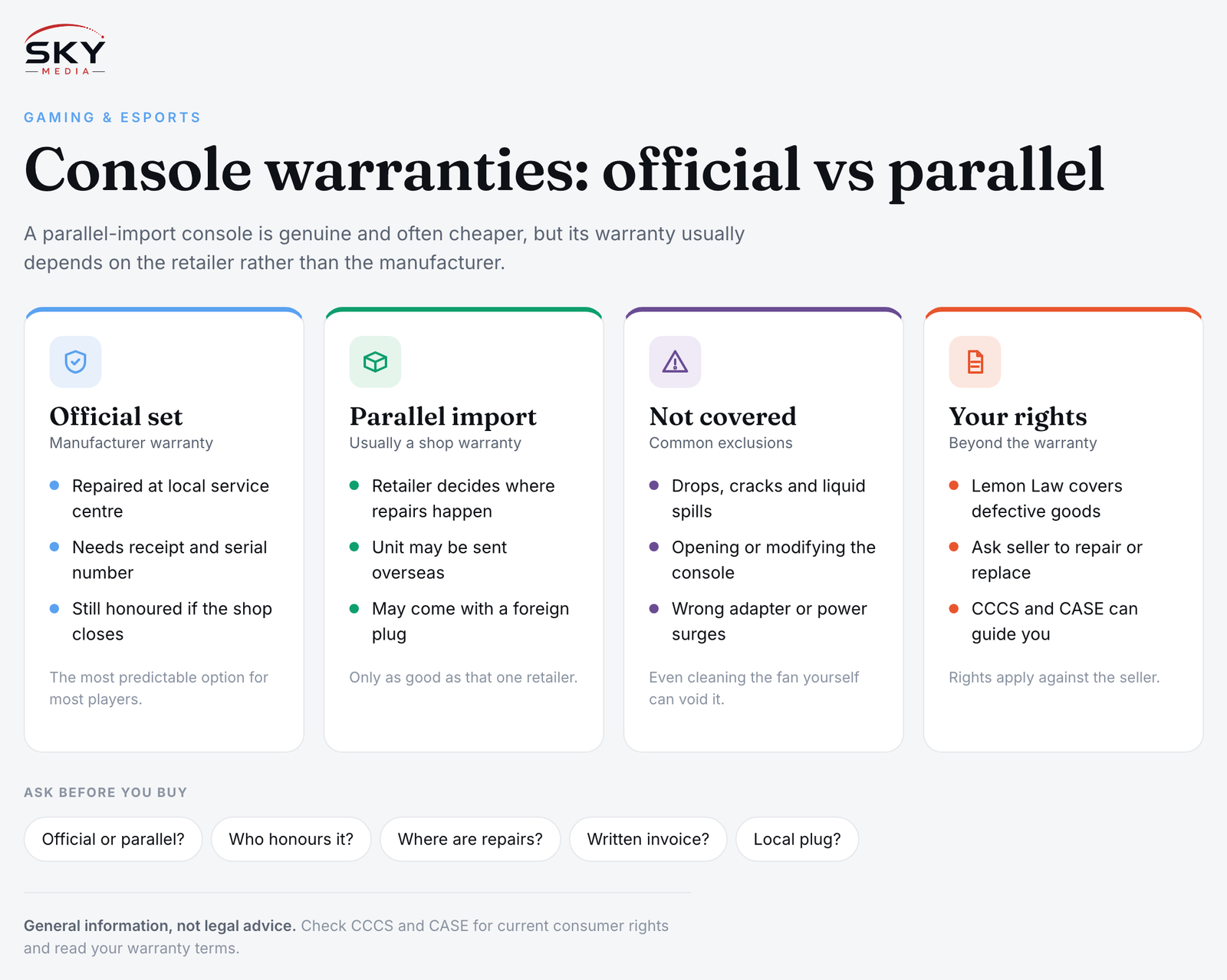
Official Versus Parallel-Import: What the Terms Mean
An official or local set is imported and distributed through the console maker’s authorised channel for Singapore. It is usually sold with a manufacturer’s warranty that is honoured by the authorised service centre here.
A parallel import is a genuine product bought from another country’s market and brought into Singapore by an independent retailer, outside the official distribution chain. It is not a fake. The hardware is normally the same or very similar, but the warranty arrangement often is not.
The differences tend to show up in four areas:
- Who honours the warranty. For an official set, it is the manufacturer’s local service network. For a parallel import, it is often the retailer itself, through a “shop warranty” or “store warranty”.
- Where repairs happen. Official repairs go through the authorised channel. Shop warranty repairs may be done in-house, by a third-party technician, or by sending the unit back overseas.
- Region-specific details. Plug type, language settings, bundled accessories, online store region and sometimes the model variant can differ.
- Proof needed. Official warranties generally rely on your receipt and the serial number. Shop warranties rely on the retailer’s own records and terms.
If you are weighing grey imports more broadly, our guide to buying parallel-import electronics during Singapore sales covers the wider picture beyond consoles.
How the Warranties Compare in Practice
The table below sums up the typical differences. Actual terms vary by brand, model and seller, so always read the specific warranty card or invoice.
| Point to compare | Official local set | Parallel-import set |
|---|---|---|
| Who provides the warranty | Manufacturer, via its authorised local service channel | Usually the retailer (shop warranty); sometimes none, sometimes an overseas manufacturer warranty |
| Where it is repaired | Authorised service centre in Singapore | Retailer’s own arrangement; may involve sending the unit overseas |
| Typical turnaround | Set by the service centre’s process | Depends heavily on the retailer; overseas repairs can take longer |
| If the retailer closes | Warranty still honoured by the manufacturer’s channel | Shop warranty may become difficult or impossible to claim |
| Bundled items | Local plug, local packaging and accessories | May come with a foreign plug, adapter or different accessories |
None of this means parallel imports are always a bad deal. A reputable retailer with clear warranty terms can provide good service. The risk is that the quality of your warranty depends on that one business rather than on the manufacturer.
What Warranties Usually Do Not Cover
Whichever route you choose, standard console warranties tend to exclude similar things. Check your own terms, but expect exclusions such as:
- Accidental damage, drops, cracked screens and liquid spills.
- Damage from unauthorised opening, modification or third-party repairs.
- Wear and tear on consumable parts, which can sometimes include controller sticks. Some manufacturers have specific policies on stick drift, so check what yours says.
- Damage from power surges or using the wrong adapter, which is worth noting if a parallel import arrived with a foreign plug.
- Software, account and online service issues, which are handled separately from hardware.
Opening your console yourself, even to clean a fan, can void the warranty. If dust and heat are a concern, ask the service centre or retailer about safe maintenance first.
Your Rights Beyond the Warranty
A warranty is a promise from the manufacturer or seller. Separately, Singapore’s consumer protection law gives buyers certain rights when goods are defective. The Consumer Protection (Fair Trading) Act includes what is commonly called the Lemon Law, which covers goods that do not conform to the contract at the time of delivery. Under it, consumers can ask the seller to repair or replace the item and, in some cases, seek a price reduction or refund.
This is general information, not legal advice. The details, including time limits and what counts as a defect, are set out by the Competition and Consumer Commission of Singapore (CCCS). The Consumers Association of Singapore (CASE) also provides guidance and can help with disputes against retailers. Check both sites for current information.
These rights apply against the seller, whether the console is official or parallel-imported. That makes it even more important to buy from a retailer you can actually reach later.
Repair Options When Things Go Wrong
When a console develops a fault, your options depend on its warranty status.
Still under official warranty:
- Note the fault clearly, with photos or a short video if possible.
- Gather your receipt and the serial number from the console or box.
- Contact the manufacturer’s local support channel to start a repair request.
- Back up saves and log out of accounts where possible before handing the unit over.
Still under shop warranty (parallel import):
- Contact the retailer first, with your invoice.
- Ask where the repair will be done, roughly how long it might take, and whether you will get a replacement or loan unit.
- Get the outcome in writing, such as a job sheet.
Out of warranty:
- Independent repair shops can fix many common faults, such as controller drift, HDMI ports and fan noise. Ask for a quote before work begins, and ask whether they offer a warranty on the repair itself.
- Some manufacturers offer paid, out-of-warranty repairs through their service channel. This may cost more than an independent shop but keeps parts official.
Questions to Ask Before You Buy
Whether you are browsing a mall shop or an online marketplace, ask these questions before you commit:
- Is this an official local set or a parallel import?
- What exactly does the warranty cover, for how long, and who honours it?
- Where are repairs carried out, and what is the usual process?
- Will I get a written invoice showing the serial number and warranty terms?
- Does it come with a local plug, or will I need an adapter?
- Are there any region locks or differences in features, online stores or language?
Keep your receipt and warranty card together. Our guide on how to digitise receipts and warranties shows simple ways to keep them safe and easy to find. If you are tempted by an add-on, our article on whether extended warranties are worth buying explains how to judge those offers.
Making the Choice That Suits You
For most players, an official set offers the most predictable experience: one clear process, local repairs and a warranty that survives even if the shop closes. A parallel import can make sense if the saving is significant, the retailer is established with written terms you understand, and you accept that repairs may be slower or handled differently. Weigh the price gap against the hassle you would face if the console failed in its first year, and choose with that scenario in mind.
Further reading: Console Store Regions Explained for Singapore Gamers