
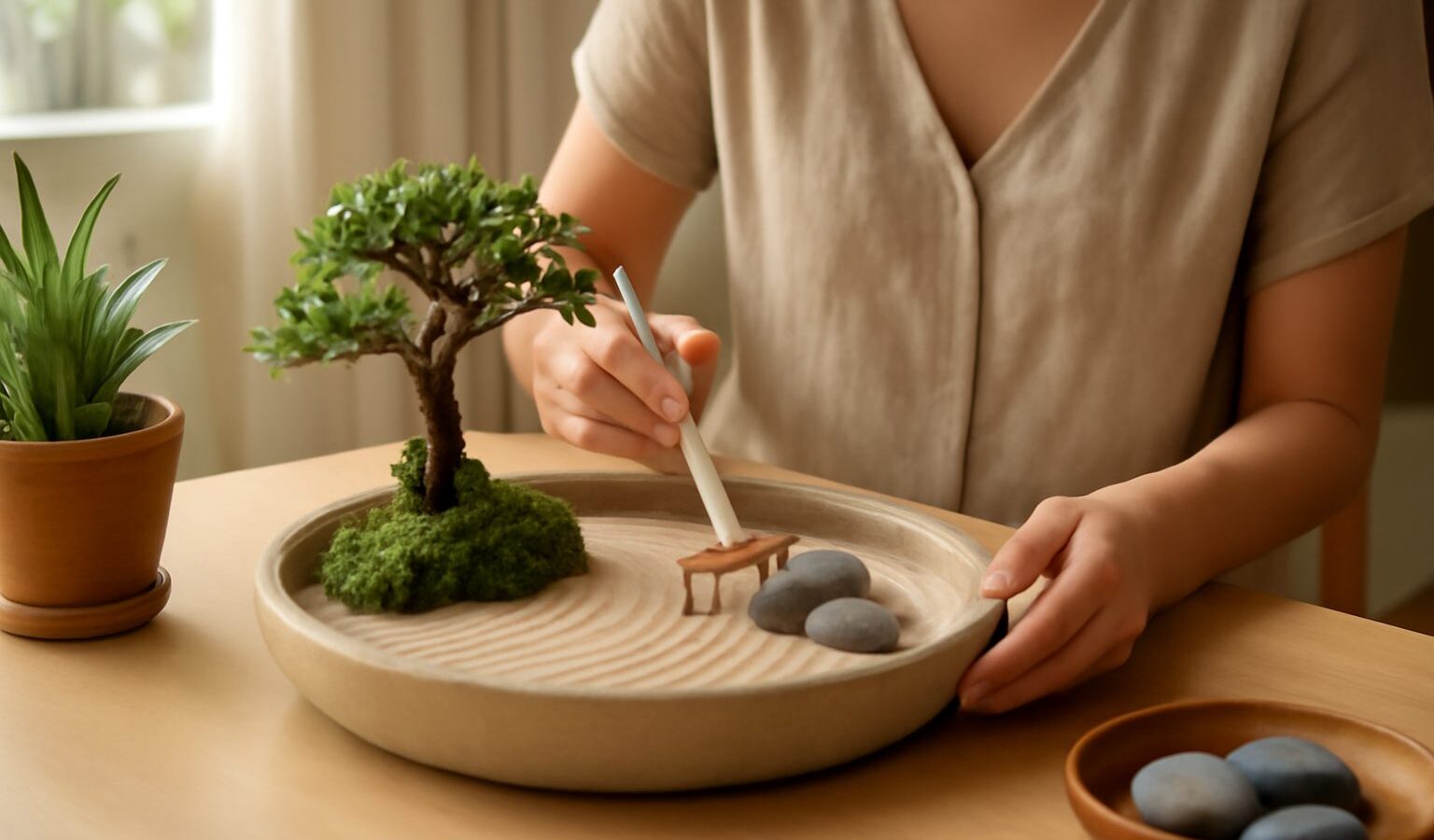
Creating a zen garden in Singapore is a lovely way to carve out a pocket of calm in a busy, high-rise life, and you do not need a sprawling backyard to do it. Inspired by Japanese dry landscape gardens, a zen garden uses raked sand or gravel, a few carefully placed stones and minimal planting to suggest water, mountains and open space. Scaled down, it fits on a desk, a coffee table or a quiet balcony corner, and the simple act of raking the sand into patterns is a genuinely soothing little ritual you can return to whenever you need to slow down.
Two ways to start: tabletop or balcony corner
The easiest entry point is a tabletop zen garden. Take a shallow wooden or ceramic tray, fill it with fine light-coloured sand, add two or three interesting stones, and finish with a small wooden rake. That is the whole setup. The pleasure comes from raking gentle lines and ripples around the stones, smoothing them away, and starting again. It sits on a work desk beautifully, which is why so many people keep one at the office. If a calming desk plant appeals too, our guide to the best plants for your work desk pairs nicely with the idea.
The larger option is a balcony or corridor corner. Here you frame a small area with edging, lay down a bed of gravel or coarse sand, set a few feature rocks, and add restrained planting around the edges. The principle stays the same: emptiness and simplicity are the point, so resist the urge to fill every gap. In our small HDB spaces, that discipline is what makes a corner feel spacious rather than cluttered.
Plants that suit a tropical zen garden
Traditional Japanese gardens lean on moss, pines and maples, which struggle in our heat. The trick for a zen garden in Singapore is to borrow the calm, minimalist look using plants that actually thrive here. Reach for restrained, sculptural, easy-care greenery rather than anything busy or flowery:
- Snake plants for strong, upright architectural lines
- Small mounding succulents for texture near stones
- A neat clump of ophiopogon or mondo grass for soft green
- Moss in a shadier, damper spot if you can keep it moist
- A single well-shaped bonsai-style plant as a focal point
Keep the palette green and quiet. One or two plants placed with intention will do far more for the mood than a crowd of pots. If you like the upright, low-fuss structure of snake plants, our guide to snake plants and ZZ plants covers keeping them thriving indoors and out.
Caring for it in our climate
The good news is a zen garden is about as low-maintenance as gardening gets, but our weather does add a couple of quirks. Sand and gravel outdoors will collect fallen leaves, dust and, during a hazy stretch, grime, so a light rake and the occasional rinse keeps it looking crisp. Heavy monsoon rain can wash patterns away and pool in a tray, so either shelter an outdoor garden or simply accept that re-raking is part of the ritual. For any planting, make sure water drains freely, because standing water in our humidity leads to rot and mosquitoes. Empty any tray that holds water after rain to avoid breeding mosquitoes.
For the planted elements, follow the same sensible watering habits you would anywhere in the tropics. Our guide to how to water plants in Singapore’s heat will stop you over- or under-doing it, especially with the drought-tolerant species that suit this style.
Choosing the right stones is worth a little thought, because they carry the whole design. Look for a few pieces with character, perhaps one taller upright rock and a couple of flatter, lower ones, and set them in odd-numbered groups, which tends to look more natural than pairs. Bury the base of each stone slightly so it looks rooted in the ground rather than dropped on top. If you are working outdoors, weathered rocks that have picked up a little algae or texture read as more established than brand-new ones. Keep the sand or gravel topped up over time, as some will inevitably scatter, blow away or wash out in the rain, and a thin, patchy bed loses the crisp, meditative look that makes the raking so satisfying in the first place.
Beyond that, the maintenance is mostly you: taking a few minutes to rake, to breathe, and to enjoy the quiet. That is really the whole point of a zen garden. In a dense, fast-moving city, a small tray of sand and a couple of well-chosen stones can become a daily reset you genuinely look forward to. Start tiny, keep it simple, and let the empty space do the work.