
Few things sour your day like returning to your parked car and finding a fresh scratch, dent, or scrape that was not there before, with no note and no one around. It feels unfair, and it is. Knowing how to handle a carpark scratch hit and run singapore situation calmly and correctly gives you the best chance of identifying who did it, or at least sorting out the repair properly. This guide walks through the practical steps to take, in order, so you do not miss anything important in the heat of the moment.
The first thing is to resist the urge to just drive off in frustration. A little methodical effort in the first few minutes, gathering evidence and noting details, can make a real difference to what happens next.
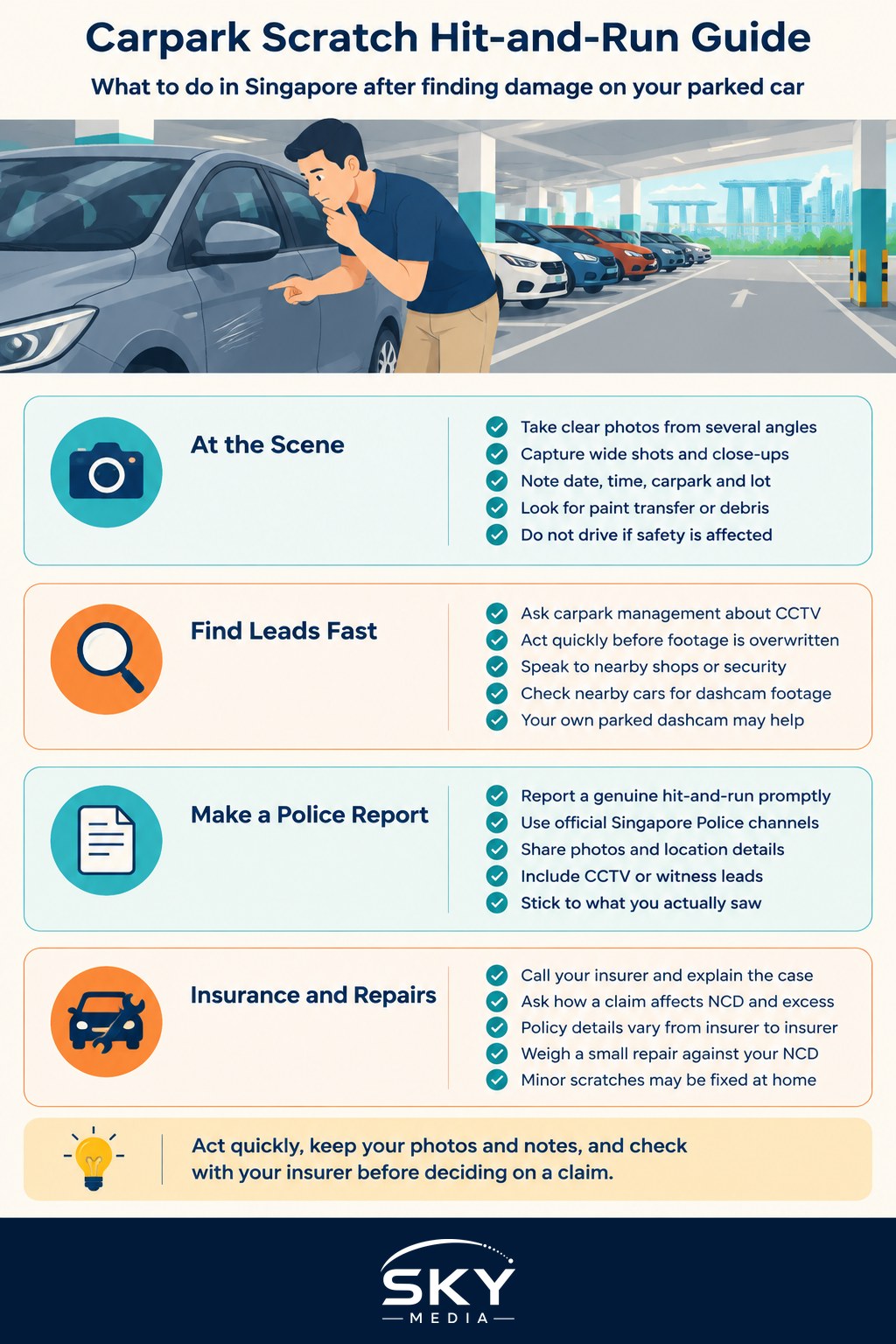
First Steps at the Scene
Before you touch or clean anything, document the damage thoroughly.
- Take clear photos from several angles, including wide shots that show where the car is parked and close-ups of the damage.
- Note the date, time, and exact location, including the carpark name, level, and lot number.
- Look for any transferred paint, debris, or marks that might hint at the other vehicle.
- Check whether the damage is superficial or something that affects how the car drives. If anything seems to affect safety, do not drive until you are sure it is safe.
Photos and details matter because memories fade and cars move. The more you capture now, the stronger your position later, whether you are approaching the carpark management, making a police report, or speaking to your insurer.
Finding Out Who Did It
A hit-and-run is not always a dead end. There are a few avenues worth pursuing.
CCTV is often your best hope. Many carparks, whether at malls, HDB estates, or private buildings, have cameras. Approach the carpark or building management as soon as possible to ask whether footage covering your lot exists and how to request it, since footage is sometimes overwritten after a period. Be polite and prompt, and bring your photos and details.
Witnesses and other dashcams can also help. Ask nearby shops, security staff, or attendants whether anyone saw anything. If cars parked near you have dashcams, they might have captured the incident, so it can be worth leaving a note or asking around. Your own dashcam, if it records while parked, may have caught the culprit too. Our guide to dash cameras explained covers how parking modes generally work, which is useful to know for next time.
Making a Police Report
For a hit-and-run, where another party caused damage and left without leaving contact details, making a police report is a sensible and often necessary step. It creates an official record of the incident, which your insurer will typically want, and it is the proper channel if you are hoping the other driver can be identified.
Report the incident to the Singapore Police Force through their official reporting channels, providing your photos, the location details, and any CCTV or witness leads you have gathered. Do not invent or exaggerate details, and stick to what you actually observed. A police report is about creating an accurate record, not guessing at what happened.
This is different from a straightforward accident where both drivers are present. If you are ever in that situation, our guide on what to do after a car accident covers the steps when the other party is there to exchange details.
Insurance, NCD, and Repairs
How you handle the repair depends on your policy and the situation, and this is where it pays to slow down and think. Making a claim for damage caused by an unknown party can have implications for your No Claim Discount, and the details vary from policy to policy. Rather than assume, contact your insurer, explain that it was a hit-and-run with a police report, and ask directly how a claim would affect your premium and NCD, and what your excess would be.
It genuinely can make sense to weigh the cost of a small repair against the effect on your NCD, but the right answer depends on your specific policy and the amounts involved, so let your insurer lay out the options rather than deciding blind. To understand the general principle beforehand, our guide to no claim discount explained is a helpful primer. Just remember that only your insurer can tell you how your own policy will be affected.
If the damage is a minor cosmetic scratch and you decide not to claim, some light marks can be improved at home, and our guide to fixing small car scratches and chips shows what is realistic to tackle yourself and what is better left to a professional.
Staying Calm and Prepared
A carpark hit-and-run is frustrating, but a clear head and a methodical approach give you the best outcome. Document everything, chase down CCTV and witnesses quickly, make a police report for a genuine hit-and-run, and let your insurer guide you on the claim and NCD question. Park a little more defensively where you can, keep your dashcam and its parking mode in mind, and you will be better placed if it ever happens again.
Official sources: Singapore Police Force
Further reading: Wheel Clamping in Private Carparks in Singapore: Is It Legal and What to Do