
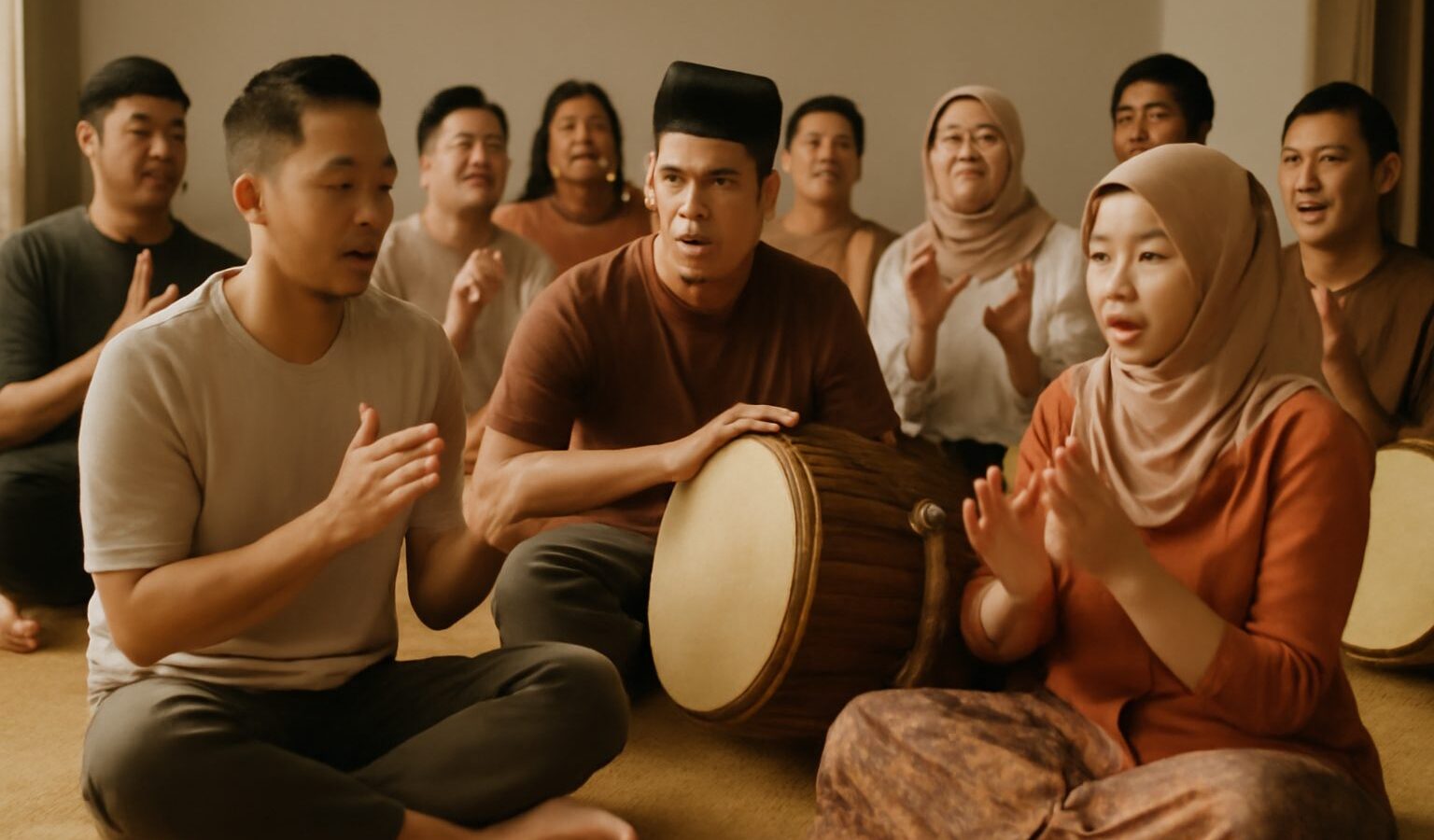
If you have ever passed a community club on a weekend evening and heard rows of people singing, clapping in perfect time and roaring with laughter, you may have stumbled onto a rehearsal of dikir barat. This lively group performance is one of the best loved Malay art forms in Singapore, blending song, rhythm, comedy and quick wit into something that is joyful to watch even if you do not understand every word. This guide explains what dikir barat is, how it is performed, and where a curious newcomer can catch it or even learn it today.
Dikir barat is enjoyed across the Malay community here, though the way each group performs varies with its members, their teachers and their tastes. Treat what follows as a friendly introduction rather than a fixed rulebook.
What Dikir Barat Is and Where It Comes From
Dikir barat is a form of Malay choral singing performed by a seated group who sing, chant and move their hands and upper bodies in unison. The word “dikir” is linked to the Arabic term for devotional chanting or remembrance, a reminder that the form has roots in communal call and response singing. Over time it grew from those older chanting traditions into the spirited secular entertainment enjoyed today.
The form is strongly associated with the Malay communities of the north-eastern Malay Peninsula and neighbouring areas, where it developed its familiar shape. From there it spread across the wider Malay world, including Singapore, carried by families, teachers and community groups. Today it is firmly part of Singapore’s Malay cultural life and appears at community celebrations, school events and national occasions.
What makes dikir barat distinctive is that it is as much about togetherness as about music. A group can number a dozen or more singers sitting cross-legged in rows, and the pleasure of it comes from many voices and many hands moving as one.
How a Dikir Barat Performance Works
A performance is built around a few key roles and a strong, steady beat. Once you know who does what, the whole thing becomes easy to follow.
- The tok juara, or lead singer, opens with the main melody and sets the tune that the group answers.
- The tukang karut is the improviser, a sharp witted singer who spins clever, often comic verses on the spot for the chorus to echo.
- The jemaah, or chorus, is the seated group who repeat lines, sing the responses and perform the synchronised hand and body movements.
- The musicians keep time on percussion, most recognisably the rebana, a Malay frame drum, often joined by a gong and other hand percussion.
The verses are frequently built on the pantun, a traditional Malay poetic form of rhyming quatrains prized for its imagery and hidden meanings. A skilled tukang karut weaves social commentary, gentle teasing and topical humour into these verses, which is why audiences listen so closely for the next clever turn.
Dikir barat is often staged as a friendly contest between two groups who take turns performing and answering one another. The competitive back and forth, matched with the rising energy of the clapping and drumming, is a big part of the thrill for both performers and spectators.
Where to Watch or Learn Dikir Barat in Singapore
For newcomers, the good news is that dikir barat is very much a living, accessible art rather than a museum piece. You can encounter it in several everyday settings:
- Community clubs and centres, where interest groups rehearse and perform, and where beginners are often welcomed to join.
- Schools and student groups, since many schools run dikir barat as a co-curricular activity, giving young Singaporeans an early love of the form.
- Cultural festivals and national events, where groups perform on outdoor stages, often as part of broader celebrations of Malay heritage and Singapore’s multiracial arts.
- Heritage institutions and arts venues, which stage Malay performing arts and can be a good place to see polished shows.
If you would like to learn, the friendliest route is usually a community group. Many are happy to take in enthusiastic beginners regardless of background, and you do not need to be a trained singer, since the chorus carries you along. A visit to the Malay Heritage Centre can also help you place dikir barat within the wider story of Malay arts and culture in Singapore.
How Dikir Barat Compares to Other Malay Performing Arts
Dikir barat is one thread in a rich tapestry of Malay performance. Seeing it beside its cousins helps a newcomer understand what is unique about it.
| Art form | Main medium | Typical setting | What stands out |
|---|---|---|---|
| Dikir barat | Group singing and rhythm | Community stages, contests | Witty improvised verse and unison clapping |
| Bangsawan | Sung theatre and drama | Stage productions | Costumed stories and acted scenes |
| Wayang kulit | Shadow puppetry | Screen and lamp performances | Puppets, narration and a single puppeteer |
| Kompang groups | Hand drumming | Weddings and processions | Layered drum patterns and welcome rhythms |
The table simplifies a diverse scene, so read it as a friendly map. If these neighbours intrigue you, explore our guides to bangsawan Malay opera, wayang kulit shadow puppetry and gamelan and kompang music, all of which share the same warm, communal spirit.
Why Dikir Barat Still Matters Here
Dikir barat endures in Singapore because it does so much at once. It keeps the Malay language and the art of the pantun alive in a form young people genuinely enjoy. It teaches teamwork, timing and confidence, since every singer must listen and move as part of a whole. And it offers a stage for gentle, clever commentary on everyday life, a role that community art has always played.
For a newcomer, dikir barat is also one of the easiest ways into Singapore’s multiracial cultural life. You do not need to speak Malay fluently to feel the rhythm, laugh at a well timed verse or admire the discipline of a chorus moving in unison. Watching a contest between two groups, with the drums building and the crowd cheering, you get a vivid sense of how a community celebrates itself.
Efforts to keep the form thriving come from many directions, including schools, community groups and national bodies such as the National Heritage Board that support Malay performing arts. The healthiest sign, though, is simpler than any programme. On weekend evenings across the island, in ordinary community halls, people of all ages still gather to clap, sing and trade verses for the sheer joy of it. That living energy, passed from one generation to the next, is what has carried dikir barat this far, and it is what will carry it forward.
Explore More
Dikir barat is one doorway into Singapore’s Malay and wider Asian performing arts. To go further, read our guides to bangsawan Malay opera and gamelan and kompang music, and visit the Malay Heritage Centre to see how these traditions fit together.