
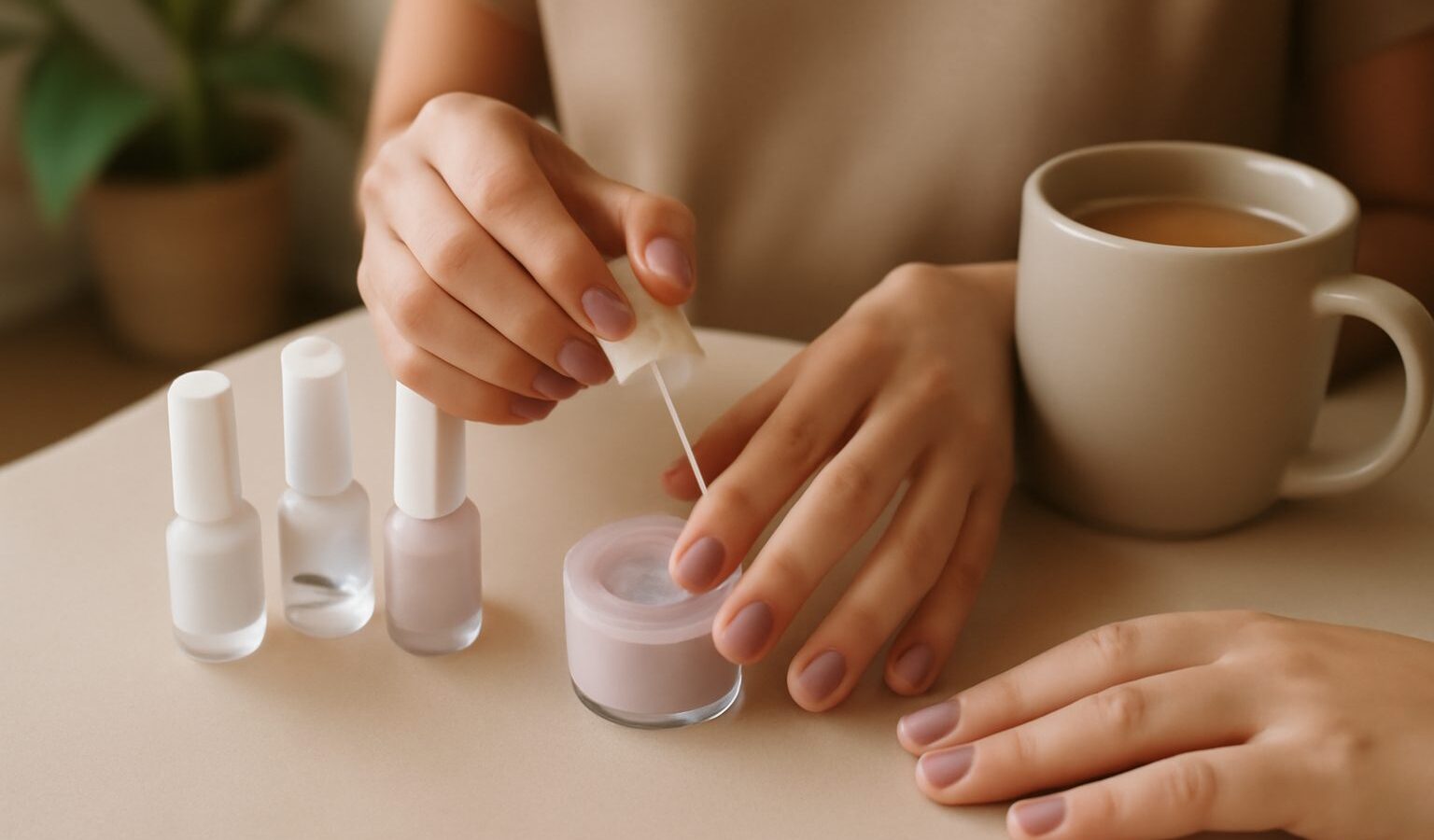
If you have seen long-lasting manicures that do not sit under a UV lamp, you may have come across the dip method. Dip powder nails singapore salons offer are a popular middle ground between regular polish and full enhancements, promising durability with a fairly quick application. This guide explains what dip powder actually is, how it goes on, how it compares to gel and acrylic, and the hygiene points worth knowing before you book or try a kit at home.
How Dip Powder Works
Dip powder is a coloured, finely milled acrylic powder that bonds to your nail using a resin-based liquid rather than a lamp. Instead of curing under UV or LED light like gel, it hardens through a glue-and-powder reaction.
A typical application follows these steps.
- The natural nail is cleaned, gently buffed, and prepped.
- A bonding base coat is brushed on.
- The nail is dipped into the coloured powder, or the powder is poured over it, then the excess is brushed off.
- The base and dip steps are usually repeated for two or three layers to build colour and strength.
- An activator is applied to harden the layers, then the nail is filed, shaped, and finished with a sealing top coat.
The result is a hard, smooth coating that many people find lasts longer than standard polish. Because there is no lamp involved, some find the process quick and fuss-free, and the colour range is wide.
How Long It Lasts and How It Compares
Dip powder tends to be durable, and many wearers get a couple of weeks or more before regrowth becomes obvious. It sits somewhere between gel and acrylic in feel: thinner and lighter than a full acrylic set, but generally sturdier than a plain gel polish on natural nails.
Here is a simple way to think about the options.
- Gel polish: Cured under a lamp, flexible, natural-looking, and easy to soak off. Best for people who want colour and shine on their own nails. Our gel versus acrylic comparison breaks this down further.
- Acrylic: Sculpted from liquid and powder, strong, and good for adding length and shape. Firmer and thicker than dip.
- Builder gel and BIAB: A brush-on overlay that adds strength while staying flexible, removed by soaking. See our guide to builder gel and BIAB if you want a strengthening overlay.
- Dip powder: No lamp, hard finish, quick to apply, and long wearing, but removed by soaking in acetone.
None of these is objectively best. The right choice depends on your nails, your budget, how much length you want, and how you feel about lamp exposure or removal time.
Hygiene, Removal, and Nail Health
Hygiene is the point most worth flagging with dip powder. In a salon, your fingers should never be dipped directly into a shared communal jar, because that can pass bacteria and fungus between clients. A good technician will instead pour the powder over your nail, or use a fresh individual portion, and discard the excess. It is completely reasonable to ask how they handle this before you start, and a professional will be happy to explain.
Removal matters too. Dip powder is taken off by soaking in acetone, usually with foil wraps or soak-off clips, and it should not be peeled or scraped off. Picking at the coating pulls away the top layers of your natural nail and leaves it thin and rough. If your nails already feel weak, our guide to strengthening weak and peeling nails has gentle ways to rebuild them.
Between sets, give your nails some care. The buffing, activator, and acetone involved can be drying, so daily cuticle oil and hand cream help keep the surrounding skin healthy, which matters in Singapore where frequent hand washing and aircon add to the dryness. Our overview of cuticle care and healthy nails is a handy routine to pair with any enhancement.
Is Dip Powder Right For You?
Dip powder suits people who want a hard-wearing, low-shine-to-glossy colour that lasts, without sitting under a lamp, and who like a relatively quick appointment. It is less ideal if you frequently change colours every week, since removal takes longer than swapping regular polish, or if your natural nails are very fragile and need a rest from enhancements.
As with any method, the finish is only as kind to your nails as the application and removal. Choose a hygienic salon or a careful at-home routine, soak off rather than peel, and give your nails an occasional break to recover. Try it for a set or two, notice how your nails feel afterwards, and let that guide whether dip powder earns a regular spot in your routine.