

In a country where air conditioning runs almost all day, cooling is one of the biggest slices of electricity use in buildings. Most of us picture it as a box on the wall or a condenser on the ledge. District cooling in Singapore works differently: instead of every building running its own chillers, one central plant makes chilled water and pipes it to many buildings through an underground network. This guide explains how that works, where it is used at Marina Bay, Punggol and Tengah, and why it can save energy.
What District Cooling Actually Is
Air conditioning in large buildings usually relies on chillers. A chiller cools water, the cold water is pumped through the building to air handling units, fans blow air across coils filled with that water, and the warmed water returns to the chiller to be cooled again. Heat removed from the building is rejected outside, often through cooling towers on the roof.
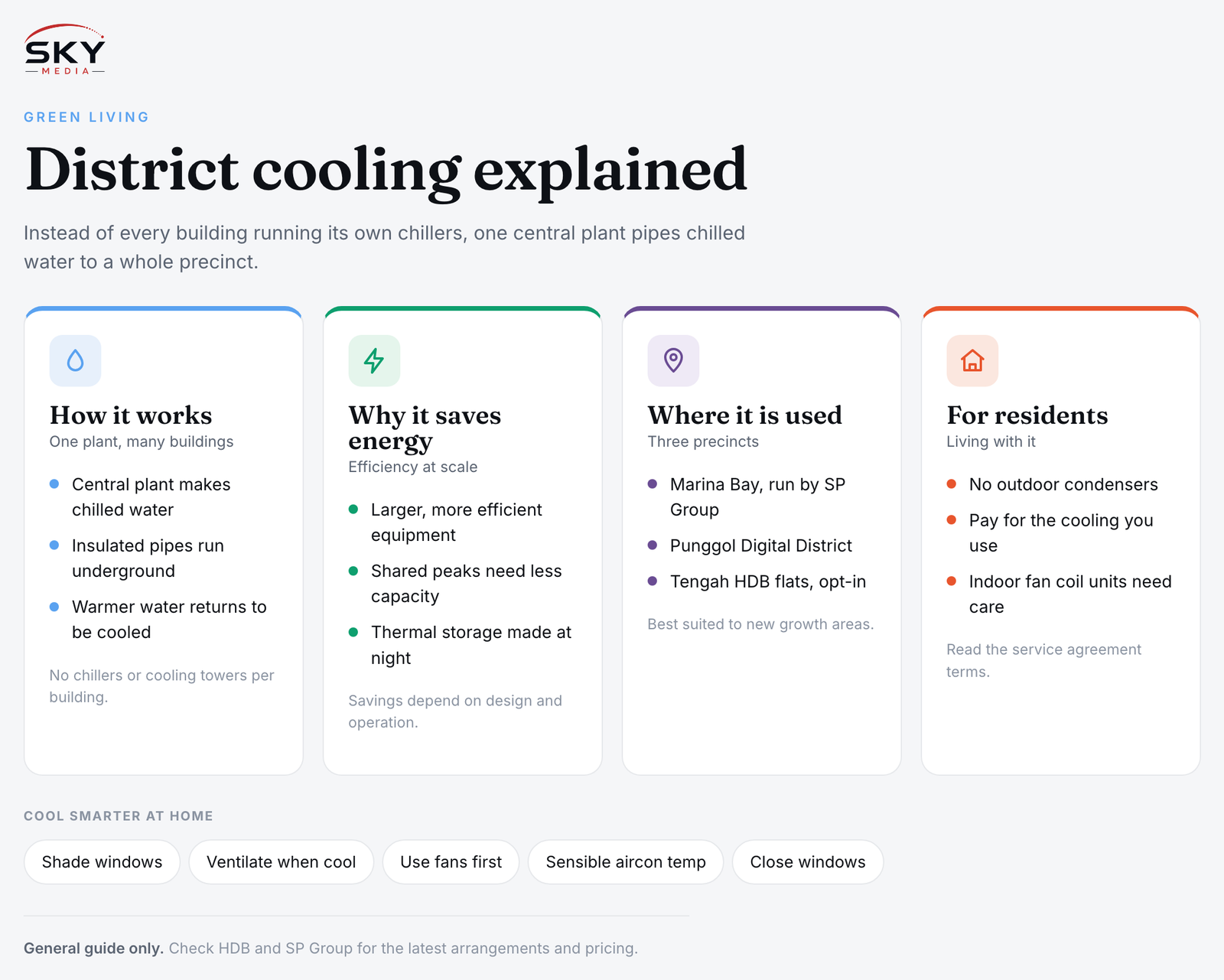
District cooling moves the chiller out of the individual building. A central plant serving a whole precinct produces chilled water at scale and sends it through insulated supply pipes. Each connected building takes what it needs through a heat exchanger in an energy transfer station, then sends the warmer water back through return pipes. The customer building no longer needs its own chiller plant or cooling towers.
Think of it like the difference between every household running its own generator and everyone drawing power from a shared grid. One well-run, efficient plant can do the job better than dozens of smaller ones, each sized for its own worst day.
Why a Shared Plant Can Save Energy
The savings come from several sources, and they add up:
- Larger, more efficient equipment. Big industrial chillers, pumps and cooling towers tend to be more efficient per unit of cooling than small ones, and a central plant can afford the best equipment and specialist operators.
- Diversity of demand. Offices peak in the working day, malls in the evening and homes at night. When all of these share one plant, the combined peak is lower than the sum of individual peaks, so less total capacity needs to be built.
- Running chillers at their sweet spot. A building plant often runs part-loaded and inefficiently in the early morning or late evening. A central plant can switch chillers on and off to keep each one near its most efficient load.
- Thermal storage. Some plants make chilled water or ice at night, when overall electricity demand is lower, and store it to use during the day. This smooths the load on the power grid.
- Professional maintenance and monitoring. Fouled coils and poorly tuned controls quietly waste energy in many buildings. A dedicated operator monitors the whole system continuously.
The exact savings depend on the design and how well each system is run. Operators and agencies publish their own estimates, so look to SP Group, HDB and the relevant developer for current figures rather than relying on a single number.
Where You Will Find District Cooling in Singapore
Marina Bay
Marina Bay hosts Singapore’s best-known district cooling network, operated by SP Group. Chilled water is produced in plants within the area and distributed through pipes running under the streets to commercial buildings, hotels and attractions around the bay. It is often cited as one of the largest underground district cooling networks in the world. Because the network was planned alongside the new downtown, buildings were designed to connect from the start, freeing up rooftop and basement space that would otherwise hold chillers and cooling towers.
Punggol
Punggol Digital District, the business and university precinct next to Punggol’s waterfront, was planned with centralised cooling as part of its smart and sustainable design. Bringing cooling into a precinct-wide system fits the district’s aim of managing energy, waste and other utilities at a district level rather than building by building.
Tengah
Tengah, HDB’s “forest town” in the west, was the first HDB town to offer a centralised cooling system for flats. Instead of each household installing its own condensers, residents who opt in draw cooling from chiller plants placed on the rooftops of multi-storey car parks, with the service run by SP Group. Residents pay for the cooling they use, similar to a utility bill. Uptake is optional, and arrangements, pricing and availability for new blocks can change, so check the latest details with HDB and SP Group if you are buying or living in Tengah.
District Cooling Compared With Other Ways of Cooling
The table below compares the options most Singaporeans will encounter.
| Setup | Where it is used | How cooling is produced | Key trade-offs |
|---|---|---|---|
| Split or multi-split aircon | Most HDB flats and condos | Each home has its own compressor and outdoor condenser | Simple and flexible, but many small units with variable efficiency and heat rejected along the facade |
| Building chiller plant | Most offices, malls and hospitals | One plant per building with its own chillers and cooling towers | Under the owner’s control, but uses roof and basement space and often runs part-loaded |
| District cooling | Marina Bay, Punggol Digital District and similar precincts | A central plant pipes chilled water to many buildings | Efficient at scale and frees up space, but needs long-term planning and a large upfront network investment |
| Centralised cooling for homes | Tengah HDB estates (opt-in) | Shared chillers on car park rooftops serve flats | No outdoor units to maintain, but households depend on a service provider and its pricing |
What It Means for Building Users and Residents
For office workers and shoppers, district cooling is invisible. The air feels the same; the difference is what happens behind the scenes.
For residents in a centralised cooling estate, a few practical points matter:
- No outdoor condensers. You do not need to service a compressor on your ledge, and the building facade stays cleaner and cooler.
- Usage-based billing. You pay for cooling consumed, so habits still matter. Setting a sensible temperature and closing windows when the aircon is on keeps bills down.
- Indoor fan coil units still need care. The indoor unit has filters and coils that need cleaning, similar to any aircon. Check what the service provider covers and what is your responsibility.
- Contracts and terms. Read the service agreement for how charges are calculated, how faults are handled and what happens if you choose not to sign up or later change your mind.
The Bigger Picture for a Greener Singapore
Singapore has very limited renewable energy options, so using less electricity in the first place is one of the most effective climate tools available. The Singapore Green Plan 2030 and the Green Mark scheme by the Building and Construction Authority (BCA) both push buildings toward higher efficiency, and district cooling is one of the tools planners use, especially in new precincts where pipes can be laid before buildings rise.
It is not a fit everywhere. Retrofitting an existing, built-up neighbourhood with underground pipes is costly and disruptive, and the system only works well when enough buildings connect. That is why you mostly see district cooling in new growth areas such as Marina Bay, Punggol and Tengah, and it is likely to be considered for other planned districts. The Jurong Lake District is one example of a new precinct where sustainable infrastructure features prominently in planning.
Cooling Smarter at Home While You Wait
Most of us will not live in a district-cooled estate any time soon, but the same principles apply at home: reduce the heat coming in, then cool efficiently. Shade windows, ventilate in the cooler hours and use fans before reaching for the remote. Our guide to passive cooling for your home covers layout and shading tips, and smart fans and cooling gadgets looks at affordable devices that let you set the aircon a little warmer without losing comfort.
District cooling shows what is possible when a whole precinct shares one efficient system. Understanding how it works helps you make sense of the green features in new estates and think more clearly about cooling choices in your own home.
Frequently Asked Questions
Will district cooling lower my electricity bill? Not automatically. A central plant is more efficient overall, but residents are billed for the cooling they use, much like a utility, so your habits and the provider’s pricing still matter. Compare the charges in the service agreement with what you spend on your own aircon, and ask HDB or SP Group for current details.
Can an existing HDB estate switch to district cooling? It is possible in theory but rarely practical. Laying underground pipes through a built-up neighbourhood is costly and disruptive, and the system only works well when enough buildings connect. That is why district cooling appears mainly in new precincts planned from scratch.
What happens if the central cooling plant breaks down? Large plants normally run several chillers so that one unit can be serviced or fail without shutting everything down. How faults are handled and how quickly they are fixed should be set out in your service agreement. Ask the provider about repair response before signing up.
Is district cooling better for the environment than ordinary air conditioning? It can be, mainly because it uses less electricity for the same cooling, and electricity use is the main climate cost of aircon. Savings depend on design and operation, and the network itself takes resources to build. It is one tool alongside efficient buildings and sensible home habits.
If I buy a flat in Tengah, can I still install my own aircon? Centralised cooling in Tengah is opt-in, so households are not forced to use it. Whether and how you can fit your own units may depend on the block and its arrangements, which can change. Confirm the current rules with HDB and SP Group before buying or renovating.