

Almost every home has one: the violin from primary school CCA, the keyboard bought during a lockdown hobby phase, the guitar that has not been tuned in years. If you want to donate musical instruments Singapore schools, charities and bands can actually use, the good news is that a playable instrument can make a real difference to a student, a community band or a beneficiary of a charity programme. The catch is that not every organisation can take every instrument, and a bit of preparation makes your donation far more likely to be accepted and used.
This guide covers who typically accepts instruments, how to match your instrument to the right place, and how to prepare it before you hand it over.
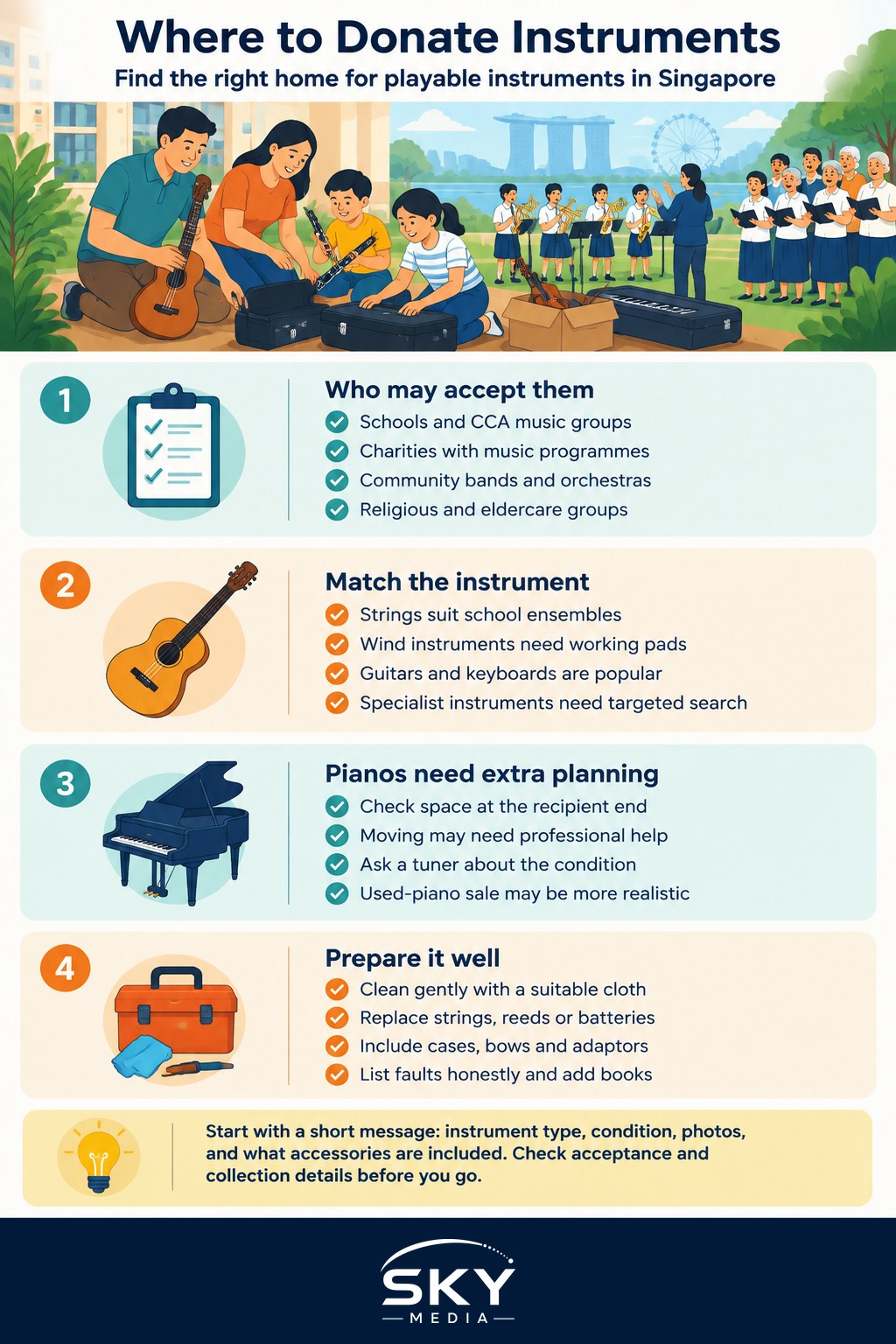
Who Usually Accepts Donated Instruments
There is no single national collection point for instruments, so you will need to approach organisations directly. These are the main types of recipients to consider.
- Schools and their CCA groups. Primary and secondary school bands, string ensembles and Chinese orchestras sometimes welcome instruments, especially common ones like flutes, clarinets, violins and percussion. Contact the school’s general office and ask to reach the music teacher or CCA teacher in charge.
- Charities and social service agencies. Some charities run music programmes for children from lower-income families, youth at risk, persons with disabilities or seniors. They may want specific instruments for an existing class.
- Community bands and orchestras. Volunteer-run wind bands, guitar ensembles, choirs and Chinese orchestras connected to community clubs or associations often run on tight budgets.
- Religious organisations. Churches, temples and other places of worship with music ministries or youth groups sometimes accept keyboards, guitars and percussion.
- Eldercare and active ageing centres. Simple instruments such as ukuleles, hand percussion and small keyboards can suit group activities for seniors.
- Reuse platforms and community groups. Free-giving groups on social media and general donation drives can find a home for instruments that formal groups decline.
Policies change often and depend on space, current students and teachers’ plans. Always call or email first rather than turning up with an instrument.
Matching the Instrument to the Right Recipient
Some instruments are much easier to donate than others. Use this as a rough guide.
| Instrument | Most likely recipients | What to check first |
|---|---|---|
| Violin, viola, cello | School string ensembles, charity music classes | Size (full or fractional), bow condition, no cracks in the body |
| Flute, clarinet, saxophone, trumpet | School concert bands, community wind bands | Pads, keys and valves working; mouthpiece cleaned or replaced |
| Acoustic or electric guitar | Youth programmes, religious groups, community classes | Neck straight, no cracks, strings that can be replaced |
| Digital keyboard or digital piano | Charities, eldercare centres, religious groups | All keys work, power adaptor included |
| Upright or grand piano | Schools, churches, community halls (rarely) | Space at the recipient, moving cost, tuning stability |
| Erhu, guzheng, pipa, dizi | School and community Chinese orchestras | Skin, strings and bridges intact; case included |
Common band and string instruments tend to find homes fastest, because they slot straight into existing lessons. Unusual or very specialised instruments may need a more targeted search, such as a specialist ensemble or a teacher who uses that instrument.
Pianos Need Extra Planning
Acoustic pianos are the instrument people most want to give away and the hardest to donate. Many schools and charities simply do not have the floor space, and moving a piano needs professional movers. Before offering one:
- Expect that you may have to pay for moving, even when the recipient is happy to take it.
- Get a rough idea of its condition from a piano tuner if you are unsure. An instrument that cannot hold its tuning is a burden, not a gift.
- Take clear photos, note the brand and approximate age, and measure it.
- Ask about lift access and stairs at the recipient’s end before agreeing a date.
If no organisation can take it, a used-piano dealer or a private buyer may be more realistic, and you could donate the proceeds instead.
How to Prepare an Instrument for Donation
A little effort turns a dusty instrument into one a teacher can hand straight to a student.
- Clean it gently. Wipe down the body, keys or strings with a suitable cloth. Avoid harsh chemicals on wood and lacquer.
- Replace consumables if you can. New strings for a guitar or violin, or fresh reeds for a clarinet, make a big difference. If you cannot, mention it so the recipient knows.
- Clean or replace mouthpieces. For hygiene, wind instrument mouthpieces should be thoroughly cleaned, and many recipients prefer to fit a new one.
- Gather accessories. Cases, bows, straps, power adaptors, music stands, tuners and spare parts all add value.
- List any faults honestly. A sticky key or a missing string is fine if the recipient knows in advance.
- Include beginner books. Clean, unmarked method books and sheet music are often welcomed alongside the instrument.
Questions to Ask Before You Hand It Over
When you contact an organisation, a short, clear message helps. Include the instrument type, brand, size, condition and photos, then ask:
- Do you currently need this instrument, and will it be used soon?
- Do you collect, or should I drop it off? Where and when?
- Do you accept instruments that need minor repairs?
- Can you issue a receipt or acknowledgement for the donation?
On that last point, tax deductions in Singapore generally apply to qualifying donations to Institutions of a Public Character (IPCs), and in-kind gifts are treated differently from cash. Do not assume an instrument donation is tax deductible. Check the current rules with IRAS and the organisation itself.
When Donation Is Not the Best Option
Sometimes the kindest thing is not to donate.
- Badly damaged instruments. A cracked violin body or a keyboard with dead keys may cost more to repair than to replace. Ask a repair shop for an opinion, or offer it to a repairer who may use the parts.
- Instruments still worth a good sum. Selling and then donating money to a music charity can sometimes help more. Our guide on buying used musical instruments in Singapore explains what buyers look for, which also helps you judge value.
- Someone in the family may play again. If a younger child or relative might take it up, keep it in good storage instead.
For electronic instruments that truly cannot be used, follow e-waste recycling rules rather than putting them in the general rubbish chute. For a wider view of donation options beyond instruments, see our guide on where to donate used items in Singapore.
Making the Handover Count
When the day comes, hand over the instrument with its case, accessories and a short note on its history and any quirks. Teachers appreciate knowing that the left tuning peg slips or that the keyboard needs a particular adaptor.
Above all, be patient. It can take a few calls to find the right recipient, but an instrument that ends up in a student’s hands, rather than in a storeroom, is well worth the effort.
Frequently Asked Questions
How do I pack and transport an instrument safely for donation? Use its own case where possible, and loosen string tension slightly on bowed instruments. Pad any gaps, keep it upright and out of the sun, and never leave it in a hot car. For a piano, hire professional movers, as it is heavy and easily damaged.
How do I check an old instrument for mould before donating? Look inside the case and on the body for white or green patches, and sniff for a musty smell. Singapore’s humidity makes mould common in storage. Wipe the instrument and the case gently, air them thoroughly, and let the recipient know if there are stains.
Can I donate an instrument directly to a child who cannot afford one? Yes, but it works better through a school or charity that knows the family, because they can check the instrument suits the child and offer lessons. If you pass it on privately, ask the child’s teacher what size and type is needed first.
How can I find out whether my donated instrument is being used? Ask the organisation if they can send a short update or a photo, and mention that you would appreciate one when you donate. Many groups are happy to share where an instrument ended up. Keep your expectations flexible, since staff and programmes change.
Is it safe to offer an instrument on a free-giving group? It can be fine with sensible precautions. Describe the instrument honestly, meet in a public place or let the person collect at your lobby, and avoid sharing unnecessary personal details. Be wary of anyone who asks you to pay a fee or ship it overseas.