

A double degree in Singapore sounds like the ultimate value deal: two qualifications, one university journey. For the right student it can be exactly that. For others, it means an extra year of fees, a heavier timetable and less room for internships, exchanges and a life outside lectures. Before you tick that box on your application, it helps to understand what a double degree actually is, how it differs from a double major, and what the workload looks like in practice.
This guide is for JC, polytechnic and IB students, international students considering Singapore, and parents helping them decide. Programme names, intakes and requirements change from year to year, so always confirm the details on each university’s official admissions website.
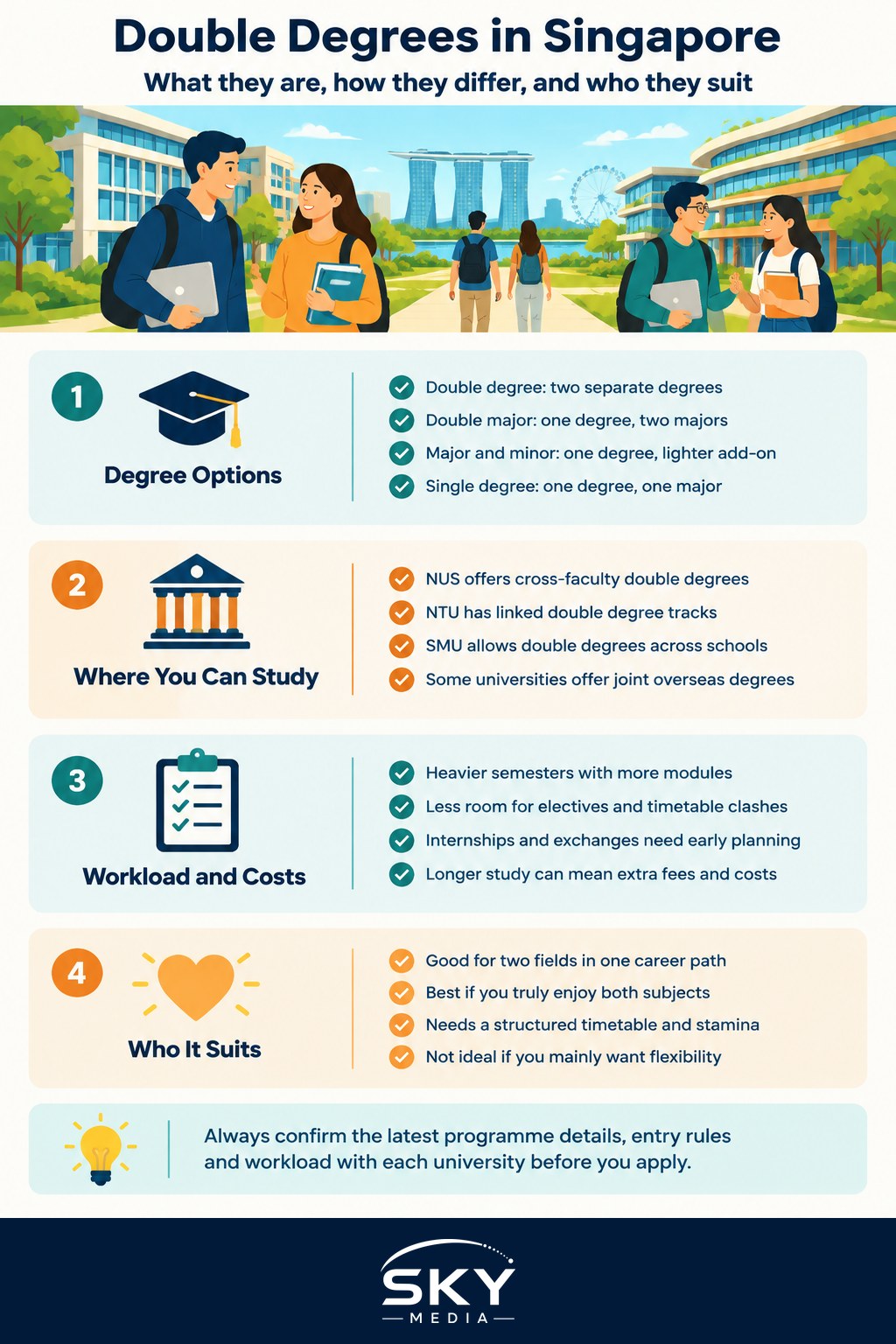
Double Degree vs Double Major: The Core Difference
The two terms get mixed up constantly, but they lead to different outcomes.
- A double degree means you graduate with two separate degrees, for example a Bachelor of Business Administration and a Bachelor of Computing. You meet the full requirements of both, though some modules count towards each.
- A double major means you graduate with one degree that lists two majors, for example a Bachelor of Arts with majors in Economics and Psychology. You complete the requirements of two subject areas within a single degree structure.
- A major and minor is lighter still: one degree, one major, plus a smaller cluster of modules in a second area.
Here is how the options generally compare. Exact rules differ between universities and programmes.
| Option | What you graduate with | Typical length | Workload | Admission route |
|---|---|---|---|---|
| Double degree | Two separate bachelor’s degrees | Usually longer than a single degree, often around five years | Heaviest, with requirements for two degrees | Often a separate application with its own selection |
| Double major | One degree with two majors | Usually the normal candidature | Heavy, but within one degree | Often declared after enrolment |
| Major and minor | One degree, one major, one minor | Normal candidature | Moderate | Usually declared after enrolment |
| Single degree | One degree, one major | Normal candidature | Standard | Standard application |
The practical takeaway: if you mainly want depth in two related subjects, a double major or minor may give you most of the benefit without the extra time and cost.
Which Singapore Universities Offer Double Degrees
All the major autonomous universities offer some form of double or combined degree, but the structure varies.
- National University of Singapore (NUS): offers double degree programmes that pair degrees across faculties, such as business, computing, engineering, law and the humanities. NUS also runs concurrent degree programmes that combine a bachelor’s with a master’s.
- Nanyang Technological University (NTU): offers double degree programmes that link disciplines such as business, accountancy, computing, engineering and economics, with some combinations designed as fixed, structured tracks.
- Singapore Management University (SMU): allows students to pursue double degrees across its schools, and its programme structure is known for making two degrees within one candidature more feasible for strong students.
- Other institutions: some universities offer joint or dual degrees with overseas partner universities, where you spend part of your studies abroad.
Which combinations exist, and whether you apply at entry or after your first year, changes regularly. Check the admissions and programme pages of each university, and use the course finders for the year you are applying. If you are still shortlisting schools, our guide to applying to local universities walks through the application cycle.
What the Workload Really Looks Like
The headline “two degrees” hides the day-to-day reality. Students in double degree programmes commonly describe:
- Heavier semesters. You will often carry more modules per semester than your single degree friends, especially in the middle years.
- Less flexibility. With two sets of requirements, there is less room for unrestricted electives, and timetable clashes between faculties can be tricky.
- Squeezed internships and exchanges. Many students still do them, but planning has to start early. Some programmes build them in, others leave you to fit them around core modules.
- Grade pressure. Some double degree programmes require you to maintain a minimum grade average to stay in. Check the continuation rules before you commit.
- An extra year of costs. A longer candidature can mean an additional year of tuition fees and living costs, and one less year of salary. If you are on a tuition grant or bond, check how a longer programme affects it.
None of this means a double degree is a bad idea. It means it suits students who genuinely want both disciplines and have the stamina for a long, structured programme.
Who a Double Degree Suits, and Who It Does Not
A double degree can be a strong choice if:
- Your target career sits at the intersection of two fields, such as law and business, or computing and finance.
- You enjoy both subjects equally and would be unhappy giving either up.
- You are comfortable with a structured timetable and a demanding workload over several years.
It may not be the right fit if:
- You are choosing it mainly for prestige or because friends are applying.
- You are unsure about your major and hope a double degree keeps options open. Broad-based programmes, or switching later, might serve you better. See our guide to transferring universities or courses if you change your mind after starting.
- You want lots of time for CCAs, part-time work, startups or exchange semesters.
Employers in Singapore tend to look at skills, internships and portfolios as well as qualifications. A double degree can help you stand out, but it does not replace work experience.
How to Apply for a Double Degree
Application steps differ by university, but most follow a similar pattern:
- Research combinations early. Make a list of programmes that genuinely interest you at each university.
- Check entry requirements. Double degree programmes are often more competitive, and some have subject prerequisites. Look at indicative grade profiles published by the universities, while remembering these change each year.
- Prepare for interviews or essays. Some programmes include interviews, written statements or aptitude tests. Our explainer on aptitude-based admissions explains how universities look beyond grades.
- Ask about internal applications. At some universities, you can apply for a double degree after your first year if you meet the grade requirements.
- Talk to current students. Open houses and student-run forums give an honest picture of daily life in the programme.
International students should also confirm that a longer programme fits their Student’s Pass arrangements with ICA, the Immigration and Checkpoints Authority, and any scholarship terms.
Making Your Decision
A double degree in Singapore is a serious commitment, not a free upgrade. Compare it honestly with a double major or a major and minor, which can deliver much of the same breadth with less time and cost. If you choose a double degree, do it because you want both fields, you understand the workload, and the programme’s structure fits your plans for internships and life outside class. Confirm every detail with the university, and your decision will be one you can stand behind for the full four or five years.
Further reading: Taking a Second Degree in Singapore: Fees and Subsidy Rules · University of the Arts Singapore: LASALLE and NAFA Degrees Explained · SIT vs SUTD vs SUSS: Choosing Between Them for Your Degree