

Most adults know the feeling. Something goes wrong at work, a message goes unanswered, or a plan falls through, and the first instinct is to grab the phone and ask someone, anyone, whether things are going to be okay. There is nothing wrong with leaning on people you love. The trouble starts when you cannot settle at all until someone else settles you.
Emotional independence is the ability to notice, name and steady your own feelings before (or instead of) handing them to another person to fix. It is not about becoming cold or never asking for support. It is about having a reliable inner base, so that the support you do receive is a bonus rather than a lifeline. This guide focuses on that internal skill: how to regulate yourself day to day, in a busy Singapore life, without needing constant outside reassurance.
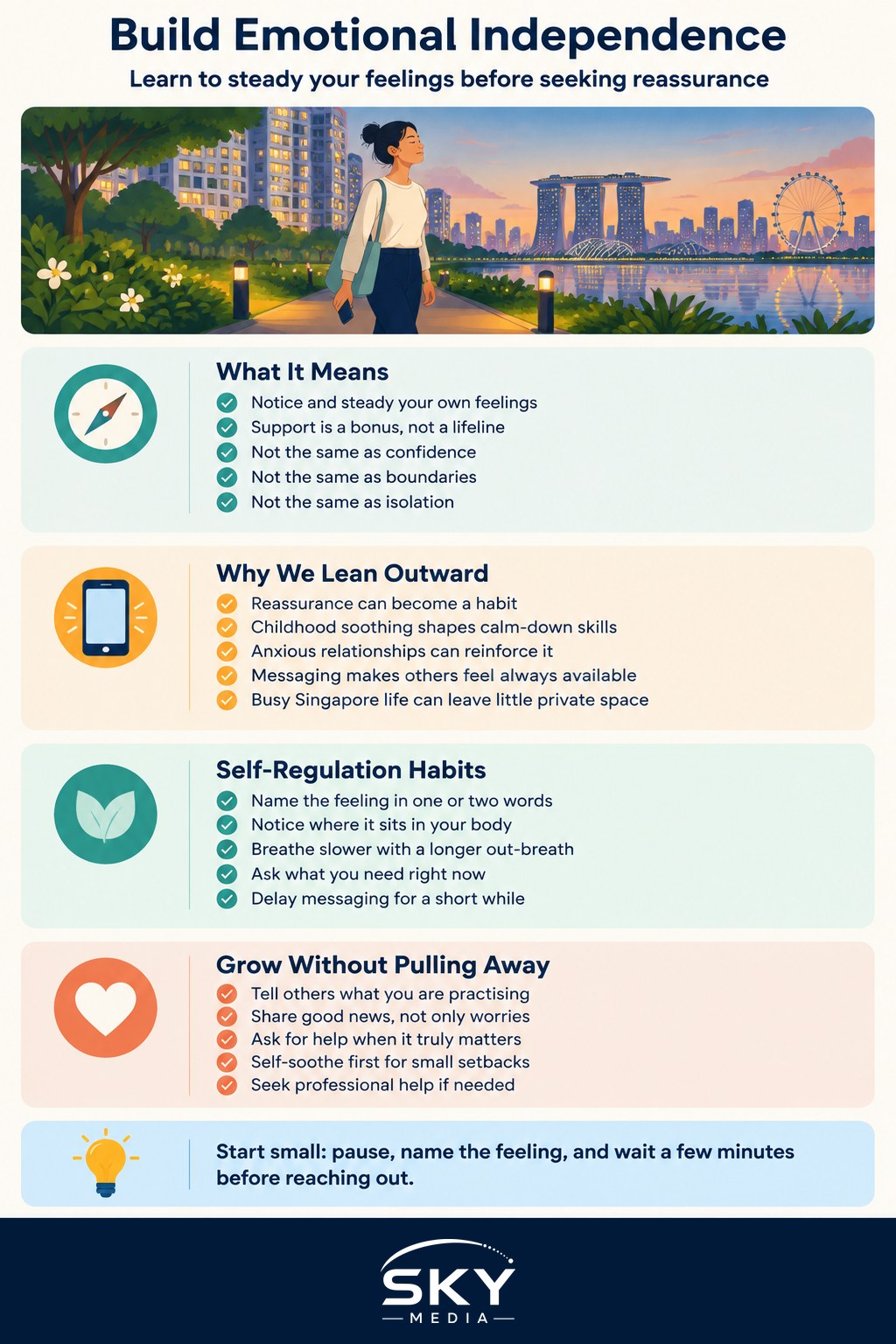
What Emotional Independence Is, and What It Is Not
It helps to separate this skill from a few neighbours it often gets confused with.
- It is not confidence. Confident people can still fall apart when a partner goes quiet. Emotional independence is about recovery from wobbles, not the absence of them.
- It is not setting boundaries. Boundaries manage what other people do. Emotional independence manages what happens inside you once they have done it.
- It is not isolation. People with strong inner stability usually have warmer relationships, because their friends and partners are not carrying the full weight of their moods.
A useful test: when you feel unsettled, how long can you sit with that feeling before you need someone else to respond? If the answer is “barely a minute”, that window is what you are trying to widen, gently and over time.
Why Adults Lean So Hard on Outside Reassurance
Reassurance seeking usually starts as a sensible strategy. As children, we were soothed by parents and carers, and that is how the nervous system learns to calm down. Some people simply never got enough practice taking over that job themselves. Others built the habit later, through an anxious relationship, a demanding workplace, or a period of loneliness after moving country.
Modern life makes it easier to keep outsourcing. Messaging apps mean someone is always theoretically available. Group chats can turn every small worry into a poll. In a dense, fast city like Singapore, where many people work long hours and live with family well into adulthood, there is often little private space to feel something fully before it is shared.
None of this is a character flaw. It is a pattern, and patterns can be retrained. If you are not sure what sets yours off, our piece on understanding your emotional triggers is a good starting point.
A Daily Self-Regulation Routine You Can Actually Keep
You do not need an hour of meditation. Small, repeatable steps work better than dramatic overhauls.
- Pause and name it. When a strong feeling hits, label it in one or two words: “anxious”, “embarrassed”, “lonely”. Naming an emotion tends to take some of the heat out of it.
- Locate it in your body. Tight chest? Clenched jaw? Restless legs? Noticing physical signals pulls attention back to the present.
- Breathe slower than you want to. A few slow breaths with a longer out-breath than in-breath is a simple way to signal to your body that you are safe.
- Ask yourself the question you would ask a friend. “What do you need right now?” Often the honest answer is rest, food, water, or a short walk rather than an urgent reply.
- Delay the reach-out. Set a small delay, perhaps ten or fifteen minutes, before you message someone for reassurance. If you still want to after that, go ahead. Often the urge passes on its own.
- Write one line down. A notes app or a small notebook works. Over weeks, these lines show you your patterns more clearly than memory does.
The goal is not to never ask for help. It is to give yourself the first go at calming down, so you arrive at the conversation steadier.
Reaching Out Versus Self-Soothing: Choosing the Right Move
Both have a place. The skill is knowing which fits the moment.
| Situation | Self-soothe first | Reach out first |
|---|---|---|
| A friend has not replied for a few hours | Yes, check your story about what the silence “means” | Only if it has been unusually long and you are genuinely worried |
| You made a minor mistake at work | Yes, review what happened and what you will do next | Talk to a colleague if you need practical input, not just comfort |
| You feel low for a day after a stressful week | Yes, rest, move, eat well, get daylight | If it lingers, share it with someone you trust |
| You are in real distress or feel unsafe | No, do not try to handle this alone | Yes, contact someone immediately or seek professional help |
| You are facing a big decision | Reflect on your own values first | Then gather views from people whose judgement you trust |
Notice that emotional independence still includes asking for help when it matters. What changes is that you ask from a place of choice rather than panic.
Building Tolerance for Uncomfortable Feelings
Much of the urge to be reassured comes from wanting a feeling to stop right now. Learning to stay with discomfort for a little longer is a muscle, and it grows with practice.
- Practise with small things. Wait in a queue without reaching for your phone. Let a minor irritation pass without commenting on it. These tiny reps build capacity for bigger moments.
- Remind yourself that feelings move. Even intense emotions rise, peak and fall. Watching that happen a few times builds trust in your own resilience.
- Separate facts from stories. “My manager frowned” is a fact. “My manager thinks I am useless” is a story. Write both down and see how much of your distress belongs to the story.
- Keep your basics steady. Sleep, regular meals, movement and time outdoors make every emotion easier to carry. Singapore’s park connectors and neighbourhood gardens are handy for a quick walk to reset.
If frustration in particular tends to tip you over, our guide to building frustration tolerance in everyday life goes deeper on that specific feeling. And for the wider habit of bouncing back after setbacks, see how to build emotional resilience.
Keeping Relationships Close While You Grow More Self-Reliant
Some people worry that becoming more emotionally independent will make them distant. In practice, it usually does the opposite, as long as you communicate the change.
- Tell people what you are working on. A simple “I am trying to calm myself down before I message you about worries” helps friends and partners understand why you may reach out less often.
- Share good news too, not only worries. If most of your messages to someone are requests for comfort, rebalancing that makes the relationship lighter for both of you.
- Stay available to others. Emotional independence frees up energy to support the people around you, which strengthens connection.
- Notice who leans on you. You may find it easier to spot when others are over-relying on you, and to respond kindly without taking on everything.
Being emotionally available to others and being able to steady yourself are two sides of the same maturity. One makes the other sustainable.
When to Look for Extra Support
Self-regulation skills are helpful, but they are not a replacement for professional care. If you notice persistent low mood, anxiety that interferes with work or sleep, panic attacks, or thoughts of harming yourself, please speak to a doctor, a polyclinic, or a qualified counsellor. In Singapore, your GP or a polyclinic can advise on local mental health services, and if you are ever in immediate danger, call emergency services straight away.
Building emotional independence is a slow, steady project. Start with one pause, one named feeling and one short delay before reaching out. Over a few months, you may notice that the storms still come, but you are much better at weathering them on your own.
Frequently Asked Questions
How long should I wait before messaging someone for reassurance? Try a small delay of ten or fifteen minutes, then decide. If you still want to reach out afterwards, go ahead. The urge often passes on its own, and you arrive at the conversation steadier. The aim is to widen your window gradually, not to never ask.
Does emotional independence mean I shouldn’t rely on my partner? No. It means having a reliable inner base so that support is a bonus rather than a lifeline. People with strong inner stability usually have warmer relationships, because friends and partners are not carrying the full weight of their moods.
How do I tell a fact from a story when I’m upset? Write both down. My manager frowned is a fact, while my manager thinks I’m useless is a story. Seeing them side by side shows how much of your distress belongs to the story, and gives you a calmer starting point.
When is self-soothing not enough and I should reach out? If you are in real distress, feel unsafe, or a low mood lingers beyond a day or two, do not handle it alone. Contact someone you trust straight away or seek professional help, and call emergency services if you are in immediate danger.
How do I explain to friends that I’m trying to rely on them less? Tell them simply what you are working on, for example that you are trying to calm yourself before messaging about worries. Share good news too, not only worries, so the relationship stays balanced and lighter for both of you.
Further reading: How to Build Distress Tolerance for Tough Moments