

The train is delayed again. The printer jams on the one page you need. Your child spills their drink just as you are leaving. A form gets rejected for a missing signature. None of these is a crisis, yet each can produce a hot flash of irritation that spoils the next hour. Frustration tolerance is the skill that decides how long that flash lasts and how much it controls what you do next.
This guide explains what frustration tolerance is, how it differs from related skills like anger management and patience, and practical ways to build it through the small irritations of daily life.
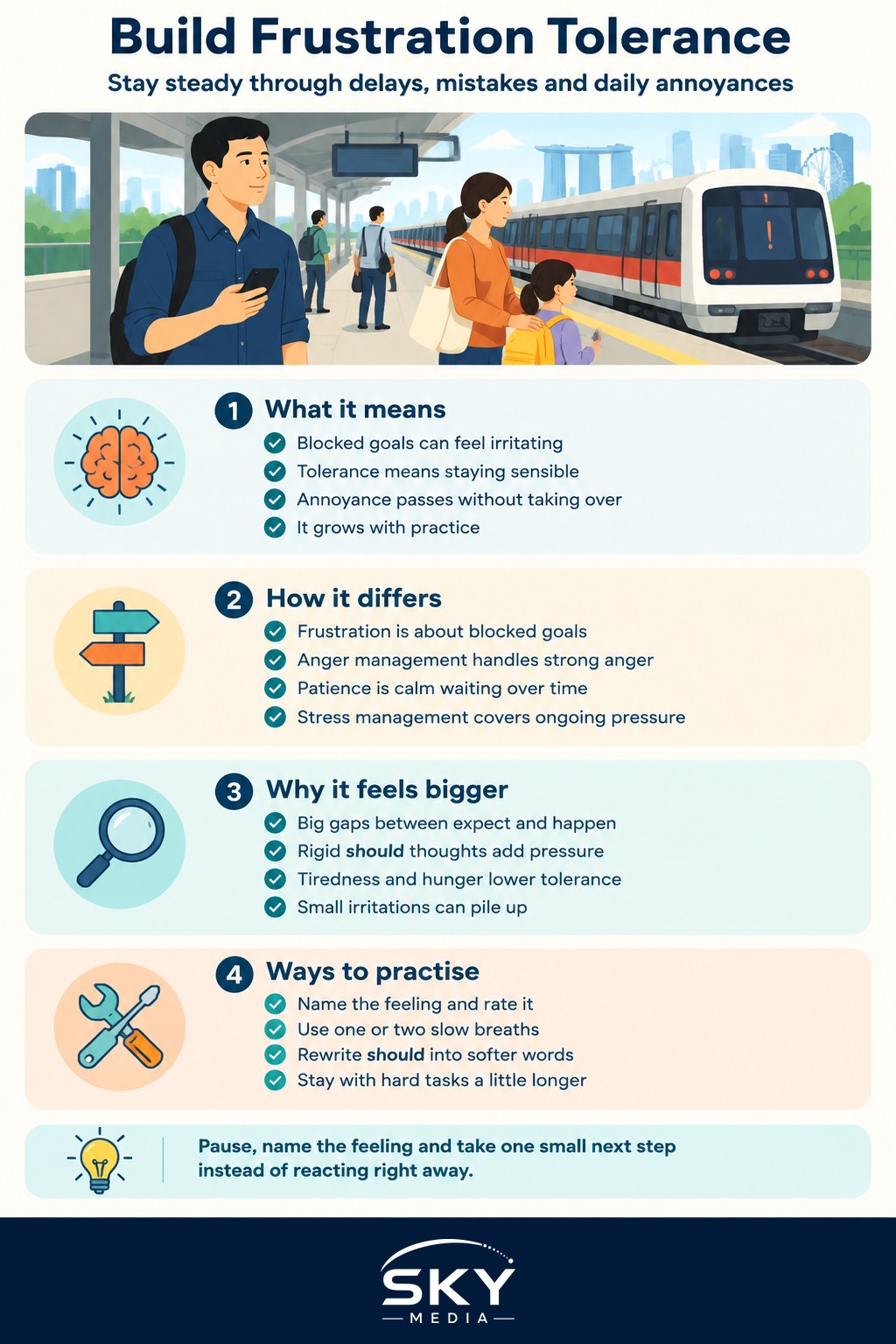
What Frustration Tolerance Actually Means
Frustration is the feeling that comes when something blocks a goal or does not go the way you expected. Frustration tolerance is your ability to feel that blocked, annoyed sensation without being overwhelmed by it, and to keep acting sensibly while it passes.
People with lower frustration tolerance often notice patterns like these:
- Giving up on a task as soon as it becomes difficult
- Feeling that small setbacks are unbearable or “not fair”
- Snapping at people over minor inconveniences
- Avoiding activities where mistakes are likely, such as learning a new skill
- Replaying an annoying moment for hours afterwards
Higher frustration tolerance does not mean you stop feeling annoyed. It means the annoyance is a passing signal rather than a command. You can think “this is irritating” and still carry on with the task, wait in the queue or fix the mistake.
Frustration tolerance is generally seen as a skill rather than a fixed trait. Like most skills, it grows with practice, and everyday life offers plenty of practice.
How It Differs From Anger, Patience and Stress Skills
These areas overlap, but they are not the same thing. Understanding the difference helps you choose the right tool.
| Skill | What it deals with | Typical moment | Main goal |
|---|---|---|---|
| Frustration tolerance | Blocked goals, delays, mistakes, small annoyances | A bus that does not come, a bug in your work | Stay engaged and keep going despite the irritation |
| Anger management | Strong anger, often directed at people | An argument that is escalating | Prevent harmful words or actions |
| Patience | Waiting calmly over time | A long queue or slow progress on a goal | Accept the pace of things |
| Stress management | Ongoing pressure and load | A heavy workload over several weeks | Reduce and recover from sustained strain |
| Distress tolerance | Intense emotional pain in tough moments | Bad news or a crisis | Get through without making things worse |
Frustration often comes before anger, so building tolerance early can reduce how often anger shows up at all. If anger itself is your main concern, our guide to managing anger and frustration goes deeper. For much stronger emotional moments, see how to build distress tolerance.
Why Small Frustrations Feel So Big
Understanding what drives frustration makes it easier to work with.
Expectations. The gap between what you expected and what happened is often bigger than the event itself. If you assumed the trip would take twenty minutes, a delay feels like a loss.
Rigid “should” thoughts. Thoughts like “this should work”, “people should know better” or “I should get this right first time” turn ordinary problems into personal injustices.
Tiredness and hunger. Frustration tolerance tends to drop when you are tired, hungry, unwell or already stressed. The same spilled drink feels different at 8am and at the end of a long day.
Accumulation. Several small irritations in a row stack up. The final one gets blamed for the whole pile.
Low sense of control. Situations where you can do nothing, such as waiting for a reply or a delayed service, are often harder than problems you can actively fix.
Daily Practices to Build Frustration Tolerance
The aim is not to remove frustration from life, which is impossible, but to practise staying steady with it. Try a few of these and notice which suit you.
Name it, then rate it
When you feel the flash of irritation, quietly label it: “I’m frustrated.” Then rate it from one to ten. Naming a feeling tends to create a little distance from it, and rating it often reveals that a “huge” annoyance is really a three.
Use a short pause
Before reacting, take one or two slow breaths, or count to five. This short gap is often enough to choose a response instead of simply reacting. Mindfulness practice can strengthen this pause over time; see how to practise mindfulness in everyday life for simple starting points.
Rewrite the “should”
Swap rigid rules for more flexible statements. “The train should be on time” becomes “I’d prefer it on time, but delays happen.” “I should get this right immediately” becomes “Most people need a few tries to learn this.”
Stay with hard tasks a little longer
When you want to give up on something difficult, such as a puzzle, a spreadsheet formula or a new language exercise, set a small target: two more minutes, or one more attempt. Gradually extending that window builds tolerance in the same way gentle training builds stamina.
Plan for predictable annoyances
Many frustrations are foreseeable. Bring something to read for queues, leave a buffer for travel, save work often and keep a checklist for forms. Reducing avoidable frustration leaves more capacity for the unavoidable kind.
Look after the basics
Regular meals, enough sleep and some movement are not glamorous, but they have a clear effect on how much irritation you can absorb.
Practising Frustration Tolerance in Real Situations
Here is how the skills can look in common moments.
- Transport delay. Notice the frustration, rate it, accept that the delay is outside your control, then use the time: message ahead, listen to something or simply rest.
- A mistake at work. Pause before reacting, remind yourself that errors are normal, and move to the next useful step, such as fixing the problem or asking for help.
- Learning something new. Expect the awkward early phase. Treat each frustrating attempt as part of the process rather than proof you are bad at it.
- Household mishaps. Spills, breakages and lost keys are part of living with other people. A calm response also models frustration tolerance for children.
- Slow replies or admin. Follow up once at a reasonable interval, then shift your attention to things you can control.
Supporting Others and Knowing When to Seek Help
You can help children and family members build frustration tolerance by staying calm yourself, naming their feelings (“that is frustrating, isn’t it?”) and encouraging them to try once more before giving up. Praise effort and persistence, not just results.
Frustration tolerance is part of broader emotional resilience, which our guide to building emotional resilience in everyday Singapore covers in more detail.
This article offers general information, not medical or psychological advice. If frustration regularly leads to outbursts, affects your relationships or work, or comes with persistent low mood or anxiety, consider speaking to a doctor, counsellor or psychologist. They can help you understand what is behind it and suggest support suited to you.
Small, repeated practice is what makes the difference. Each delay, mistake or annoyance you meet with a pause instead of a reaction makes the next one a little easier.
Frequently Asked Questions
How can I help my child who gives up on homework when it gets hard? Stay calm, name the feeling and ask them to try one more small step before stopping. Break the task into smaller parts and praise the effort, not just the result. Short breaks help. If frustration is intense or constant, speak to the teacher or a school counsellor.
Is low frustration tolerance linked to ADHD or other conditions? It can be associated with some conditions, but many people with ordinary stress, tiredness or habits also struggle with it, so it does not point to a diagnosis on its own. If it is severe, long-lasting or affecting school, work or relationships, see a doctor or psychologist.
Does venting or hitting a pillow help with frustration? Not reliably. Venting can keep the anger going rather than release it. Calming strategies such as slow breathing, a short walk or a pause tend to work better. Talking things through with someone calm can help once the intensity has dropped.
How long does it take to improve frustration tolerance? There is no fixed timeline, since it builds through repeated practice in small daily moments. Many people notice they recover faster after a few weeks of using a pause and naming the feeling. Progress is uneven, and tiredness or stress can set you back temporarily.
How can I stay patient during a slow commute or long queue? Expect the delay and bring something to occupy you, such as a podcast, a book or a few messages to clear. Rate your irritation and remind yourself the delay is out of your control. Leaving a time buffer also reduces the sense of being rushed.