

Is bonus taxable Singapore? The short answer is yes. Your year-end bonus, the Annual Wage Supplement (AWS, often called the “13th month”) and most other cash rewards from your employer count as employment income, and they go into the same pot as your salary when the Inland Revenue Authority of Singapore (IRAS) works out your income tax. There is no separate “bonus tax”, which is why many people are surprised by a bigger bill the following year.
This guide explains how a bonus flows into your tax, which year it is taxed in, and how to estimate the extra amount you will owe so it does not catch you off guard. It is general information, not tax or financial advice. Rules and rates change, so always confirm current details with IRAS.
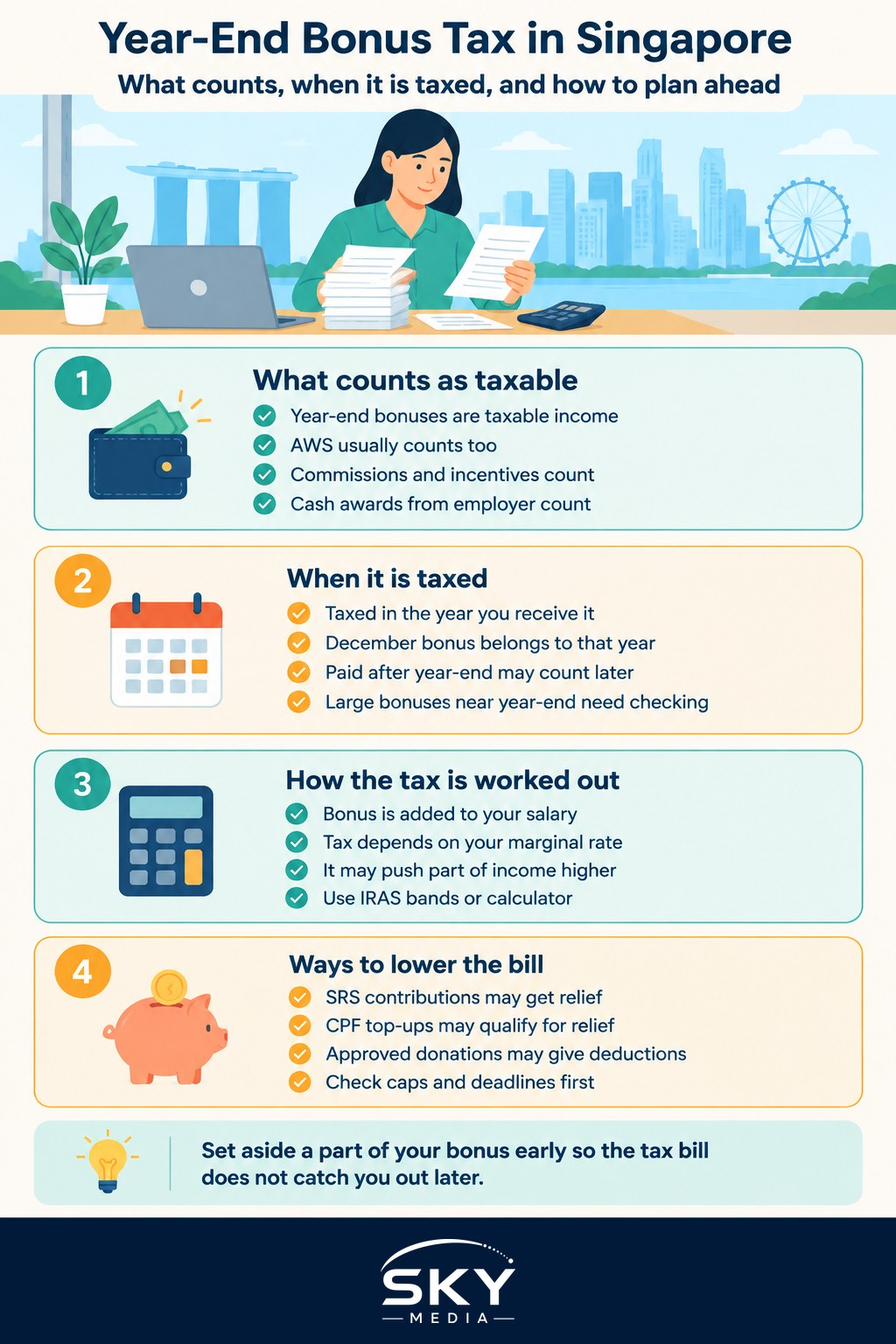
Bonuses and AWS Are Part of Your Employment Income
Singapore taxes employment income broadly. Alongside your monthly salary, IRAS generally treats the following as taxable:
- Performance bonuses, whether paid at year end or another time.
- AWS or 13th-month pay, the fixed extra month many employers pay in December.
- Commissions and incentive payments, including sales incentives.
- Sign-on, retention and other one-off cash awards from your employer.
- Certain share awards and stock options, which have their own timing rules; check IRAS guidance on employee equity if you receive these.
All of these are added to your salary to arrive at your employment income. After allowable deductions (such as approved donations or employment expenses, if any apply to you), you get your assessable income. Personal reliefs, such as the relief for your own compulsory CPF contributions, are then subtracted to reach your chargeable income, which is what the tax rates apply to.
Most employers in Singapore report your income directly to IRAS under the Auto-Inclusion Scheme (AIS) for employment income. If your employer is on AIS, your bonus and AWS will usually appear in your pre-filled tax return automatically. If not, you will need to declare them yourself. Check myTax Portal each filing season to make sure the figures are complete and correct.
Which Year Your Bonus Is Taxed In
Singapore uses a “preceding year” basis. Income you earn in one calendar year is assessed in the following Year of Assessment (YA). So income received in 2027 is generally taxed in YA 2028, with the bill arriving around the middle of 2028.
For bonuses, the general position is that they are taxed in the year you receive them. A year-end bonus paid in December 2027 belongs to your 2027 income. A bonus for the 2027 performance year that is only paid in March 2028 generally falls into your 2028 income instead.
There are nuances. IRAS distinguishes between contractual bonuses (written into your contract, like many AWS arrangements) and variable bonuses that depend on approval each year, and the timing rules for each can differ slightly. If your bonus is large or paid around a year boundary, check IRAS’s guidance on bonuses or ask your HR department how it will be reported.
The practical effect: the tax on a December bonus does not hit you for many months. That gap is exactly why it is worth setting money aside now.
How the Extra Tax Is Worked Out
Singapore’s personal income tax for residents is progressive. Chargeable income is split into bands, and each band is taxed at a higher rate than the one below it. The rate on your last dollar of income is your marginal rate.
A bonus sits on top of your salary, so it is taxed at your marginal rate, and if it is big enough it can push part of your income into a higher band. It does not raise the rate on the income you already had; only the portion inside each higher band is taxed at that band’s rate.
| Scenario | What happens to your tax | What to do |
|---|---|---|
| Small bonus, stays in the same band | Extra tax is the bonus multiplied by your current marginal rate | Set aside that percentage of the bonus |
| Bonus crosses into a higher band | Part is taxed at your current rate, the rest at the next band’s rate | Work out each slice separately, or use the IRAS calculator |
| Bonus is offset by new reliefs | Reliefs reduce chargeable income before rates apply | Confirm the relief applies and that you are within any overall relief cap |
| Non-resident for tax purposes | Different rules apply to employment income | Check IRAS guidance for non-residents before estimating |
IRAS publishes the current tax bands and rates and offers a free tax calculator for resident individuals on its website. Use the current year’s figures, because bands and rebates have changed in past Budgets.
Estimating Your Bill Step by Step
You do not need to be an accountant to get a reasonable estimate. Try this:
- Total your expected employment income for the year. Add your gross monthly salary for all months, your AWS and your bonus, plus any commissions.
- Subtract your likely reliefs. Start with your CPF relief for your own contributions, then any others you qualify for, such as earned income relief or reliefs for dependants. IRAS lists eligibility for each.
- Apply the current tax bands. Either work through the bands manually or plug your figures into the IRAS calculator.
- Compare with last year. The difference gives you a sense of how much extra your bonus is adding.
- Set aside the extra. Move that amount into a separate savings account so it is untouched when the bill arrives.
Remember that CPF contributions are also deducted from your bonus. Bonuses and AWS are treated as “additional wages” for CPF, which have their own ceiling. Your payslip will show the CPF deducted. The CPF Board website explains how additional wages are handled.
Legitimate Ways to Reduce the Bill
There is no special trick to avoid tax on a bonus, but some existing reliefs may lower your overall chargeable income. Whether they suit you depends on your circumstances, so treat these as starting points to research, not recommendations.
- Supplementary Retirement Scheme (SRS). Contributions to SRS can attract tax relief, subject to caps and withdrawal rules. Money is generally locked in until retirement age unless you accept a penalty.
- CPF cash top-ups. Voluntary top-ups to your own or family members’ retirement accounts under the CPF Retirement Sum Topping-Up scheme may qualify for relief, within limits. The money stays in CPF.
- Approved donations. Donations to approved Institutions of a Public Character (IPCs) may qualify for tax deductions.
Note that IRAS caps the total amount of personal reliefs an individual can claim in a year. Check the current cap and the timing deadline for each relief, since some must be made by 31 December to count for that year.
Paying the Bill Without Stress
When your Notice of Assessment arrives, you can usually pay in one lump sum or set up GIRO to spread payments over monthly instalments, subject to IRAS’s terms. Instalments make a bonus-boosted bill easier to manage, but only if you budget for them.
If you are a foreigner leaving Singapore, your employer must seek tax clearance with IRAS before your final pay is released, and any bonus paid around your departure will be included. Plan for that when you negotiate your last day.
For a wider look at what to do with the cash itself, see our year-end bonus checklist for Singapore workers and the guide to doing an end-of-year money review. If you also earn from investments, is investment income taxed in Singapore covers that side.
Official sources: IRAS
Further reading: When to Resign After Your Year-End Bonus: Timing a Job Switch