
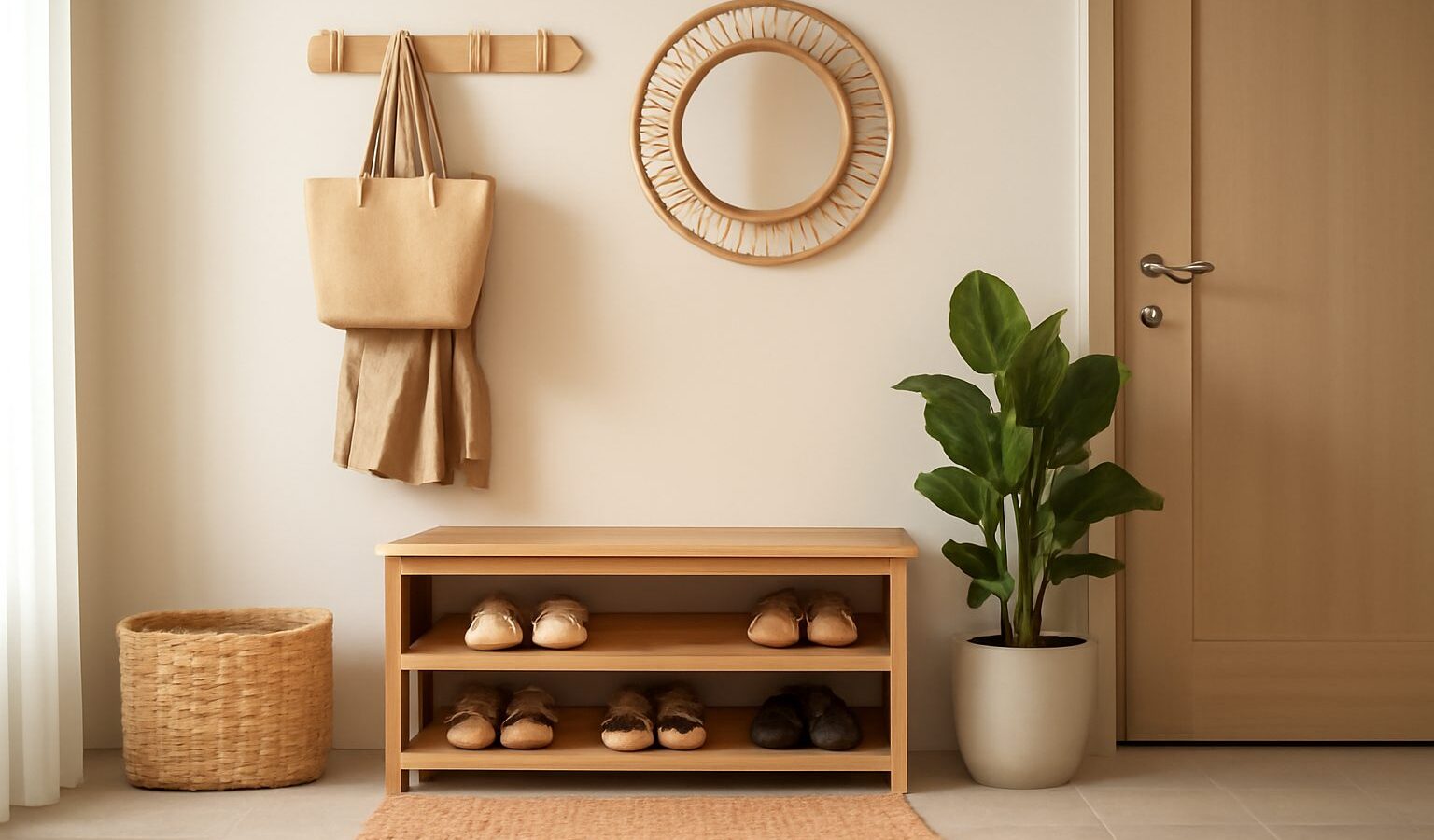
Almost every home here runs on a shoes-off rule, which means the few steps just inside your door do a lot of quiet work. Get shoe storage in Singapore right and the entrance stays tidy, dry and easy to walk through. Get it wrong and you end up with a heap of slippers by the gate, a musty smell in the wet months, and a corridor the town council eventually asks you to clear. This guide walks through the options that actually fit HDB flats and condos, the rules you need to know, and how to keep footwear fresh in our climate.
Why the Entryway Matters More Here
In many countries shoes come off at the bedroom or not at all. In Singapore, shoes come off at the door, so that threshold zone has to hold the whole household’s daily rotation of covered shoes, sports shoes, sandals, slippers and the occasional formal pair. On top of that, most flats open straight from a common corridor into the living room, with no hallway or mudroom to absorb the clutter.
The practical goal is simple: a spot to sit or steady yourself while you slip shoes on and off, closed storage for the pairs you wear often, and a small landing surface for keys, mask, umbrella and parcels. Everything else is a variation on that theme, scaled to the space you have.
Shoe Cabinets, Benches and Built-Ins
The workhorse of the local entryway is the shoe cabinet. A slim, closed cabinet keeps dust and smell contained and gives you a clean top surface. Flip-down or “louvre” style drawers are popular because they are shallow and let a little air move through. Ready-made units from IKEA, Courts or the heartland furniture shops are the quickest fix, while built-in carpentry lets you run storage up to the ceiling and hide it behind doors that match your walls.
A shoe bench is worth its footprint if anyone in the house struggles to balance on one leg, which is most of us after a long day. Look for a bench with storage underneath or a lift-up seat. If you have children or older parents, the seat matters more than the extra shelf.
Common approaches, roughly compared:
| Storage type | Best for | Rough capacity | Watch-outs |
|---|---|---|---|
| Slim flip-down cabinet | Narrow entry, small HDB flats | 9 to 18 pairs | Shallow drawers; tall boots do not fit |
| Bench with under-seat cubbies | Homes with kids or elderly | 4 to 8 pairs | Open cubbies gather dust |
| Full-height built-in carpentry | Maximising a wall or awkward nook | 20 pairs and up | Higher cost; get quotes and plan ventilation |
| Over-door or wall-mounted rack | Renters, very tight spaces | 4 to 10 pairs | Not for heavy shoes; check wall type |
| Open metal shoe rack | Budget, service yard overflow | 12 to 20 pairs | Looks messy in a living area |
Capacities are indicative only, so measure your actual pairs and check current prices before you commit.
The Corridor Reality and the Rules
Because indoor space is tight, many households push some shoes outside the front door. This is normal, but it is also where people get into trouble. HDB common corridors are shared escape routes, and the town council and SCDF treat them as fire-safety zones. Bulky racks, piles of shoes, shoe cabinets, bicycles, potted plants and other clutter that obstructs the corridor can be flagged, and you may be asked to remove them. The guiding idea is a clear passage for everyone, especially in an emergency.
A sensible middle path:
- Keep only a small, low tray or a single slim rack right against your own wall, not blocking the walkway.
- Store the bulk of your shoes inside, and reserve the outside for the couple of pairs in daily rotation.
- Never let items encroach on the shared path or a neighbour’s frontage.
- If in doubt, check your town council’s specific corridor guidelines, as enforcement and allowances vary by estate.
Treat anything outside the door as temporary and minimal. The reliable, dispute-free storage is the storage inside your flat.
Keeping Shoes Fresh in the Humidity
Our heat and humidity are hard on footwear. Trapped moisture leads to smell, and in the worst cases mould on leather and canvas after a rainy stretch. A few habits go a long way:
- Let wet or sweaty shoes air out before shutting them into a closed cabinet. A quick spell on the service yard or by a window helps.
- Slip in silica gel packs or activated-charcoal deodoriser bags and swap or dry them out regularly.
- Leave a small gap between the cabinet back and the wall, or choose louvre doors, so air can move.
- Rotate pairs so nothing stays damp for days, and wipe leather down after wet weather.
- For prized leather shoes, cedar shoe trees absorb moisture and hold shape.
If you already fight mould elsewhere, the same climate discipline applies at the door. During long wet spells, a low-cost dehumidifier or even running the aircon nearby keeps the whole entry drier.
Small-Entryway Ideas That Actually Work
When there is no room for a proper cabinet, go vertical and go multi-purpose. A tall, narrow cabinet uses wall height instead of floor space. A wall-mounted flip rack lifts shoes off the ground and frees the floor for sweeping. A slim console with baskets underneath doubles as a landing spot for keys and parcels while hiding slippers below.
Other space-savers worth trying:
- Use the wall behind the door with an over-door organiser for light footwear.
- Add a mirror above the cabinet so the entry feels larger and you can do a last check before heading out.
- Fit a hook rail for umbrellas, tote bags and lanyards to keep them off the shoe surface.
- Push seasonal or rarely worn pairs into the bomb shelter or a high storage cabinet, keeping the entry for daily shoes.
- Choose furniture with a footprint that still lets the front door swing fully open.
Good lighting matters too. A warm downlight or a small lamp near the door makes the whole zone feel intentional rather than like an afterthought, and it helps you spot the right pair on a dark morning.
The best entryway is not the biggest, it is the one that matches your household’s real habits: closed storage for the everyday pairs, a place to sit, a clear corridor, and enough airflow to beat the humidity.
Explore more
For more ways to reclaim floor space, see our guide to storage and organisation solutions in Singapore. To finish the entryway with the right fixtures and mood, read home decor and lighting in Singapore. Working with a compact flat overall? Our take on small-space living in Singapore ties these ideas together.