

Most Singapore homes have a shoes-off rule, which means the front door is where every pair in the household ends up. In a typical HDB flat or condo unit, that space is often a narrow strip beside the main door, sometimes shared with a meter box, a door swing and a corridor that needs to stay clear. Choosing the right shoe cabinet in Singapore is less about looks and more about fitting the space, keeping air moving in a humid climate and holding the number of pairs your family actually owns.
This guide focuses on the buying decision: how to measure, which cabinet style suits a small entryway, and what to check before you pay. If you want broader ideas such as benches, hooks and outdoor racks, see our entryway and shoe storage ideas.
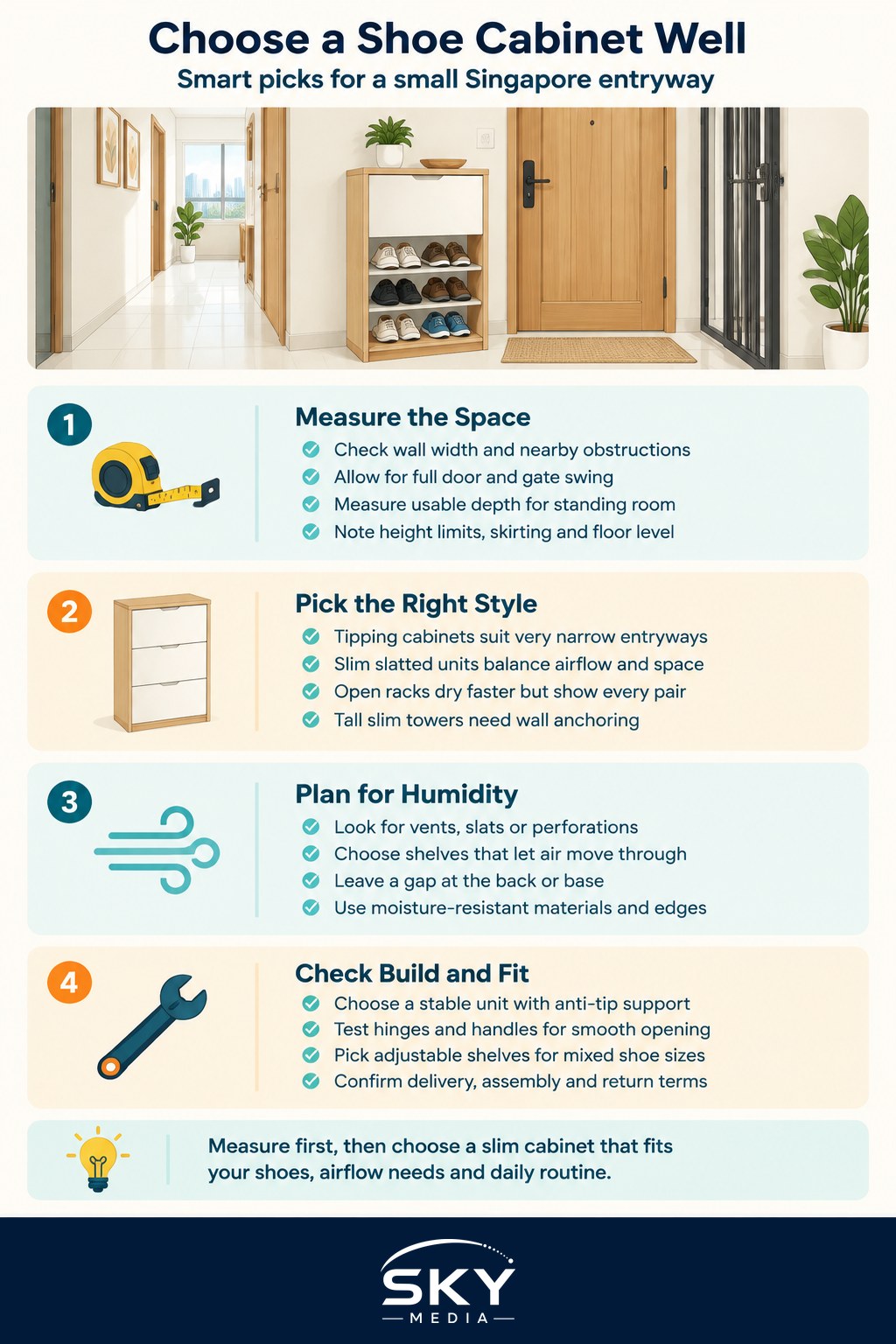
Measure the Space Before You Shop
A shoe cabinet that looks slim in a showroom can still block a door in a small flat. Before browsing, take these measurements with a tape measure and write them down:
- Wall width available, from the door frame to the nearest corner, switch or obstruction.
- Door swing clearance. Open your main door and gate fully and note how far they reach. The cabinet must not stop either from opening completely.
- Usable depth. Measure from the wall to where people walk. Leave enough room for someone to stand, bend and put on shoes without bumping the cabinet.
- Height limits. Check for switches, intercom panels, a distribution board or a window ledge that a tall unit could cover.
- Skirting and floor level. Thick skirting boards push a cabinet forward, and an uneven floor can make a tall unit wobble.
Also count your shoes honestly. Add up everyday pairs, work shoes, sports shoes, slippers and the pairs guests leave behind. A cabinet that only fits today’s collection will overflow quickly, so allow some spare space.
If you live in a condo, check whether the common corridor outside your door can be used at all. Many MCSTs (Management Corporation Strata Titles, the body that manages a condo’s common property) have house rules against leaving items in corridors. Town councils also take fire safety seriously in HDB common corridors, so keep escape routes clear and check current guidelines with your town council or MCST before placing anything outside.
Compare Shoe Cabinet Styles for Small Spaces
Different designs trade off depth, capacity and airflow. This comparison covers the common types you will see in furniture stores and online listings.
| Cabinet type | Best for | Watch out for |
|---|---|---|
| Tipping (flip-down) cabinet | Very narrow entryways, since shoes stand at an angle and depth stays shallow | Bulky boots and high-tops may not fit; hinges need gentle use |
| Standard shelf cabinet with doors | Families with mixed shoe sizes and some floor depth to spare | Needs more depth; closed doors trap moisture without vents |
| Open rack or slatted shelf | Maximum airflow and quick drying after rain | Shoes are on display and gather dust |
| Tall slim tower | Wall space that is narrow but tall | Must be anchored to the wall to prevent tipping |
| Built-in carpentry cabinet | Awkward corners and full use of floor-to-ceiling space | Harder to change later; ventilation must be planned in the design |
| Bench-style cabinet | Homes with elderly members or kids who need to sit to put shoes on | Lower capacity for the floor area it uses |
For many small HDB entryways, a tipping cabinet or a slim slatted unit gives the best balance. If you have a recess or an odd corner, built-in carpentry can use every centimetre, but discuss ventilation and door direction with your contractor before work starts.
Plan Ventilation for Singapore Humidity
Singapore’s warm, humid air is the main reason shoe cabinets start to smell. Shoes come home damp from sweat or rain, then sit in a closed box with little airflow, which encourages odour and mould.
When comparing options, look for:
- Vents or perforations on the doors or back panel. Louvred doors, slatted fronts and small cut-outs all help.
- Slatted or wire shelves instead of solid boards, so air can rise through the unit.
- A gap at the back or base so the cabinet is not sealed against a cool wall where condensation can form.
- Moisture-resistant materials. Laminated boards, metal and some plastics cope better with damp than raw wood or untreated particle board. Check the edges, since exposed edges absorb moisture.
Good habits matter as much as design. Let wet shoes air out before putting them away, use absorbent inserts or moisture absorbers inside the cabinet, and wipe shelves regularly. Our guide on how to clean and deodorise your shoe cabinet covers the routine in detail.
Check Build Quality, Safety and Fittings
Once you have shortlisted a size and style, look closely at how the cabinet is made. Small details decide whether it lasts.
Stability and anchoring. Tall and slim units can tip over, especially if a child pulls on a door or climbs a shelf. Choose a cabinet that comes with an anti-tip wall bracket, and install it. If your wall is a type that needs special fixings, ask the seller or a handyman which anchors suit it.
Hinges and handles. Tipping cabinets rely on their hinge mechanism, so test it in the store if you can. Opening should be smooth with no grinding. Standard doors should close fully and line up neatly. If something loosens later, our guide to replacing cabinet hinges and handles walks you through simple repairs.
Shelf adjustability. Adjustable shelves let you fit sneakers, heels and children’s shoes in the same unit and change the layout as kids grow.
Top surface. A cabinet top is useful for keys, masks and parcels. Check that the surface resists scratches and that the height suits the people who will use it.
Assembly. Flat-pack furniture saves money but takes time. Check whether delivery includes assembly and whether the seller will carry items up if your lift does not stop on your floor. Policies vary, so confirm before you order.
Match the Cabinet to How Your Household Lives
The best shoe cabinet is the one that suits your daily routine, not just the floor plan. A few questions to ask yourself:
- Who uses the entryway? Elderly parents may need a bench or a sturdy surface to hold while putting on shoes. Young children need low shelves they can reach themselves.
- How many guests visit? If you often host, keep an open shelf or empty tray near the door so visitors’ shoes do not end up in a pile. Our guide to visiting etiquette and removing shoes explains why this matters so much in local homes.
- What else needs a home? Umbrellas, delivery bags, keys and masks all gather at the door. A cabinet with a drawer or a hook rail can stop clutter spreading.
- Do you rent? Tenants may not be allowed to drill into walls or install built-ins. Check your tenancy agreement and ask the landlord before fixing anything to the wall, and choose freestanding pieces that you can take with you.
A Simple Buying Checklist
Before you pay, run through this list:
- The cabinet fits your measured width, depth and height, with door swing clearance.
- It holds your current shoe count plus some extra room.
- It has vents, slats or gaps for airflow.
- The materials and edges handle humidity.
- It comes with a wall anchor if it is tall or slim.
- Hinges and doors work smoothly.
- Delivery, assembly and return terms are clear in writing.
A well-chosen shoe cabinet keeps the doorway tidy, protects your shoes and makes coming home feel calmer. Take time to measure, think about airflow, and buy for the household you have, and the small entryway will work much harder for you.
Frequently Asked Questions
How deep should a shoe cabinet be for a narrow HDB entryway? There is no single standard depth, so measure your own space. Measure from the wall to where people walk, leaving room to stand and put on shoes. If depth is tight, a tipping cabinet is usually the shallowest option because shoes stand at an angle.
Can I put a shoe cabinet outside my HDB flat door? Rules are strict, so check before you do. Town councils take fire safety seriously and want common corridors and escape routes kept clear. Ask your town council for the current guidelines, and if you live in a condo, ask the MCST about its house rules.
Is a built-in shoe cabinet worth it over a freestanding one? It depends on your space and plans. Built-in carpentry uses awkward corners and the full height, but it is harder to change later and ventilation has to be planned in. Freestanding units are cheaper to replace and can move with you, which suits renters.
How do I stop a tall shoe cabinet from tipping over? Fix it to the wall with an anti-tip bracket. Tall, slim units can topple if a child pulls on a door or climbs a shelf. If you are unsure which anchors suit your wall type, ask the seller or a handyman.
What should renters look for when buying a shoe cabinet? Choose a freestanding piece you can take with you. Drilling into walls or adding built-ins usually needs your landlord’s permission, so check the tenancy agreement first. Wall-anchoring a tall unit is the main thing to clear with the landlord.
Further reading: What to Check Before Buying a Shoe Bench for Small Entryways · How to Organise a Small Entryway in Singapore Homes · How to Choose a Shoe Rack for Singapore Homes