
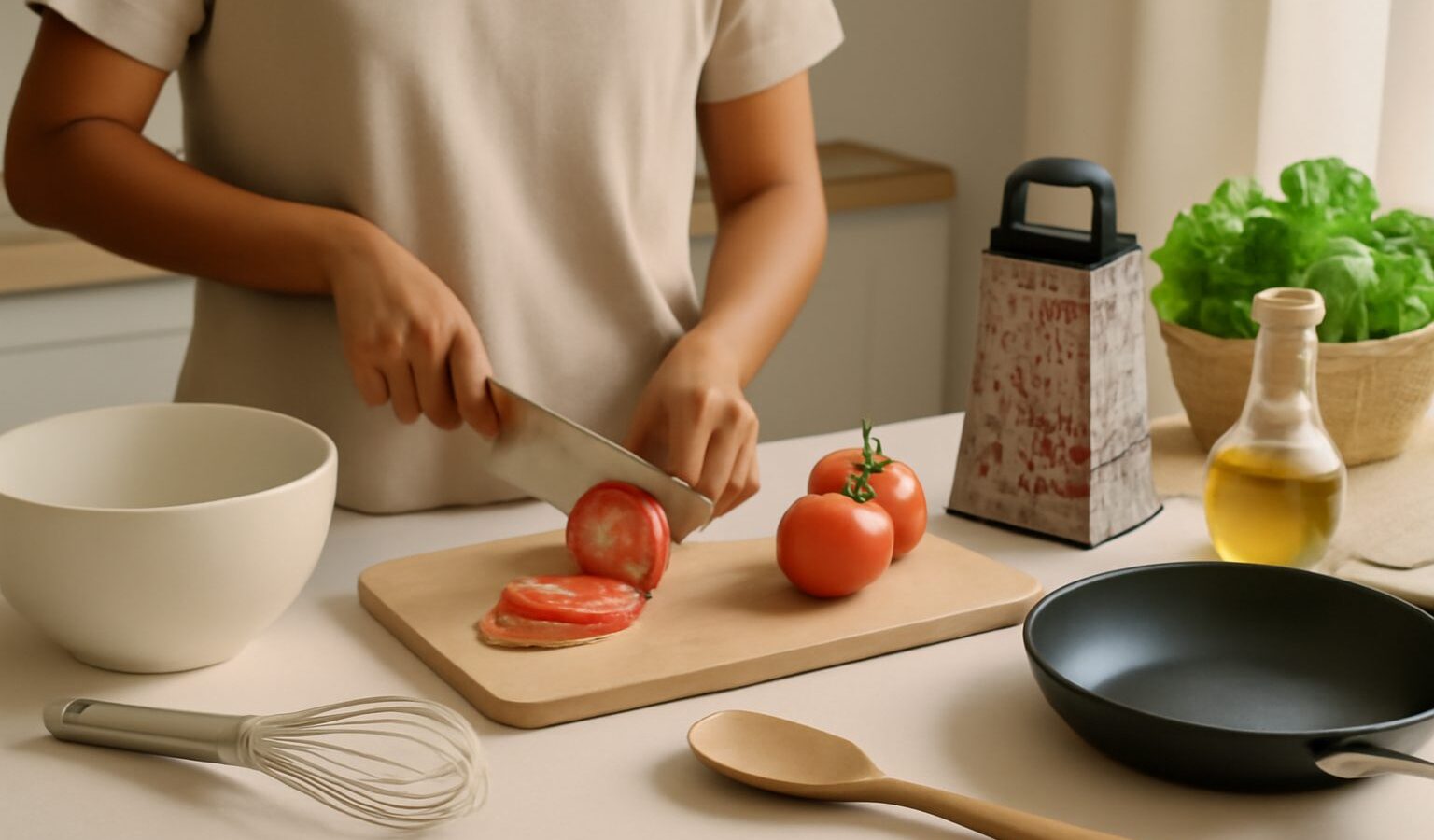
If you are just starting to cook at home, walking into a kitchenware shop can feel overwhelming. There are spiralisers, garlic presses, egg slicers and gadgets for jobs you did not know existed. The good news is that you need very few of them. The essential kitchen tools most Singapore home cooks actually reach for would fit in one small drawer and a corner of the counter, which is exactly what you want when your HDB or condo kitchen is tight on space.
This guide covers what to buy first, what can wait, and what to skip entirely. The goal is a lean setup that lets you cook rice, stir-fry a plate of vegetables, boil a pot of soup, and fry an egg without fuss. You can always add more later once you know what you cook most.
Start With a Good Knife and a Board
If you buy one thing well, make it a knife. A single decent chef’s knife, roughly 18 to 20cm, handles almost everything: slicing onions, cutting chicken, chopping garlic, portioning fish. Many local cooks also love a Chinese cleaver, the flat rectangular one, which doubles as a scoop to carry chopped garlic straight to the wok. Either works. Hold a few in the shop and pick the one that feels balanced and not too heavy in your hand.
Pair it with a sturdy cutting board. Get two if you can: one for raw meat and seafood, one for vegetables and cooked food. Keeping them separate is the simplest way to avoid cross-contamination, which matters more in our warm, humid climate where bacteria multiply quickly. Plastic boards are cheap and go in the dishwasher; wooden boards are kinder to your knife edge but need hand washing and drying. A dull knife is more dangerous than a sharp one because it slips, so add a simple honing steel or a pull-through sharpener to your list too.
The Pots and Pans You Will Actually Use
You do not need a matching ten-piece set. Most weeknight cooking in Singapore happens in two or three vessels.
- A non-stick frying pan, around 24 to 28cm, for eggs, fish, pancakes and quick fries. This is the most forgiving pan for beginners.
- A medium saucepan with a lid for boiling noodles, blanching vegetables, and simmering soup.
- A wok or a deep pan for stir-frying. On induction hobs, a flat-bottomed wok works; on gas, a round or flat-bottomed one is fine.
Add a larger stockpot only if you like making soup or braises in batches. Match your cookware to your hob: induction needs magnetic-base pots, so bring a small magnet to the shop and check it sticks before buying. If you are on a HDB gas hob, almost any pot works.
Small Tools That Punch Above Their Weight
These inexpensive items save you the most frustration:
- A pair of tongs and a heatproof spatula or wok turner for flipping and tossing.
- A wooden spoon or silicone spoon for stirring without scratching non-stick.
- A colander for washing rice and draining noodles.
- Two or three mixing bowls that nest to save space.
- A set of measuring spoons and a measuring cup, useful while you are still learning to eyeball amounts.
- A can opener, a peeler, and kitchen scissors, which locals use constantly for snipping spring onions and chilli.
- A fine grater for ginger and garlic.
A digital kitchen scale is optional but genuinely helpful, especially for baking and for scaling recipes up or down. Weighing in grams removes a lot of guesswork.
Buy Now, Buy Later, or Skip
Here is a simple way to prioritise so you do not overspend on day one.
| Tool | Priority | Why |
|---|---|---|
| Chef’s knife or cleaver | Buy now | Does most cutting jobs; worth spending on |
| Cutting boards (2) | Buy now | Keeps raw and cooked food separate and safe |
| Non-stick frying pan | Buy now | Easiest pan for eggs, fish and quick fries |
| Saucepan with lid | Buy now | Boiling, blanching, simmering |
| Wok | Buy soon | Central to local stir-fry cooking |
| Kitchen scale | Buy later | Helpful for baking and scaling recipes |
| Rice cooker | Buy later | Convenient, but a pot works too |
| Single-use gadgets | Skip | Garlic press, egg slicer and the like clutter drawers |
Think in terms of what you cook this month, not what you might cook one day.
Where to Buy in Singapore Without Overspending
You have plenty of options. Neighbourhood kitchenware shops, often near wet markets, stock solid budget knives, woks and enamel pots that hawkers themselves use, usually at fair prices. Department stores and homeware chains carry mid-range non-stick and knife sets if you prefer to see everything in one trip. Supermarkets cover the basics like spatulas, bowls and peelers. Online marketplaces are handy for comparing, though it helps to hold a knife before you commit.
You do not need to buy premium to start. A modest knife that you sharpen and a reliable non-stick pan will outperform an expensive set you are afraid to scratch. Spend a little more on the knife and the pan you use daily, and save on the rest.
Caring for Your Tools So They Last
Tropical humidity is hard on kitchen gear. Dry knives immediately after washing to prevent rust spots, and store them in a block or on a magnetic strip rather than loose in a drawer where the edge dulls and fingers get nicked. Hand wash non-stick pans with a soft sponge, never a metal scourer, and use wooden or silicone tools on them. Season and dry your wok well so it does not rust between uses. Store lids and nesting bowls stacked to reclaim cupboard space, and keep boards standing upright to dry fully so they do not stay damp and grow mould.
Your first attempts in the kitchen will not be perfect, and that is completely normal. The right small set of tools simply removes the extra friction so you can focus on learning to cook. Start lean, cook often, and add tools only when you genuinely miss having them.
Explore more
Ready to build your skills further? Learn how to choose and care for kitchen knives so your most important tool lasts, then practise the basic knife skills every home cook should know. When you are ready for stir-frying, our guide to seasoning and caring for a wok will get you started.