
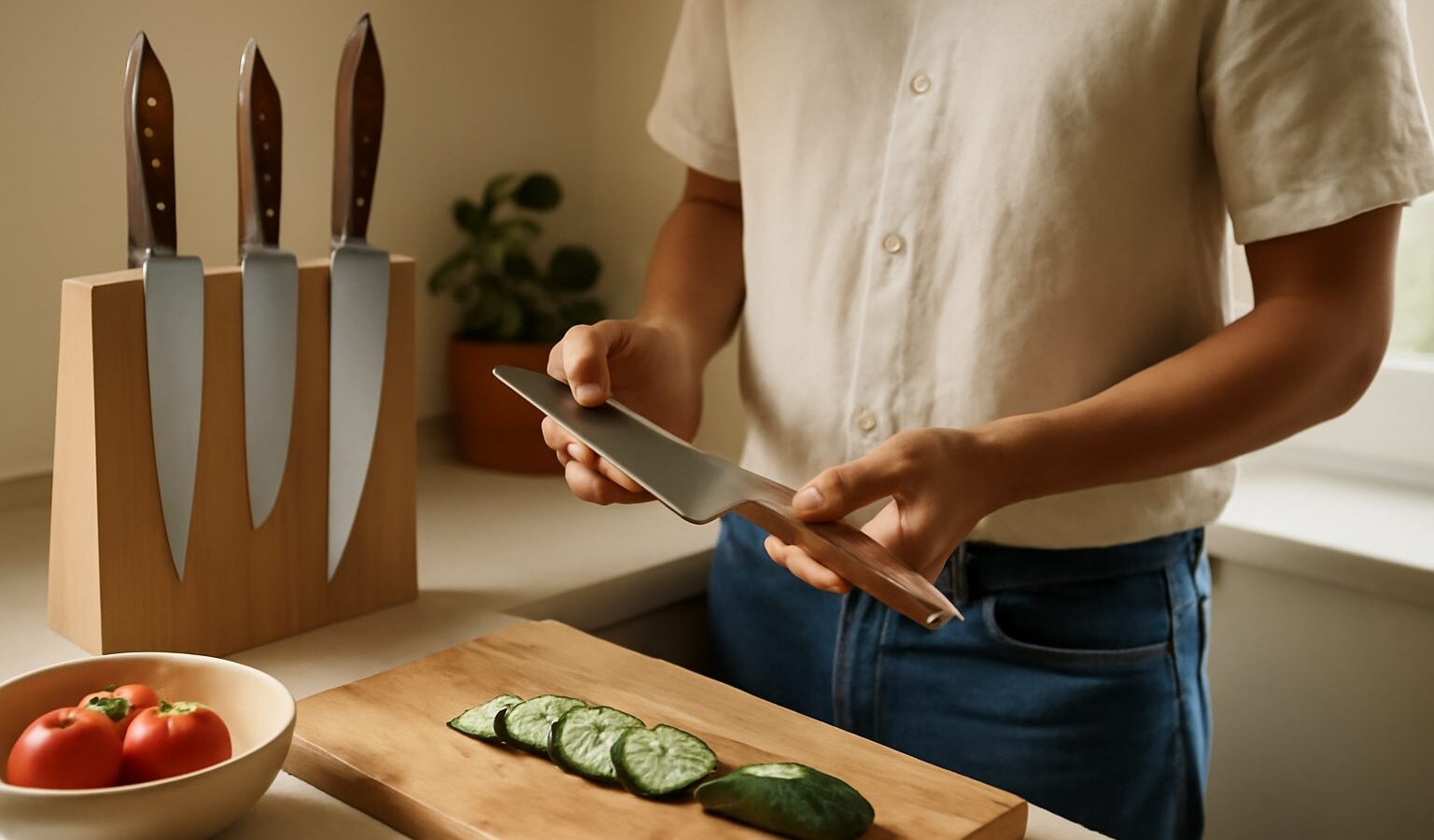
A good knife is the most useful tool in any kitchen, and it is the one beginners most often get wrong. Many homes have a drawer full of blunt, mismatched blades and not one that cuts cleanly. If you are shopping for kitchen knives in Singapore, or trying to revive the ones you own, this guide keeps it simple: which knives you actually need, how to pick one that suits your hand, and how to keep an edge sharp in our humid climate.
You do not need a wooden block bristling with twelve knives. Most home cooks manage very well with two or three, and cook better because each one is properly maintained.
The Few Knives You Really Need
Start with a single all-purpose knife and build from there.
- A chef’s knife, roughly 18 to 20cm, is the workhorse. It slices, dices and chops almost anything, from onions to chicken thigh.
- A Chinese cleaver, the flat rectangular slicer, is the local favourite. Despite its size it is nimble for vegetables and herbs, and the broad blade scoops chopped garlic straight into the wok. Note this is the thin vegetable cleaver, not the heavy bone chopper.
- A small paring knife handles fiddly jobs: hulling strawberries, deveining prawns, peeling ginger.
That trio covers the vast majority of home cooking. A bread knife and a heavier bone cleaver are nice additions later if you bake or butcher at home, but they are not day-one purchases.
Choosing a Knife That Fits Your Hand
Weight and balance matter more than brand. In the shop, hold a few knives and mime a chopping motion. The knife should feel like an extension of your arm, not too heavy at the tip, not so light it feels flimsy. Pinch the blade just in front of the handle between thumb and forefinger; a knife that balances near that point gives you the most control.
Look at the blade material too. Stainless steel resists rust, which is a real advantage in Singapore’s humidity, and is very forgiving for beginners. High-carbon steel takes a keener edge and is loved by serious cooks, but it stains and rusts easily and needs drying the moment you finish. For a first knife, stainless or a stainless-carbon blend is the sensible choice. A full tang, where the metal runs through the handle, usually feels sturdier and lasts longer.
Keeping the Edge: Honing and Sharpening
People confuse these two, but they are different jobs. Honing straightens the microscopic edge that rolls over with everyday use; sharpening actually removes metal to form a new edge. You hone often and sharpen occasionally.
| Task | How often | Tool | What it does |
|---|---|---|---|
| Honing | Every few uses | Honing steel | Realigns the edge, keeps it cutting true |
| Light sharpening | Every month or two | Pull-through or fine whetstone | Restores a dull edge |
| Full sharpening | A few times a year | Whetstone or pro service | Reshapes a badly worn edge |
A honing steel is cheap and quick: hold the knife at a low, consistent angle and draw it down the steel a few times each side. For sharpening, a pull-through sharpener is the easiest entry point, while a whetstone gives the best results once you practise. If that feels daunting, several kitchenware shops and markets offer a sharpening service for a small fee. A sharp knife is safer than a blunt one because it bites where you place it instead of slipping, so do not let this slide.
Washing, Drying and Storing in Humid Weather
Our climate is tough on blades, so build a few habits. Always wash knives by hand with warm water and a little detergent, then dry them straight away with a cloth. Never leave a knife soaking in the sink; the edge dulls, the handle loosens, and it is a hidden hazard for whoever reaches in. Skip the dishwasher, where knocking around and harsh detergent damage both edge and handle.
Storage is where many good knives quietly die. Loose in a drawer, the edge bangs against other utensils and dulls within weeks, and reaching in is asking for a cut. Better options are a knife block, an in-drawer knife tray, or a wall-mounted magnetic strip, which also saves precious counter space in a small kitchen. If you must keep a knife in a drawer, slip a blade guard over it. Store carbon-steel knives especially dry, and wipe them with a thin film of neutral oil if you will not use them for a while, to hold rust at bay.
Common Knife Mistakes and Easy Fixes
A few missteps show up again and again in home kitchens:
- Cutting on glass, stone or ceramic surfaces. These wreck an edge fast. Always use a wood or plastic board.
- Using the knife as a can opener or to pry things apart. Twisting can chip or bend the tip.
- Scraping food off the board with the sharp edge. Flip the knife and use the spine so you do not blunt it.
- Letting a blade air-dry near the sink, where humidity encourages rust spots. Dry it by hand.
- Buying a whole expensive set instead of one good knife. You end up with blades you never touch.
If your knife has already rusted lightly, a gentle scrub with a soft scourer and a little bicarbonate of soda often lifts surface spots. If the edge is simply dull, a sharpen usually brings it back to life; you rarely need to replace a decent knife.
Choosing well and caring for what you own beats owning many. Look after two or three good kitchen knives, keep them sharp and dry, and they will serve you for years of home cooking.
Explore more
A sharp knife is only useful if you handle it well, so read up on basic knife skills every home cook should know. If you are still assembling your kitchen, see our guide to essential kitchen tools for beginner cooks, and once you are chopping confidently, learn how to season and care for a wok for stir-frying.