
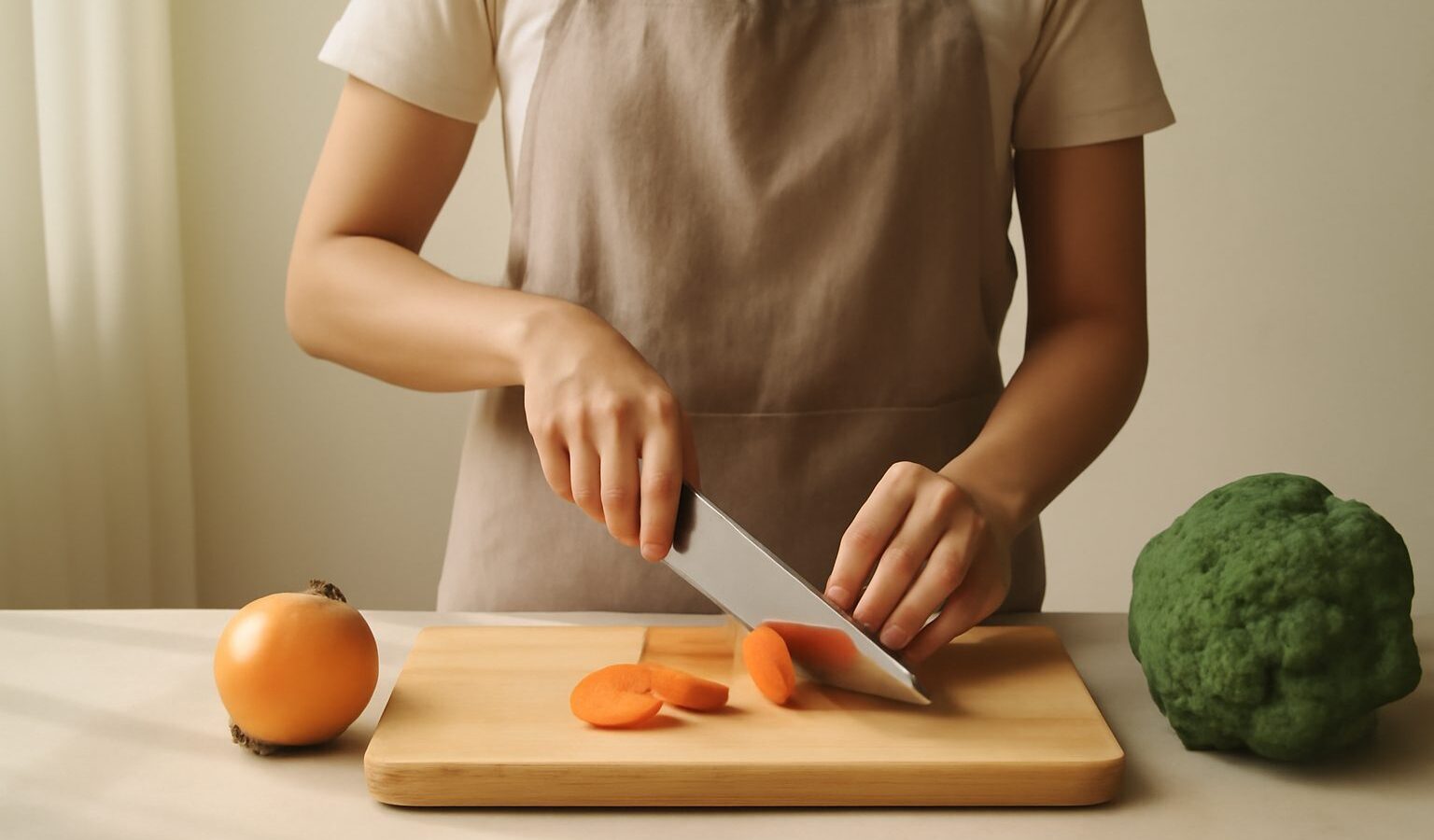
Watch anyone cook quickly and confidently, and you will notice it usually comes down to how they handle a knife. Good knife skills are not about speed or showing off; they make cooking safer, tidier and far less tiring. If your chopping feels slow and clumsy, you are not alone, and a little technique changes everything. This guide to knife skills in Singapore kitchens covers the grip, the safety hold, and how to cut the ingredients you use most, from onions to chilli padi.
You do not need a fancy blade to practise. A single sharp chef’s knife or Chinese cleaver and a steady board are enough. Everything below improves with repetition, so treat your next few dinners as practice.
Hold the Knife the Right Way
Most beginners grip the handle like a hammer, with all fingers wrapped around it. It feels natural but gives you little control. The better hold is the pinch grip: pinch the base of the blade between your thumb and the side of your forefinger, then wrap the remaining three fingers around the handle. Your hand is now closer to the food, and the knife becomes an extension of your arm rather than a tool you are pushing.
It feels odd for the first day or two, then it clicks. With a pinch grip you steer the blade with small movements and let its weight do the work, instead of forcing it down. This matters even more with a heavier Chinese cleaver, where balance from the pinch keeps you accurate.
The Claw: Keep Your Fingertips Safe
Your other hand guides the food, and it needs protecting. Curl your fingertips under so your knuckles face the blade, like a loose claw, and hold the ingredient with your fingernails tucked away. The flat side of the knife rests lightly against your knuckles, which act as a guide, and you shuffle the claw backwards as you cut.
Never chase speed before the claw is second nature. A sharp knife and tucked fingertips are a safe combination; a blunt knife and flat fingers are how people get hurt. Go slowly and deliberately at first. The rhythm and pace come on their own once the shape of the movement is in your muscle memory.
Everyday Cuts You Will Use Most
A handful of cuts cover nearly all home cooking. You do not need chef-school precision, just pieces of a fairly even size so they cook at the same rate.
- Slicing: straight cuts through vegetables like cucumber, carrot or chye sim. Keep pieces even for uniform cooking.
- Dicing: slicing into strips, then across into cubes. Small dice for aromatics, larger for stews.
- Mincing: very fine chopping for garlic and ginger. Rock the blade over the pile, keeping the tip on the board.
- Chiffonade: stacking leaves like basil or laksa leaf, rolling them tightly, and slicing into thin ribbons.
- Rough chopping: quick, uneven cuts for things headed into a blender or a long-simmered soup.
Rocking the knife, keeping the tip in contact with the board and lifting only the heel, is faster and safer than lifting the whole blade off between cuts.
How to Cut the Ingredients Singapore Cooks Use Daily
Some ingredients trip people up. Here is how to handle the usual suspects.
| Ingredient | Best cut | Quick tip |
|---|---|---|
| Onion | Dice | Halve through the root, slice towards the root, then across |
| Garlic | Mince | Smash with the flat blade first; skin slips off, mincing is faster |
| Ginger | Fine slice or mince | Peel with a spoon edge, slice across the grain to avoid stringy bits |
| Chilli padi | Thin slices | Cut on a board, wash hands well after; the heat lingers on skin |
| Spring onion | Thin slices | Bunch several together and cut, or snip with kitchen scissors |
| Leafy greens | Rough chop or ribbons | Stack, roll and slice; wash and dry first so they do not slip |
For onions, leaving the root end intact until the end holds the layers together and means fewer tears. For garlic, that first smash with the side of the blade is the single biggest time-saver in a home kitchen. Handle chilli padi with care: the heat clings to your fingers and stings if you touch your eyes, so wash thoroughly or wear a glove if you are cutting a lot.
Common Mistakes and How to Fix Them
Most chopping frustration traces back to a few habits:
- A blunt knife. If you are sawing or pressing hard, the blade is dull, not weak. Sharpen it. A sharp knife is safer and easier.
- A sliding board. Lay a damp cloth or a sheet of kitchen towel underneath so it grips the counter.
- Overcrowding the board. Clear cut pieces into a bowl so you have room and can see what you are doing.
- Cutting towards your hand. Always cut down onto the board and away from your fingers.
- Uneven pieces. Take a second to make cuts a similar size so everything cooks evenly; a stir-fry with half-raw, half-mushy vegetables usually starts here.
Set yourself up well too. A stable board at a comfortable height, a bowl for scraps, and a clear counter make cutting calmer and safer, which matters in a compact HDB kitchen where space is tight.
None of this needs to be perfect. Your dice will be uneven at first and your mince a bit coarse, and the food will still taste good. Keep the grip and the claw consistent, cut a little every time you cook, and within a few weeks it will feel natural and your prep will be noticeably quicker.
Explore more
Great technique starts with the right blade, so learn how to choose and care for kitchen knives and keep yours sharp. If you are still setting up, our guide to essential kitchen tools for beginner cooks covers the basics, and when you move on to stir-frying, see how to season and care for a wok.