

Your first payslip in a new country can be puzzling. The lines and abbreviations differ from what you are used to, and Singapore has a couple of features that genuinely surprise newcomers, especially around tax and retirement savings. This guide walks through what a Singapore payslip contains, what each part means, and who each item applies to, so you can check your pay with confidence.
This is a general overview, not tax or financial advice. Rates, thresholds and rules change, so confirm current details with the Ministry of Manpower (MOM), the CPF Board and the Inland Revenue Authority of Singapore (IRAS).
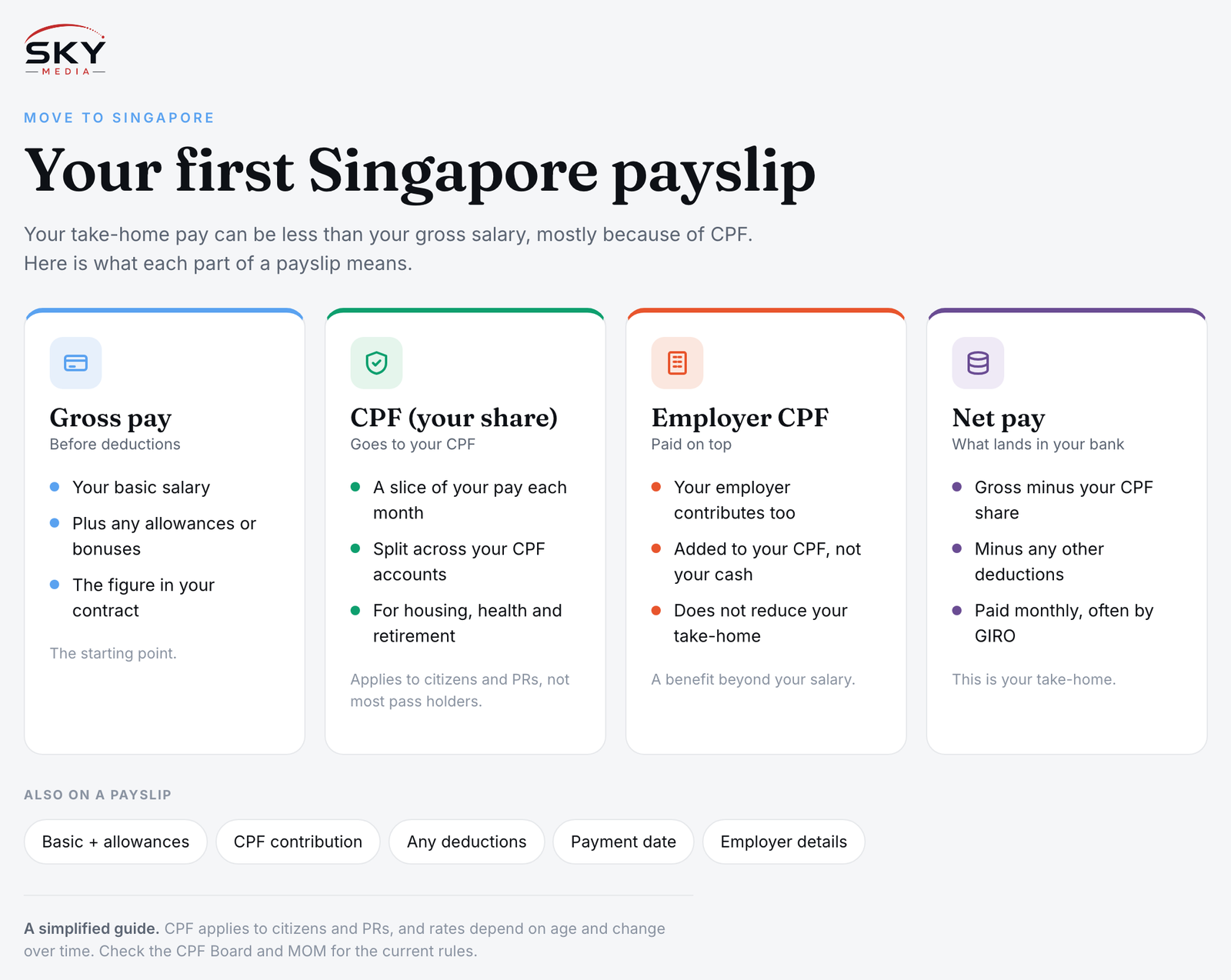
Every employee should get an itemised payslip
Under MOM rules, employers are required to give employees itemised payslips. That means your payslip should not be a single mysterious number, but a breakdown showing your basic pay, any allowances and additions, deductions, and the net amount you actually receive. If you are handed nothing, or just a figure with no detail, that is not how it is meant to work, and you can raise it with your employer or MOM.
An itemised payslip typically shows the pay period, your basic salary, fixed and variable allowances, any overtime, deductions such as CPF where applicable, and your net pay.
The big surprise: income tax is not deducted monthly
In many countries, income tax is withheld from every paycheck. Singapore generally does not work this way. For most employees, income tax is not deducted from your monthly salary. Instead, you file your income tax separately with IRAS, usually once a year, and pay the assessed amount afterwards, often by instalments.
This has two practical consequences for newcomers:
- Your monthly take-home pay can look higher than you expected, because tax has not been removed.
- You need to set money aside for your tax bill rather than assuming it is already handled.
It is worth putting a portion of each paycheck away so the annual tax assessment does not catch you off guard.
CPF: for citizens and Permanent Residents
The Central Provident Fund (CPF) is Singapore’s compulsory savings scheme for retirement, housing and healthcare. Here is the key point for newcomers: CPF applies to Singapore Citizens and Permanent Residents. If you are working on an Employment Pass, S Pass or similar foreign work pass, you do not pay CPF, and you will not see CPF deductions on your payslip.
For those who do contribute:
- Both the employee and the employer make CPF contributions, calculated on your wages up to certain limits.
- The employee portion is deducted from your salary and shown on your payslip.
- The employer portion is paid on top of your salary, not taken from it.
- Contributions are split across accounts used for retirement, housing and healthcare.
If you become a Permanent Resident later, CPF contributions begin, and your take-home pay will change accordingly, so plan for that shift.
Other things you may see
- Skills Development Levy. This is a small levy employers pay for most employees. It is an employer cost and does not reduce your salary, though you may hear it mentioned.
- Allowances. Transport, meal or other allowances may appear as separate lines.
- Overtime pay. Where applicable, overtime is itemised separately from basic pay.
- Annual Wage Supplement or bonus. Often called the AWS or a thirteenth-month payment, this is a common but not universal year-end addition, depending on your contract and company.
- Year-to-date figures. Many payslips show cumulative totals for the year, useful when it is time to file taxes.
Reading it line by line
| Line item | What it is | Who it applies to |
|---|---|---|
| Basic pay | Your core monthly salary | All employees |
| Allowances | Transport, meal and other extras | Depends on your contract |
| Overtime | Extra pay for additional hours | Eligible employees |
| CPF (employee) | Your compulsory savings deduction | Citizens and PRs only |
| CPF (employer) | Employer’s contribution, added on top | Citizens and PRs only |
| Skills Development Levy | Employer-paid levy | Paid by employer, not deducted from you |
| Net pay | What lands in your bank account | All employees |
What to do if it looks wrong
Mistakes happen, especially in your first month when pro-rating and start dates come into play. If something looks off:
- Compare the payslip against your employment contract, especially basic pay and allowances.
- Check whether your first month was pro-rated for a mid-month start.
- If you are a citizen or PR, verify the CPF deduction looks consistent month to month.
- Raise any discrepancy with your HR or payroll team, keeping a copy of your payslip.
- If it is not resolved, MOM provides avenues for employees to seek help.
Plan around the local quirks
The two habits that serve newcomers best are simple. First, because tax is not deducted monthly, set aside a slice of each paycheck for your eventual IRAS bill. Second, if PR is on your horizon, remember that CPF contributions will start and reduce your take-home pay, so do not build your budget around a foreign pass holder’s higher net figure forever. Understand these early, and your Singapore payslip quickly stops being a mystery.
When your salary has to be paid
A payslip only tells half the story if you do not also know when the money is due to land. Under the Employment Act, employers must pay salaries at least once a month, and there are timing rules worth knowing so you can spot a late payment early rather than assume it is normal.
- Regular salary. Your pay should reach you within seven days after the end of the salary period. So if your salary period runs to the last day of the month, payment is generally due within the first week of the following month.
- Overtime pay. Where overtime applies, it must be paid within fourteen days after the end of the salary period, so it can sometimes arrive slightly later than your basic pay.
- Final salary when you leave. If you resign and serve your notice, your last payment is generally due on your final day of employment. Timelines differ if notice is not served in full or if the employment ends in other ways, so check the specifics.
Most employers in Singapore pay directly into your bank account, and many use GIRO. If a payment is late or missing, start with your HR or payroll team, keep your payslip and bank records, and if it is not sorted out, MOM has channels for salary-related claims. For the current rules and any thresholds that apply to your situation, refer to MOM.
What your employer can and cannot deduct
Newcomers sometimes worry when they see a deduction they did not expect. In Singapore, employers cannot simply subtract whatever they like from your pay. The Employment Act sets out which deductions are allowed, and several of them require your prior consent or specific conditions before they can be applied.
Deductions you may legitimately see include CPF (for citizens and PRs), recovery of salary that was overpaid or paid in advance, and amounts you have agreed to in writing, such as for a benefit you signed up for. Deductions for damage or loss, or as a form of penalty, are tightly regulated and generally need due process rather than being imposed on the spot. There are also limits on how much can be deducted in total from a single month’s salary, so a deduction that swallows a large chunk of your pay is a red flag worth questioning.
The practical takeaway is to read every deduction line against your contract and any consent you actually gave. If a deduction is unexplained, ask for the basis in writing before assuming it is correct. When in doubt about whether a particular deduction is permitted, MOM sets out the authorised categories and the safeguards around them.
Explore more: Getting a job in Singapore · Singapore work passes at a glance · Cost of living in Singapore