

If you have just moved from mainland China, ordering dinner to your door is one of the first small comforts you will want back. The good news is that the food delivery apps Singapore residents use work much like Meituan or Ele.me at home: browse nearby stalls and restaurants, add to cart, pay in the app, and track the rider to your block. The names are different and the habits shift a little, but the muscle memory transfers quickly. This is a general guide to the main apps, how they compare to what you knew back home, the fees to expect, and the practical things worth checking before you tap “order”.
The Three Main Apps
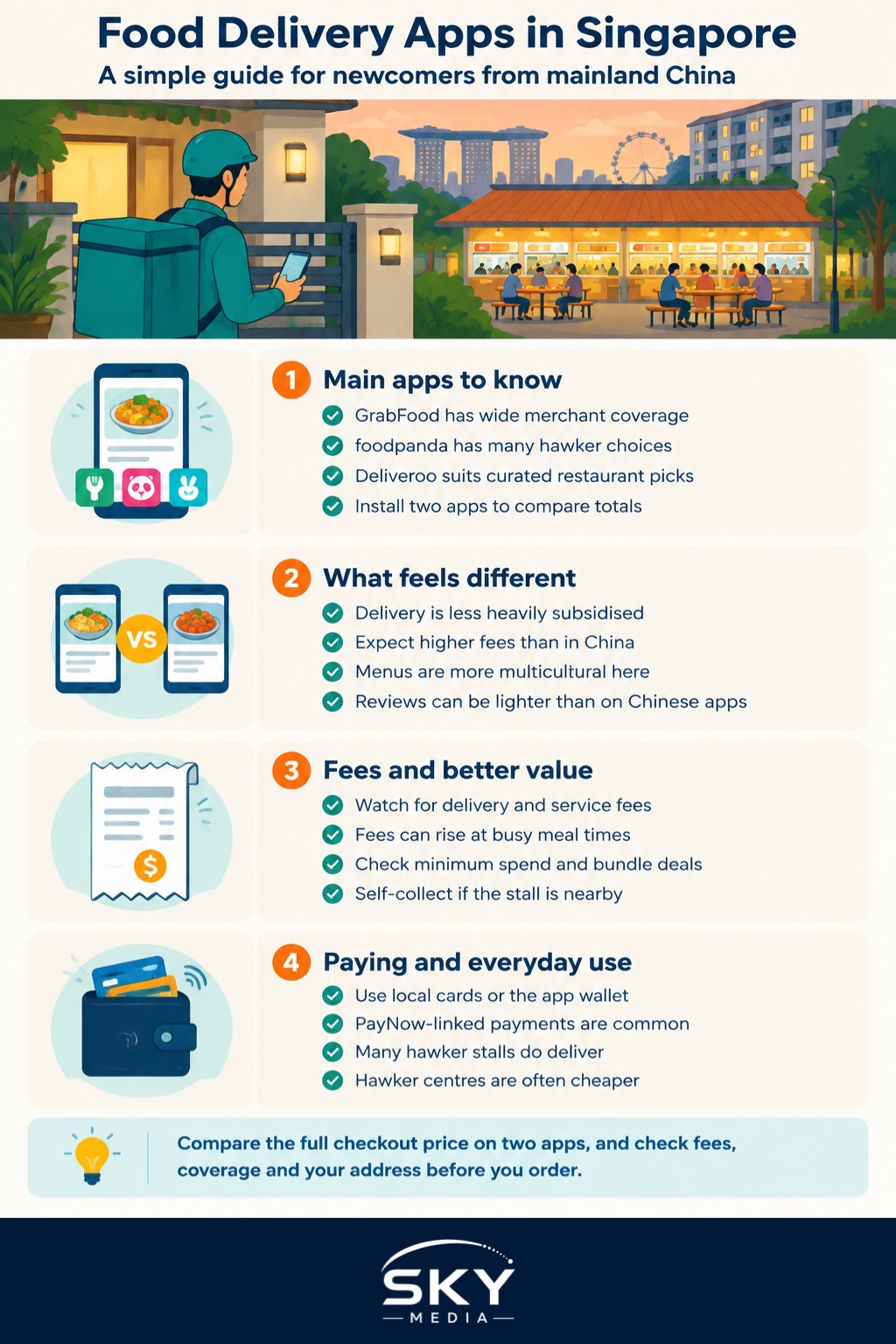
Three services cover most of the island, and many newcomers keep two of them installed to compare prices and coverage.
- GrabFood is part of the wider Grab app, which also does ride-hailing and payments. Because so many people already have Grab for transport, GrabFood tends to have the widest merchant list and strong coverage across neighbourhoods. Think of it as the closest local cousin to Meituan in the way it bundles food, rides and a wallet into one super-app.
- foodpanda is a dedicated food and grocery delivery app, easy to spot by its pink branding. It has a large restaurant and hawker selection and often runs its own promotions and a subscription option for frequent users.
- Deliveroo leans a little more towards restaurants and cafes, and is popular with people who want a curated selection rather than the widest possible net. Coverage can be strongest in central and residential areas near its partner kitchens.
There is no single “best” app. Availability changes by postcode and time of day, so the practical move is to open two and see which one actually shows the stall you want, at the better total price, right now. If you are still deciding which of your home-country apps still work here and which to replace, our overview of which China apps work in Singapore is a helpful starting point.
How They Compare to Meituan and Ele.me
The core experience will feel familiar, but a few differences are worth knowing early.
The biggest shift is scale of choice and price. In many Chinese cities, delivery is extremely cheap and fast because of dense kitchens and heavy subsidies. In Singapore, labour and rent are higher, so expect delivery to feel more like a convenience you pay a little extra for rather than a near-free default. Portion sizes, packaging and rider wait times are broadly comparable, but the “everything in ten minutes” expectation is best left at the border.
Menus are also more multicultural. Alongside Chinese food you will find Malay, Indian, Peranakan and Western options side by side, which is a nice way to explore the local food scene without leaving home. Reviews and ratings exist but tend to be lighter than the detailed review culture on Chinese platforms, so neighbourhood group chats and word of mouth still matter for finding the genuinely good stalls.
| Feature | Singapore apps (GrabFood, foodpanda, Deliveroo) | Meituan / Ele.me (China) |
|---|---|---|
| Typical cost feel | Convenience with visible delivery and service fees | Often very cheap, heavily subsidised |
| Payment | Local cards, PayNow-linked wallets, in-app wallet | Alipay, WeChat Pay |
| Food range | Very multicultural, hawker to restaurant | Huge local selection, dense coverage |
| Rider speed | Reliable, not always ultra-fast | Often very fast in dense cities |
| Super-app tie-in | GrabFood links to rides and GrabPay | Meituan links to many local services |
Rules, fees and app features change, so always confirm the current charges and coverage inside each app before you rely on it.
Fees, Delivery and Getting the Better Deal
Most apps show a few separate charges at checkout: the food price, a delivery fee that varies with distance and demand, and sometimes a small service or platform fee. During busy periods like rain, lunch and dinner peaks, delivery fees usually rise, so ordering a little earlier can save money. Setting a precise delivery address, including your block and unit number, helps riders reach you without calling.
A few habits that help newcomers keep costs sensible:
- Compare total price, not just the food. The cheapest dish on one app can end up dearer after fees.
- Look for minimum-spend free delivery or bundle deals, and consider a subscription only if you genuinely order often.
- Group orders with flatmates or colleagues to spread the delivery fee.
- Self-collect where offered, if a stall is nearby and you want to skip the fee entirely.
It is easy to over-order when everything is a tap away. If you find yourself defaulting to delivery every night, our guide to eating healthily with food delivery has simple ways to keep meals balanced, and our piece on reducing waste from food delivery in Singapore covers cutting down on packaging and asking to skip disposable cutlery.
Hawker Food, Payment and Everyday Use
One question every newcomer asks: can I get hawker food delivered? Often yes. Many hawker stalls and coffee shops (kopitiam) list on the big apps, though not every stall does, since some are tiny family operations. When your favourite stall is not on any app, it is usually a short walk to buy in person, which is also the cheapest way to eat well here.
For payment, you will not use Alipay or WeChat Pay as your default the way you did at home. Instead, link a local debit or credit card, or the app’s own wallet, which you can top up and which often connects to PayNow, Singapore’s instant bank transfer system. To open a local bank account and set up these payment methods, you will usually need your identity documents in order first, so our explainer on the NRIC and FIN explained for newcomers in Singapore is worth reading early. Cash on delivery is far less common than it once was in China, so plan to pay in-app.
A final tip: delivery is a lovely convenience, but Singapore’s hawker centres are part of daily life and often cheaper and fresher eaten there. Use the apps for the rainy nights and the lazy Sundays, and let the neighbourhood stalls tempt you out the rest of the time.
Frequently Asked Questions
Which food delivery app is cheapest in Singapore?
There is no permanent winner. The cheapest total depends on the stall, your address, the time of day and current promotions. The reliable habit is to compare the full checkout price, including delivery and service fees, on two apps before you order.
Can I pay with Alipay or WeChat Pay?
Generally not as your everyday method. Local apps run on cards, their own in-app wallets and PayNow-linked payments. Set up a local bank account and a local card early and the flow becomes seamless.
Can I really get hawker food delivered?
Frequently yes. Many hawker stalls and kopitiam list on GrabFood, foodpanda or Deliveroo, but small family stalls may not, in which case buying in person is cheaper and just as easy.
Do I need Singpass to use delivery apps?
You do not need Singpass to install and order on the apps themselves, but Singpass makes opening the bank account and payment methods behind them far smoother, so it is worth setting up soon after arrival.
Explore More
Getting set up goes faster when your phone is ready first. See our guide to essential apps for Chinese newcomers in Singapore for the transport, payment and Singpass tools that make delivery apps work smoothly. If you would rather cook, our overview of Chinese supermarkets and groceries in Singapore shows where to find familiar ingredients close to home.
Further reading: Tingkat and Tiffin Food Delivery in Singapore · Food Delivery in Singapore: Apps and How to Save