

An invitation to a gallery opening in Singapore can feel exciting and slightly intimidating at the same time. You may not know anyone, you are unsure whether you need to buy something, and you have no idea what people actually do for two hours in a white room with wine. The good news is that exhibition openings here are generally relaxed, welcoming events, and the unwritten rules are easy to learn.
This guide focuses on the social side: how invitations and RSVPs work, what happens on the night, how to talk to artists and gallerists, and the small courtesies that make you a welcome guest. If you want a primer on the galleries themselves, start with our overview of art galleries and the National Gallery in Singapore.
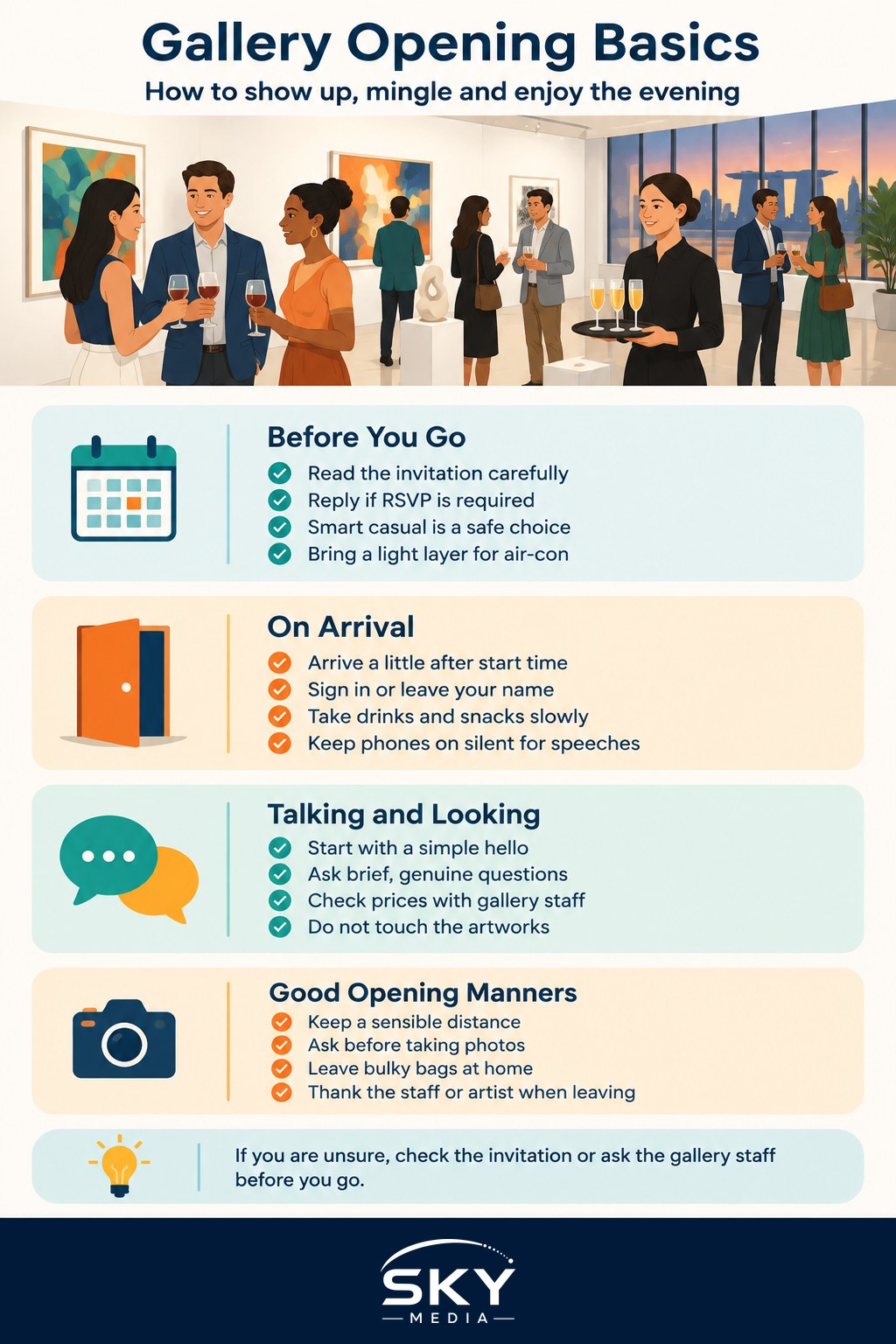
What a Gallery Opening Actually Is
An opening (sometimes called a vernissage, private view or preview) is the first evening an exhibition is shown to the public. It is part celebration, part networking event and part chance to see the work before the crowds. Commercial galleries, artist-run spaces, museums and arts centres all hold them, and the tone varies:
- Commercial galleries sell the artworks on show. Openings bring together collectors, the artist’s friends, curators and curious visitors.
- Artist-run and independent spaces tend to be more casual and community driven, often with younger crowds and experimental work.
- Museums and institutions may hold larger launches with speeches, a guest-of-honour and a more structured programme.
Most openings run for a few hours in the early evening on a weekday or weekend. The time on the invitation is a window, not a start time you must hit exactly.
Invitations and RSVP Norms
Many openings in Singapore are free and open to anyone who turns up, while others are by invitation or ask you to register in advance. Read the invitation or event listing carefully, because the wording tells you what is expected.
- “All are welcome” or “free admission”: you can usually walk in without registering.
- “RSVP required” or “by invitation”: reply by the date given. Capacity, catering and building security may depend on numbers.
- “Plus one”: only bring a guest if the invitation clearly allows it. If unsure, ask the gallery by email rather than assuming.
- Ticketed launches: some institutional or fair events charge for entry. Check the official event page for current details, as arrangements change from year to year.
If you RSVP and then cannot go, a short note to cancel is good manners and frees a spot for someone else. Galleries often keep a mailing list, so signing up through their website or social media is the simplest way to hear about future openings.
Before You Go and What to Wear
There is no strict dress code at most Singapore openings. Smart casual is the safe default: neat trousers or a skirt, a shirt, blouse or simple dress, and clean shoes. Some crowds dress more creatively, and nobody will mind if you do too.
A few practical points help:
- Galleries are usually air-conditioned and can feel cool after the heat outside, so a light layer is useful.
- Leave bulky bags at home if you can. Large backpacks are easy to swing into artworks in a crowded room.
- Check the location and transport in advance. Many galleries sit in clusters, in shophouse districts or in converted buildings where the entrance is not obvious.
- Eat beforehand. Drinks and bites, if served, are not dinner.
Arriving 20 to 40 minutes after the stated start is common. Speeches, if any, often happen in the middle of the evening, so ask a staff member if you want to catch them.
What Happens on the Night
Most openings follow a loose pattern. You arrive, perhaps sign a guest book or check in at the front desk, pick up a drink if offered and the exhibition text or room sheet, then wander. Later there may be a short welcome from the gallery, a curator or the artist, followed by more mingling. People drift away gradually towards the end.
The table below sets out common moments and what is expected of you.
| Moment | What usually happens | What you should do |
|---|---|---|
| Arrival | Staff greet guests; there may be a check-in desk or guest book | Give your name if you RSVPed; sign the book if you want to hear about future shows |
| Drinks and bites | Wine, soft drinks or snacks may be offered | Take one at a time, keep drinks well away from the walls and plinths |
| Viewing the work | Guests move around the room, read the text and chat | Look properly, follow any “do not touch” signs, give others space to see |
| Speeches | A short welcome and thanks, sometimes a guest-of-honour | Stop talking, put your phone on silent, applaud at the end |
| Mingling | Small groups form around the artist, curator and regulars | Introduce yourself briefly and join conversations politely |
| Leaving | People drift off over the final hour | Thank the gallery staff or artist on your way out if you spoke with them |
Talking to Artists and Gallerists
Many newcomers worry about this part the most, but artists generally enjoy hearing from people who have looked closely at the work. You do not need art-world vocabulary.
- Start simply. “Congratulations on the show” is a perfect opener. Follow with a genuine question, such as how long a piece took or what started the series.
- Keep it short when it is busy. The artist will be pulled in many directions. A few minutes is plenty, and you can always email or return during regular hours.
- Ask about prices discreetly. In commercial galleries, there is usually a price list available at the desk or on request. Asking the gallery staff, not the artist, is the norm. Asking does not commit you to anything.
- Do not critique loudly. Share honest opinions with friends quietly, away from the artist and their guests.
- Exchange contacts naturally. Business cards and social media handles are both common.
If you are interested in buying, tell the gallery staff. Sales conversations are their job, and they can explain how reservations, deposits and delivery work for that particular gallery.
Photos, Phones and Behaviour Around the Work
Photography policies differ by gallery and by exhibition. Many allow phone photos without flash for personal use and are happy to be tagged on social media. Others restrict photography for certain works. Look for signs or simply ask.
Other courtesies matter just as much:
- Never touch artworks unless the exhibition text invites you to. Even a light fingerprint can damage some surfaces.
- Keep a sensible distance, especially with a drink in hand or a bag on your shoulder.
- Watch children closely if they are with you and the event is family friendly. Agree on “look, don’t touch” before you go in.
- Keep calls outside and keep your voice at conversation level.
Making the Most of Openings as a Newcomer
Openings are one of the easiest ways to meet people in Singapore’s creative community, and regulars quickly start to recognise friendly faces. A few habits help:
- Go to a cluster of openings on the same evening, which is common during art week periods, to get a feel for different spaces.
- Bring a friend to your first few events.
- Return during regular gallery hours to see the work properly without the crowd.
- Follow galleries and institutions you like so you hear about talks, tours and future shows.
For museum-scale viewing beyond the opening crush, our National Gallery Singapore guide explains how to plan a longer visit. Once you have been to a couple of openings, the routine will feel familiar, and you will likely find yourself chatting to artists, curators and fellow visitors as easily as the regulars do.
Further reading: The Singapore Biennale: How to Visit and Make Sense of It