
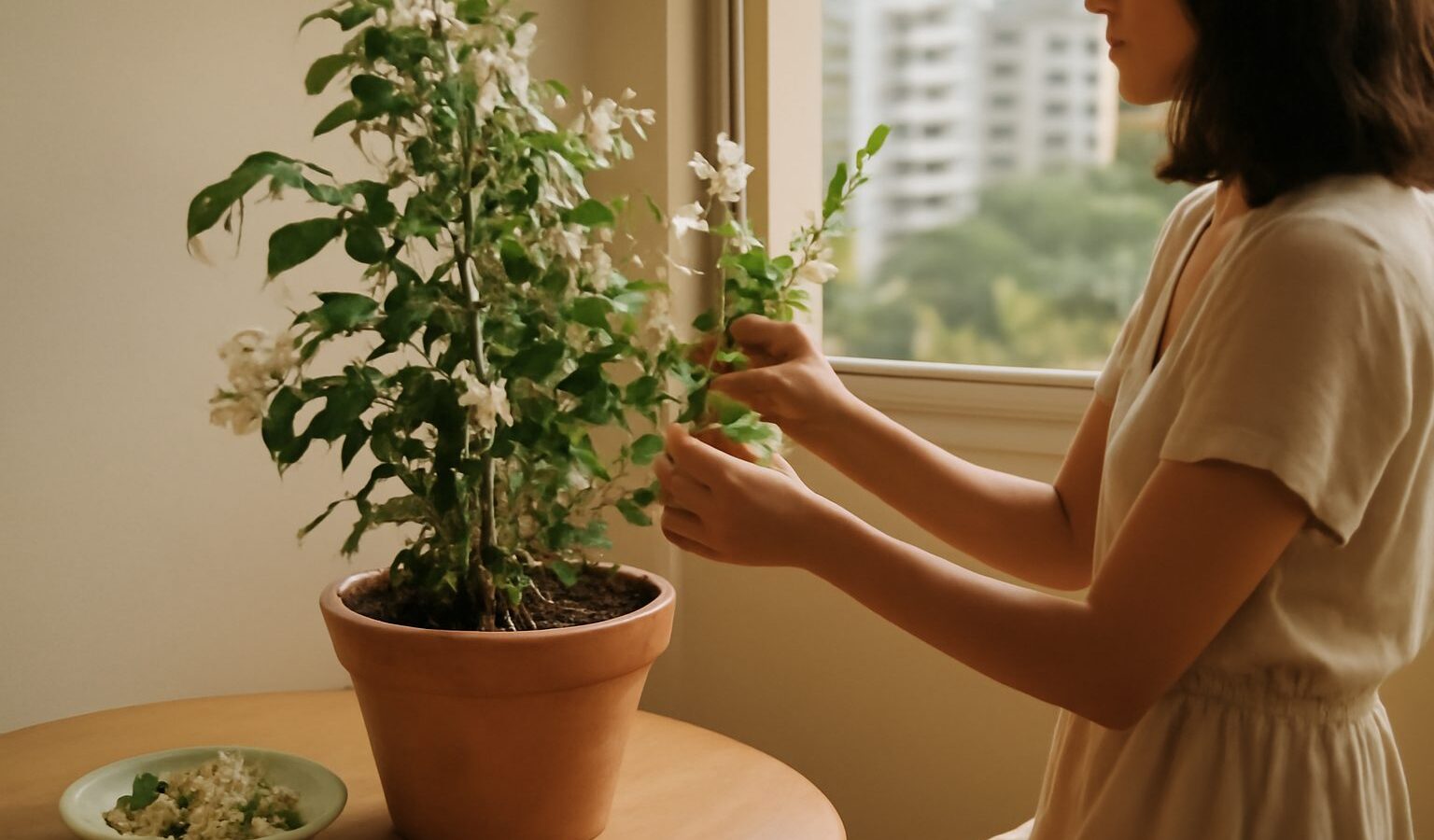
There is something special about a balcony that greets you with scent in the evening air. Growing jasmine and other fragrant climbers turns a plain railing or trellis into a living, perfumed screen, and many of these vines relish our warm, humid climate. Jasmine in particular has a long cultural place in this part of the world, from garlands to tea. This guide is for anyone who wants reliable fragrance without fuss: how much sun climbers need, how to water and support them, when they release their scent, and how a little pruning keeps the flowers coming all year in Singapore.
Jasmine and Other Fragrant Climbers to Try
“Jasmine” covers several different plants, and a few other scented climbers grow just as happily here. Knowing the differences helps you pick the right one for your space and your nose.
- Common or Arabian-type jasmine, often linked with the fragrant white flowers used in garlands and tea, is a compact, bushy climber with an intense evening scent.
- Star jasmine gives masses of small, pinwheel white flowers and a sweet perfume, and it trains neatly along a trellis or railing.
- Some fragrant climbers are not true jasmines at all but share the perfumed, climbing habit, and they thrive in the same warm, bright conditions.
All share a few things: they want warmth, which we have in abundance, they climb or scramble and so need support, and they flower best with good light. Because they are vigorous in the tropics, most reward regular light pruning with more blooms rather than resenting it.
Do note that not every plant sold as a scented climber is edible or safe to nibble, so grow these for their perfume and beauty, not for eating, unless you have positively confirmed a particular plant is a food species.
Sun, Soil and Watering for Reliable Blooms
The single biggest factor in whether your climber flowers well is light. Fragrant climbers are sun lovers. Aim for at least four to six hours of direct sun a day on a bright balcony, ledge or by a sunny railing that follows your town council rules for common areas. In deep shade they grow leafy and green but produce few flowers, and it is flowers you are after.
Get the growing basics right and the rest is easy:
- Plant in a good-sized pot with drainage holes, using a quality potting mix enriched with compost.
- Water when the top few centimetres of soil feel dry. In our heat that may be daily for a pot in full sun, less during a wet monsoon spell.
- Do not let the pot stand in a saucer of water. Tip out any saucer after watering or rain, both to protect the roots and to avoid leaving standing water where mosquitoes can breed.
- Feed regularly during active growth with a balanced fertiliser, easing toward a bloom-friendly feed when you want more flowers.
Consistency matters more than volume. A climber that dries out to the point of wilting, then gets flooded, will drop buds and sulk. Steady moisture and steady light give steady flowers.
Giving Your Climber Support to Climb
A climber needs something to climb, and setting up support early saves a tangle later. These plants twine or scramble, so give them a structure to grab.
- A trellis panel fixed to a balcony wall or railing is the classic choice and creates a green, scented screen.
- Netting, wires or a simple bamboo frame all work, and are easy to fit on an HDB or condo balcony.
- Guide the young shoots onto the support and tie them loosely with soft ties, checking that ties never bite into thickening stems.
- As the plant grows, keep weaving or tucking new growth into the frame so it covers evenly rather than bunching in one spot.
Think about where the scent will drift. Positioning a fragrant climber near a window, a doorway or a favourite seating corner means you actually enjoy the perfume in the evening, when many jasmines release their strongest scent. Growing upward also saves precious floor space, which is gold on a compact balcony. For bolder daytime colour to sit alongside your scented greenery, a sun-loving bougainvillea trained on the same railing makes a striking pairing.
When Fragrance Peaks and How to Keep It Coming
Part of the charm of jasmine is its timing. Many fragrant climbers release their strongest perfume in the evening and into the night, a natural strategy to attract night-flying pollinators. That means the reward for your care often arrives just as you sit out after a hot day.
To keep the flowers and fragrance coming, pruning is your main tool:
- After a flush of flowers fades, trim back the stems that have bloomed. This tidies the plant and encourages fresh shoots that carry the next round of buds.
- Do not be timid. In our year-round growing season these climbers regrow quickly, and regular light pruning keeps them bushy and floriferous rather than a bare, woody tangle.
- Pinch out the growing tips of young plants to encourage branching and a fuller shape.
- Remove any dead or crossing stems to keep good airflow, which matters in our humidity.
If your climber grows lush and green but stubbornly refuses to bloom, the usual culprit is too little sun, followed by too much high-nitrogen feed. Our guide on how to get your plants to flower walks through the fixes in detail.
Quick Care Comparison for Popular Fragrant Climbers
Different scented climbers suit different spots and personalities. This table helps you match one to your balcony.
| Climber | Fragrance and flowers | Care level and best use |
|---|---|---|
| Arabian-type jasmine | Intense sweet evening scent, small white blooms | Easy, loves heat, great near a window or seat |
| Star jasmine | Sweet perfume, masses of small white pinwheels | Easy, trains neatly on a trellis screen |
| Vigorous scented vine | Perfumed, fast, needs firm support | Best for covering a large trellis or railing |
| Compact scented shrub-climber | Fragrant, more restrained growth | Good for smaller pots and tighter balconies |
Whichever you choose, the recipe is the same: plenty of sun, steady watering with no standing water left behind, a sturdy trellis to climb, and regular light pruning to keep the blooms coming. Do that, and growing jasmine and fragrant climbers will turn even a small Singapore balcony into a fragrant retreat. For an edible, colourful climber to grow alongside them, our guide to growing butterfly pea flowers is a natural next step.