
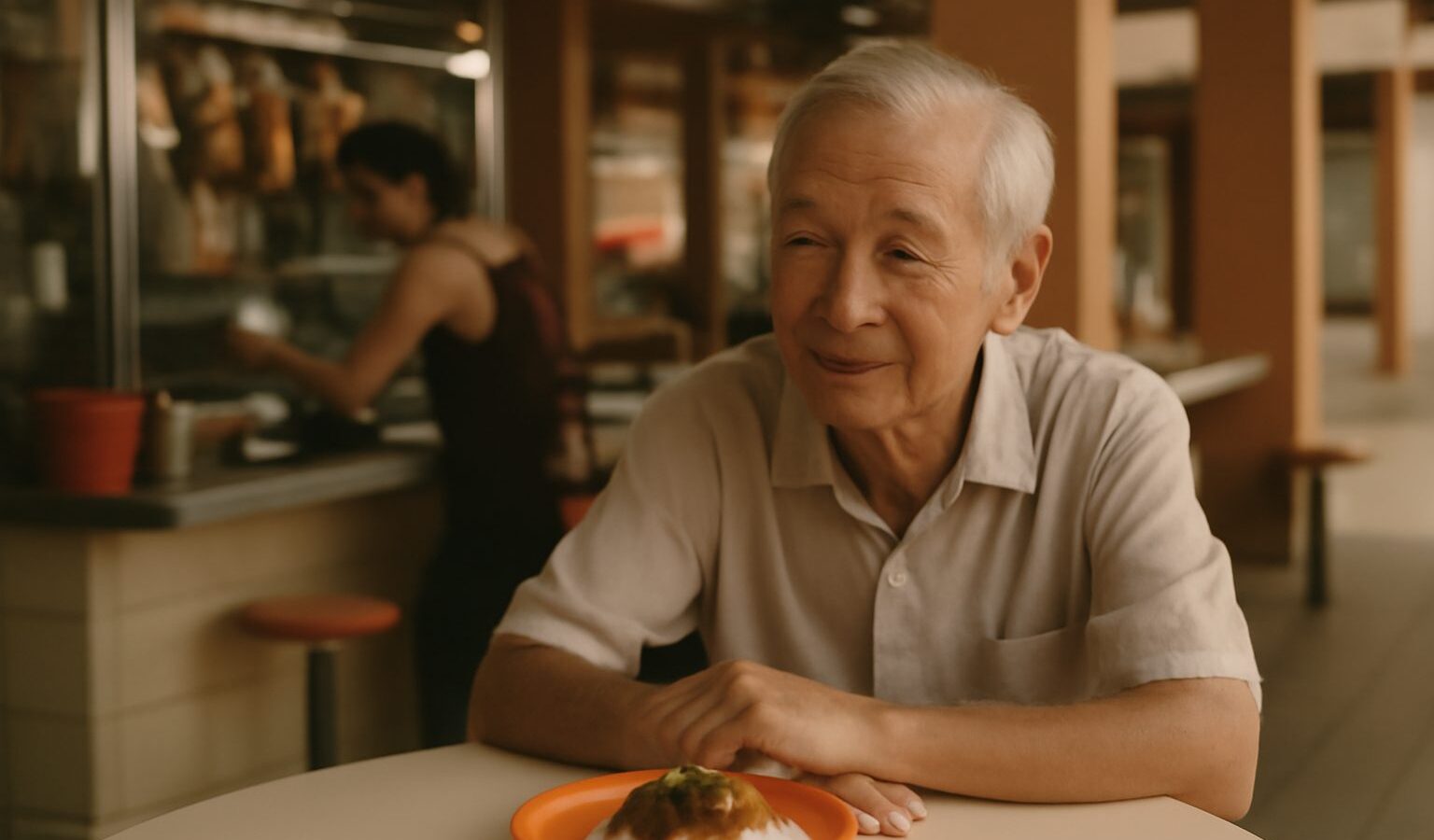
The history of hawker culture in Singapore is the story of how a city fed itself, and in doing so built one of its most beloved shared spaces. From itinerant vendors carrying their kitchens on a pole to the bustling hawker centres of today, this tradition has grown into a marker of national identity, recognised as intangible cultural heritage on the world stage.
Street hawkers in early Singapore
Long before hawker centres existed, hawkers worked the streets. As a busy port drew migrants from across the region, many with little capital turned to selling food to make a living. They carried their trade with them: a pole balanced across the shoulders with a stove at one end and ingredients at the other, or a simple pushcart parked along a five-foot way.
These vendors fed labourers, coolies, rickshaw pullers, and clerks who had no kitchens of their own and needed cheap, quick meals. The food reflected the sellers’ own heritage. Chinese, Malay, and Indian hawkers each brought their dishes, and over time these influences met and mingled, giving rise to the cross-cultural plates that define local food today.
Street hawking was affordable and flexible, but it was also difficult to regulate. Food was prepared in the open, water and waste were hard to manage, and the crowded streets raised real concerns about hygiene and congestion.
The move indoors: the birth of hawker centres
To address these problems while preserving people’s livelihoods, the approach over the years shifted from clearing hawkers away to housing them properly. Licensing brought vendors into the system, and purpose-built hawker centres gave them fixed stalls with running water, proper drainage, and waste disposal.
This move indoors changed the experience without erasing the food. The same recipes that once travelled by pushcart now had a permanent address. Hawker centres, often paired with wet markets, became fixtures of housing estates, so that affordable cooked food sat within walking distance of most homes.
The result was a distinctly Singaporean institution: a shared, open-air dining hall where a single roof shelters dozens of stalls, and where people from every background eat side by side.
Why hawker centres became more than food
A hawker centre is not only a place to eat cheaply. It became a “community dining room”, a phrase often used to describe its social role. Several qualities set it apart.
| Feature | What it means |
|---|---|
| Affordability | Complete meals at prices most can manage |
| Variety under one roof | Chinese, Malay, Indian, and other dishes side by side |
| Shared seating | Strangers of all backgrounds eat at common tables |
| Everyday gathering | A daily meeting place across classes and generations |
| Living food heritage | Recipes and skills passed down at the stall |
Because a meal is inexpensive and everyone is welcome, the hawker centre levels differences. A retiree, an office worker, and a family with young children may share a table. This openness is a large part of why the culture is treasured, and why it is seen as reflecting the multicultural society around it.
The people behind the stalls
Hawker culture rests on the hawkers themselves. Many have cooked the same dish for decades, refining a single recipe until regulars travel across the island for it. Their skills are often learned by watching and helping, passed from an older generation to a younger one at the stall rather than in a classroom.
This model carries a challenge. As long-serving hawkers age, questions arise about who will take over the demanding, long-hour work of running a stall. Efforts to encourage new hawkers, apprenticeships, and support for the trade all respond to a concern that some recipes and skills could be lost if no one inherits them.
Kopi, tea, and the wider food landscape
Hawker culture also overlaps with the kopitiam, the traditional coffee shop, where a drinks stall serving kopi and tea anchors a cluster of food stalls. Together, hawker centres and kopitiams form the everyday backbone of eating out in Singapore, distinct from restaurants yet central to daily life.
Recognition as intangible cultural heritage
The importance of hawker culture has been recognised beyond Singapore’s shores. Hawker culture in Singapore was inscribed on UNESCO’s Representative List of the Intangible Cultural Heritage of Humanity. This recognition honours not any single dish, but the living practice as a whole: the community dining, the multicultural mix of food, and the role of hawker centres in everyday life.
Inscription is a form of acknowledgement and a spur to safeguarding. It highlights the culture’s value and encourages efforts to keep it alive for future generations, from supporting hawkers to celebrating the centres as heritage rather than treating them as merely functional.
Hawker culture today
Modern hawker centres continue to evolve. Newer ones may feature different management models, cashless payment, and updated designs, while older, much-loved centres draw crowds for their long-established stalls. Some younger hawkers bring fresh ideas and fusion dishes, sitting alongside veterans who keep to traditional recipes.
Through all this change, the essentials hold. The food remains affordable, the mix of cuisines remains broad, and the shared table remains open to all.
Enjoying hawker centres with respect
- Return your tray after eating, keeping tables clear for the next diners.
- Be patient with popular stalls, where queues are a sign of quality.
- Try dishes across different cuisines; the variety is the whole point.
- Support long-serving hawkers, whose skills are part of the heritage.
A shared table worth keeping
The history of hawker culture in Singapore runs from a pole across the shoulders to a UNESCO listing, yet its heart has stayed the same. It is about feeding everyone well and affordably, and about a common table where the whole society meets. To value hawker culture as heritage is to recognise that these humble food halls carry the memory, the flavours, and the everyday togetherness of the nation.
Explore more: Kopitiam history in Singapore · Wet markets in Singapore: a guide · Traditional Chinese customs in Singapore