

Singapore is known for excellent healthcare, with modern hospitals, well-trained doctors and short waits by international standards. For newcomers, the important thing is to understand how the system is structured, how you access care, and how you pay, because the rules differ depending on whether you are a citizen, a Permanent Resident or a foreign pass holder. This guide gives you the practical map.
This is a general overview, not medical or financial advice. Schemes and costs change, so confirm current details with the Ministry of Health (MOH) and your insurer.
How the system is structured
Singapore’s healthcare has a public and a private side, and both are of high quality.
- Polyclinics are government-subsidised clinics offering everyday medical care, health screening and follow-ups, often at lower cost but sometimes with longer waits.
- GP clinics are private general practitioners found in almost every neighbourhood, convenient for minor illnesses, prescriptions and referrals, usually with little waiting.
- Public hospitals handle more serious conditions and emergencies, with subsidised rates for eligible residents.
- Private hospitals and specialists offer more comfort and choice at higher cost.
For a cough, a fever or a minor issue, a neighbourhood GP is usually the quickest and easiest first stop.
The big difference: who pays how
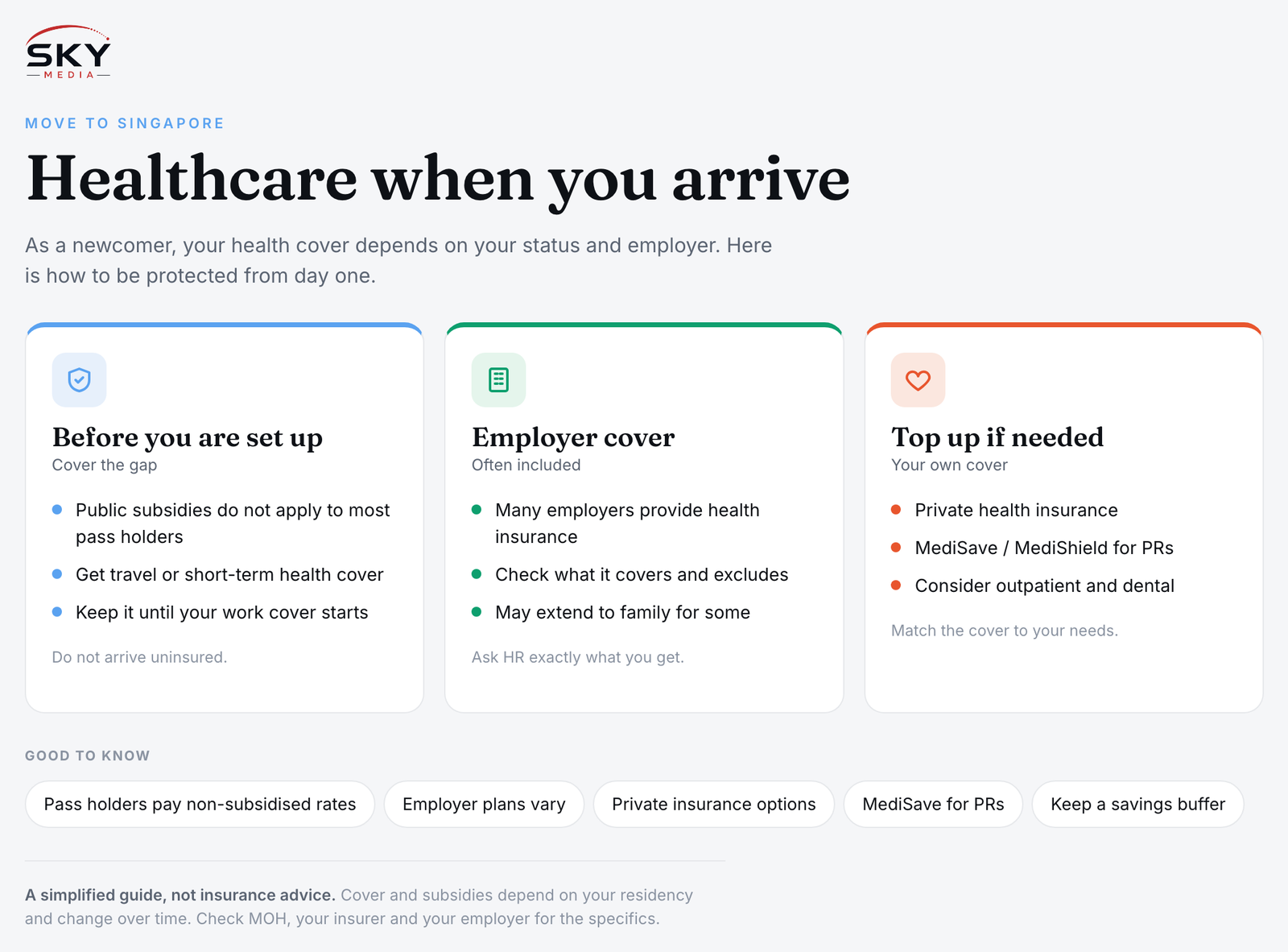
This is the part newcomers most need to understand. Singapore has national medical savings and insurance schemes, but they apply to citizens and Permanent Residents, not to foreign pass holders.
- MediSave is a national medical savings scheme, part of CPF, used to pay for certain healthcare costs. It is for citizens and PRs.
- MediShield Life is a national health insurance scheme that helps with large hospital bills, again for citizens and PRs.
- Foreign pass holders, such as those on an Employment Pass, S Pass or Dependant’s Pass, do not have MediSave or MediShield Life. Instead, they rely on private health insurance, very often provided or required by their employer.
If you are moving on a work pass, check your employment package carefully to see what medical insurance is included, and consider topping up with private cover for anything important to you, such as outpatient care, dental or maternity.
Registering with a GP
You do not formally need to register with a single doctor to get care, since you can visit most GP clinics as a walk-in. That said, finding a regular family GP near your home is worth doing early. A doctor who knows your history is invaluable when you are unwell, and it makes referrals to specialists smoother. Look for a clinic close to home or work, note its opening hours, and keep its details saved.
For eligible residents, MOH has been rolling out a national programme, Healthier SG, which encourages enrolling with a regular family doctor for preventive and long-term care. Eligibility and details are set by MOH, so check whether it applies to you.
Emergencies and urgent care
Know your options before you need them.
- For a life-threatening emergency, go to a hospital Accident and Emergency department, or call for an ambulance.
- For urgent but not critical issues, many GP clinics offer extended hours, and some areas have urgent care options.
- For minor ailments, a regular GP visit during the day is usually the most efficient and affordable path.
Keep the location of your nearest hospital and a 24-hour clinic noted in your phone.
Prescriptions, dental and maternity
- Prescriptions are typically dispensed at the clinic or hospital where you are seen, and pharmacies are widely available for over-the-counter needs.
- Dental care is mostly private for adults, so factor it into your insurance or budget. Routine check-ups are easy to arrange.
- Maternity care ranges from public to private, with a wide span of costs. If you are planning a family, review what your insurance covers well in advance.
Care settings at a glance
| Care setting | What it is for | Who can use it | Rough cost level |
|---|---|---|---|
| GP clinic | Minor illness, prescriptions, referrals | Everyone | Low to moderate |
| Polyclinic | Everyday care, screening, follow-ups | Everyone, subsidies for eligible residents | Low, subsidised for citizens and PRs |
| Public hospital | Serious conditions, emergencies | Everyone, subsidies for eligible residents | Moderate to high, lower for eligible residents |
| Private hospital or specialist | Choice, comfort, faster access | Everyone with means or insurance | High |
Practical tips for newcomers
- Sort out insurance first. Before anything else, know exactly what your health cover includes and what it does not. This is the single most important step for a foreign pass holder.
- Keep your records. Bring vaccination records and any important medical history, and keep new records organised as you go.
- Have a first-aid basics kit and know where the nearest clinic and pharmacy are.
- Ask about costs upfront at private providers, since prices vary and you are often paying out of pocket or claiming later.
The reassuring part
Once you know the structure, Singapore’s healthcare is genuinely easy to use. Clinics are everywhere, standards are high, and getting seen is usually quick. The key task for a newcomer is not learning to navigate a maze, but making sure your insurance is sorted, since that is what protects you from large bills. Do that early, find a nearby GP you trust, and you can relax knowing good care is close at hand.
How to choose the right health insurance
Because foreign pass holders rely on private cover rather than the national schemes, choosing a plan well matters more here than almost anywhere else in your move. Employer-provided insurance is a good start, but it is often built around hospitalisation and may leave gaps you only notice when a bill arrives. Before you commit, read the policy wording rather than the marketing summary, and weigh a few things that newcomers frequently overlook.
- Inpatient versus outpatient. Many basic plans cover hospital stays well but include little for everyday GP visits, so ask whether outpatient care is included or needs a rider.
- Pre-existing conditions. Confirm in writing how anything you were treated for before arriving is handled, as exclusions are common and vary widely between insurers.
- Panel and reimbursement. Some plans only pay in full at listed clinics, while others let you claim afterwards. Understand how you pay on the day and how you get money back.
- Family and life stages. If you plan to have children or want dental and specialist cover, check limits and waiting periods early rather than at the point of need.
Permanent Residents can also look into an Integrated Shield Plan, which builds private hospital cover on top of MediShield Life. Terms and eligibility are set by the CPF Board and MOH, so confirm the current details before deciding.
Common mistakes newcomers make
Most healthcare stress for newcomers comes not from the system itself, which is efficient, but from a handful of avoidable slip-ups. The biggest is assuming an employer plan covers everything, then discovering an exclusion mid-treatment. Others let a policy lapse during a job change, leaving a dangerous gap in cover. Some head straight to a private hospital A and E for a minor complaint that a neighbourhood GP could handle far more cheaply and quickly. A few forget to bring vaccination or medical records from home, which slows follow-up care. Sort your cover first, keep your documents together, match the care setting to the problem, and these problems simply do not arise.
Explore more: Where to go for healthcare in Singapore · Moving to Singapore checklist · Cost of living in Singapore