
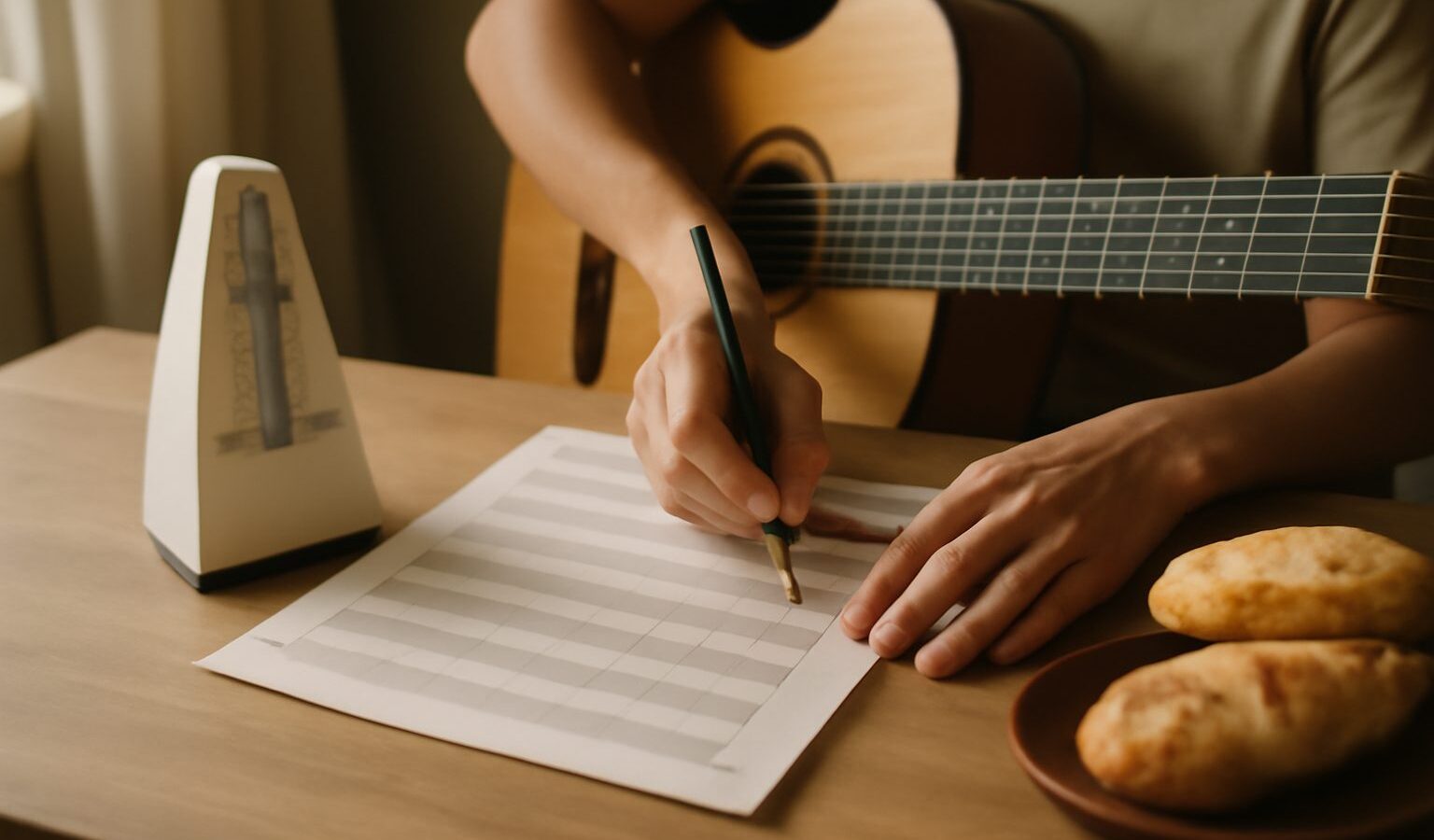
Counting rhythm is the skill that keeps your playing in time, lets you read new music with confidence, and helps you lock in with other musicians. Many players can hum a tune but fall apart the moment the rhythm gets tricky, and almost always the fix is learning to count and subdivide properly. This guide gives you a clear, practical system.
Why Counting Matters
Pitch tells you which note to play. Rhythm tells you when to play it and how long to hold it. You can play every correct pitch and still sound wrong if the timing is off, yet rhythm is often the part beginners neglect. Learning to count out loud turns vague guessing into something exact and repeatable.
Counting also builds an internal clock. Once you can keep a steady pulse in your head, you no longer depend entirely on a metronome or a bandmate to hold you together. That inner sense of time is one of the clearest signs of a confident musician.
Note Values and the Pulse
Everything starts with the beat, the steady pulse you tap your foot to. Note values describe how many beats a note lasts relative to that pulse. In common four beat time the main values are as follows.
- A whole note lasts four beats.
- A half note lasts two beats.
- A quarter note lasts one beat.
- An eighth note lasts half a beat, so two fit in one beat.
- A sixteenth note lasts a quarter of a beat, so four fit in one beat.
Rests follow the same values but tell you to stay silent for that length. A quarter rest is one beat of silence, and so on. Reading rests accurately is just as important as reading notes, because the gaps shape the rhythm as much as the sounds.
What Subdivision Means
Subdivision is the habit of mentally dividing each beat into smaller equal parts, even when you are playing longer notes. Instead of only feeling “one, two, three, four”, you feel the smaller pulses inside each beat. This is the single most useful rhythm skill you can build, because it keeps long notes from being cut short and fast notes from rushing.
Think of subdivision as a grid running underneath the music. When you feel that grid, every note has a clear place to land. Without it, you are guessing at the spaces between beats, which is where most timing errors happen.
A Simple Counting System
Here is a reliable way to count each level of subdivision out loud. Say the numbers for the main beats, then add syllables for the divisions.
| Subdivision | How to count one bar | Notes per beat |
|---|---|---|
| Quarter notes | 1, 2, 3, 4 | One |
| Eighth notes | 1 and 2 and 3 and 4 and | Two |
| Sixteenth notes | 1 e and a 2 e and a 3 e and a 4 e and a | Four |
| Triplets | 1 trip let 2 trip let 3 trip let 4 trip let | Three |
For sixteenth notes the syllables are usually said as “one ee and uh”. For triplets, three even notes fill a single beat, which is a different feel from the even divisions above. Practise saying each row slowly and evenly before you try to play anything.
How to Practise Counting
Counting is a skill you drill, not a fact you memorise. Work through these steps in order.
- Count out loud first. Before playing a new passage, tap the pulse and say the counting aloud with no instrument. Only add the instrument once the counting is steady.
- Use a metronome. Set a slow tempo and count along so the clicks line up with your main beats. A metronome is the honest reference that shows whether you are truly steady. Start slow and speed up only when a tempo feels easy.
- Keep the subdivision going. Even during a long held note, keep the smaller pulse ticking in your head. This stops you from cutting the note short or coming in early on the next one.
- Clap rhythms away from your instrument. Clapping removes the challenge of notes and fingers so you can focus purely on time. Clap the rhythm, count aloud, then move to the instrument.
- Isolate the hard bar. When one bar keeps tripping you up, loop just that bar slowly with counting until it is secure, then join it back to the passage.
Counting in Other Time Signatures
Not all music sits in four beats. In three beat time you count “one, two, three” per bar, common in waltzes. In compound time such as six eight, the beat divides into groups of three, and a common feel is two main pulses each split into three, counted “one two three four five six” or grouped as “one trip let two trip let”. The core idea never changes though. Find the main pulse, decide how each beat divides, and keep that subdivision running underneath.
Common Mistakes
The most frequent error is only counting the beats you play and ignoring the rests and the gaps. Silence has length too, and skipping over it throws off everything that follows. Count through the rests just as carefully as the notes.
Another common problem is rushing the fast notes and dragging the long ones. This is almost always a subdivision failure. When you feel the small grid clearly, fast passages stop feeling like a scramble and long notes get their full value.
A third mistake is abandoning counting once a piece feels familiar. Even when you know a piece well, a quiet mental subdivision keeps your timing honest, especially under the pressure of a performance.
Bringing It Together
Counting rhythm is not a beginner chore you leave behind, it is a lifelong tool that keeps your playing accurate and your ensemble tight. Learn your note values, feel the pulse, and above all keep a steady subdivision running underneath everything you play. Practise slowly with a metronome, count aloud until it becomes automatic, and be patient. Solid timing takes time to build, but once it is yours, every other part of music gets easier.
Explore more: Understanding rhythm and time signatures · Practising with a metronome · Music theory basics for beginners