

Somewhere along the way, many of us started to think of learning as something that ends. You finish school, you finish your studies, you get the certificate, and that is that. But the mind does not close for business at graduation, and neither does the world stop changing. Lifelong learning in Singapore, a place that prizes education yet moves fast enough to make yesterday’s skills feel dated, is less about chasing more qualifications and more about staying curious, capable, and open for the whole of your life. The good news is that it is available to anyone, at any age, on any budget. It asks for curiosity far more than it asks for money.
Let us be honest about one thing first. Lifelong learning is often sold as effortless joy, all wonder and no work. Real learning takes effort. It involves being a beginner, feeling awkward, and sometimes being bored or frustrated before things click. Embracing it does not mean pretending that is fun. It means deciding the effort is worth it, and finding a pace you can sustain.
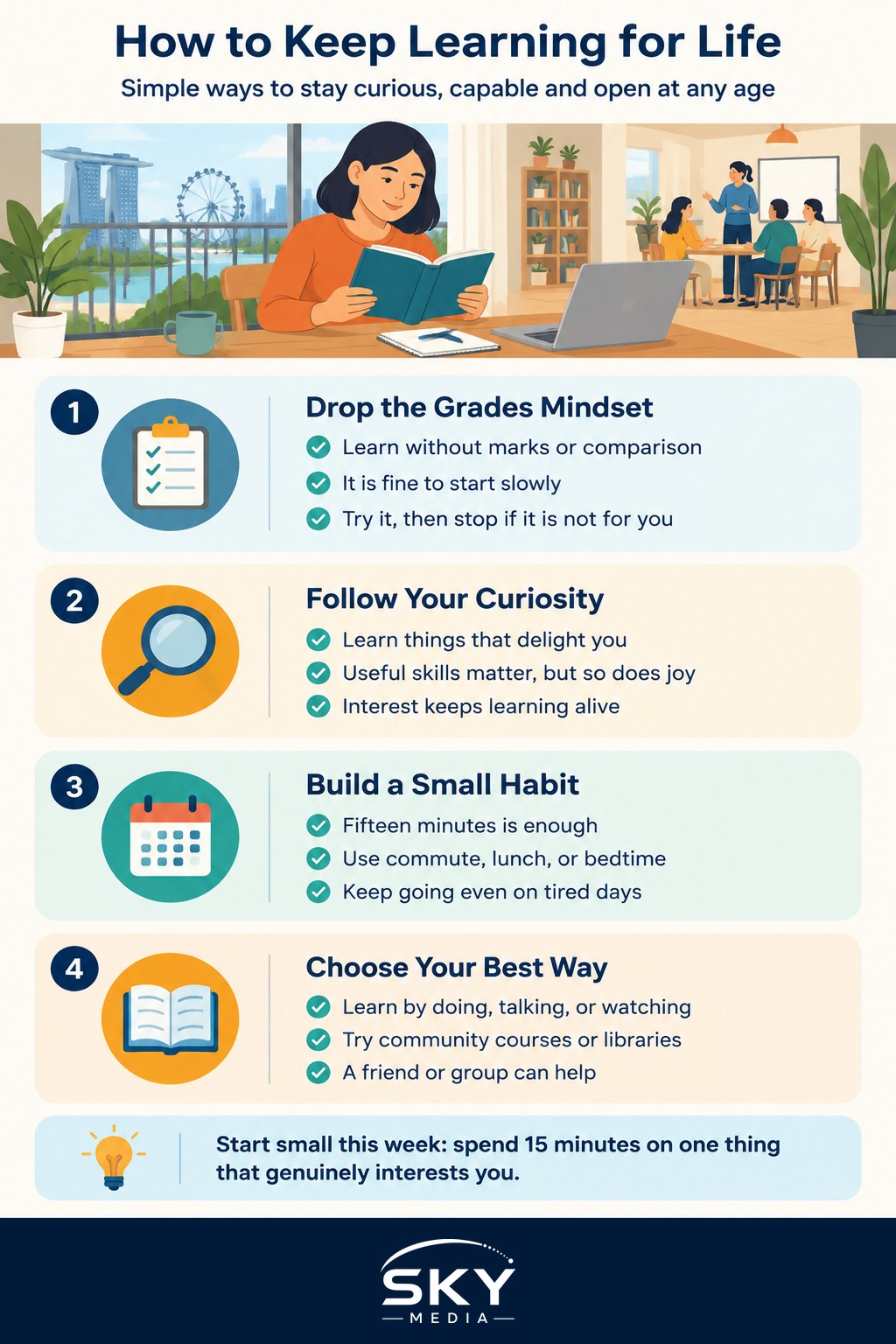
Let Go of the Grades Mindset
For many of us, learning still carries the weight of school: tests, marks, comparison, the fear of getting it wrong. That mindset is exactly what makes adult learning feel heavy. No one is grading you now. You are allowed to learn something slowly, badly, or just for the pleasure of it. You are allowed to try a subject, decide it is not for you, and stop without it being a failure.
Releasing the pressure to perform is what makes lifelong learning sustainable. When the goal is growth rather than a score, curiosity has room to breathe. This shift is really an extension of developing a growth mindset, the simple belief that your abilities can improve with effort rather than being fixed. You do not have to be naturally gifted at something to get meaningfully better at it. Most people badly underestimate how far steady, patient practice will carry them.
Follow Your Curiosity, Not Just Utility
There is a quiet trap in a practical culture: we only allow ourselves to learn things that are “useful”, meaning things that advance a career or add a line to a resume. Career-relevant learning matters, of course. But a learning life built purely on utility tends to feel like more work, and it burns out.
Some of the most rewarding learning has no obvious payoff. Picking up a language because the sound of it delights you. Learning to bake, to sketch, to identify the birds in your neighbourhood, to understand a bit of history. These things feed a different kind of hunger, and oddly, they often make you better at learning in general by keeping the habit alive and pleasant. So give yourself permission to be interested in things that do not “count”. Curiosity is not frivolous. It is the engine. If a particular skill calls to you, it is worth reading about learning a new skill as an adult, which takes the fear out of starting from zero.
Make Learning a Small, Regular Habit
The biggest myth about lifelong learning is that it requires large blocks of time you do not have. Between work, family, caregiving, and a long commute, few people can carve out hours. The answer is not to wait for free time that never comes. It is to make learning small and regular enough to fit the life you actually have.
A steady fifteen minutes beats an ambitious three-hour plan you abandon by the second week. Consider a few gentle ways to fit it in:
- Use the in-between moments. A podcast on the commute, an article over lunch, a few pages before bed.
- Attach it to something you already do. Learn while the kettle boils or after your evening meal, so it rides on an existing routine.
- Keep the bar low. On a tired day, five minutes still counts. The point is to keep the thread unbroken, not to be heroic.
This is really about habit design more than willpower. If you want the mechanics, it is worth learning how to build habits that actually stick, because a learning life is built from small repeated acts, not grand intentions. Consistency, not intensity, is what compounds.
Learn in Ways That Suit You
There is no single correct way to learn, and the school model of sitting still and reading is only one option. Some people learn best by doing, some by discussing, some by teaching others, some by watching. Singapore offers plenty of routes, from community centre courses and subsidised skills programmes to libraries, online platforms, and interest groups. Do check current details and eligibility directly with the relevant bodies, as schemes and offerings change over time.
You do not need any of them to begin, though. A library card, a curious question, and a willingness to be a beginner are enough. If you learn well with others, find a group or a friend on the same path. If you learn by teaching, explain what you have learned to someone else; it will show you what you have not yet understood.
Be Patient and Kind With Yourself
Lifelong learning is a long game, and long games reward gentleness. You will have stretches where you learn eagerly and stretches where life is too full and you barely learn at all. Both are fine. The habit is not broken by a quiet season; it is broken only by deciding you are “done”. As long as you keep returning, however slowly, you are still a learner.
So start where you are, this week, with something small. Read about one thing that genuinely interests you. Sign up for nothing, spend nothing, and simply follow one curiosity for fifteen minutes. Notice how it feels to grow a little on purpose. That quiet feeling, repeated over years, is what a learning life is made of. You will not master everything, and you do not need to. Staying curious and open, for as long as you live, is the whole reward.
Further reading: How to Learn in Public