

A good five year plan is not a rigid contract with your future self. It is a direction, a rough map that keeps your daily choices pointed at what matters to you. Most people either never make one, or write something so vague it gathers dust. This guide helps you build a plan that is clear enough to guide you and flexible enough to survive real life.
Why Five Years Is a Useful Horizon
Five years is long enough for meaningful change yet short enough to imagine clearly. In one year you can only tweak your life. In twenty, everything is a blur. Five years lets you switch careers, build a skill to real depth, save toward something big, or shift the shape of your days, while still being able to picture the person you are becoming.
Treat it as a compass, not a timetable. The value is in the direction it sets, not in hitting every date exactly.
Start With a Vision, Not a List
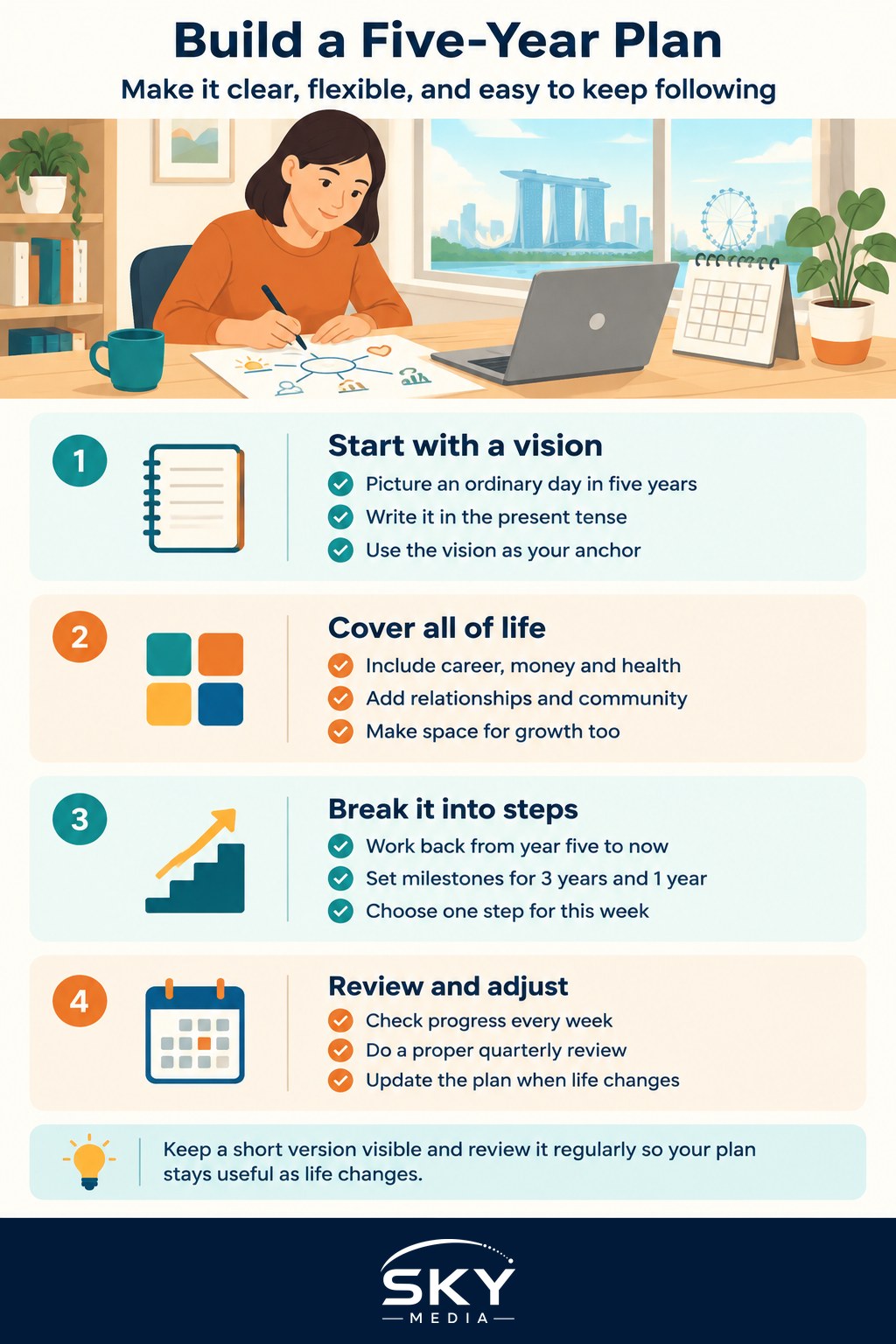
Before goals, get honest about the life you want. Imagine yourself five years from now and describe an ordinary day. Where do you live? What work fills your hours? Who is around you? How do you feel most mornings?
This is not fantasy for its own sake. A vivid picture gives your goals a reason to exist. Write a short paragraph in the present tense, as if it were already true. That paragraph becomes the anchor everything else hangs from.
Cover the Whole of Life, Not Just Work
A plan built only around career leaves you lopsided. Sketch goals across the areas that make up a full life:
- Career: the role, skills or business you want to grow into.
- Money: savings, debt, or a specific fund you want to build.
- Health: fitness, sleep and habits you want to hold.
- Relationships: family, friendships and community.
- Growth: learning, travel, creativity, or a personal project.
You do not need ambitious goals in every area. Some may simply need maintaining. The point is to see your life whole, so one area does not quietly starve while another grows.
Turn the Vision Into Milestones
A five-year goal is too far away to act on directly. Break it into milestones that pull it closer. Work backwards from year five to today.
| Timeframe | Question to Ask | Example |
|---|---|---|
| 5 years | Where do I want to be? | Leading a team in my field |
| 3 years | What must be true by then? | Managing a small project |
| 1 year | What do I start now? | Take on more responsibility |
| This quarter | What is my first step? | Ask my manager for a stretch task |
| This week | What can I do today? | Book a chat with my manager |
Notice how the far goal shrinks into something you can do this week. That is the whole trick. A plan you cannot act on this week is just a wish.
Make the Goals Concrete
Vague goals resist action. “Get fitter” or “earn more” give you nothing to grab. Sharpen each one until you would know clearly whether you had reached it.
- Not “save money” but “build six months of expenses in savings”.
- Not “advance my career” but “move into a role that leads others”.
- Not “be healthier” but “run five kilometres comfortably”.
A concrete goal tells you what to do next. A vague one only tells you to feel guilty.
Schedule Regular Reviews
This is where most plans fail. A five year plan written once and never opened is useless. Life will change, and so should the plan.
- Weekly: a quick glance to keep this week’s actions aligned.
- Quarterly: a proper review of milestones and progress.
- Yearly: a bigger reflection. Does the vision still fit? Adjust boldly if not.
Changing your plan is not failure. It is the plan doing its job, responding to a you who keeps growing. The person who wrote the plan knows less than the person reviewing it.
Expect the Plan to Change
You will not predict everything. New opportunities appear, priorities shift, and some goals lose their shine as you grow. A rigid plan snaps under this pressure. A flexible one bends and carries on.
Hold the vision loosely and the direction firmly. If the destination changes but the values behind it stay steady, you are still on track. The map can be redrawn; the compass keeps pointing true.
Anticipate the Obstacles
A plan that ignores obstacles is a plan that stalls at the first setback. For each major goal, spend a moment naming what is most likely to get in the way, then decide in advance how you will respond.
- If the barrier is time, which lower priorities will you drop to make room?
- If it is money, what is the smallest version of the goal you could still pursue?
- If it is motivation, what will remind you why the goal mattered in the first place?
Thinking through obstacles before they arrive is not pessimism. It is preparation. When the setback comes, and it will, you already have a next move instead of an excuse to quit.
Keep the Plan Somewhere You Will See It
A plan hidden in a document you never open cannot guide you. Keep a short version somewhere visible: the front page of your journal, a note on your phone, or a single card on your desk. The vision paragraph and your three current goals are enough. Seeing them regularly keeps your daily choices quietly aligned without any extra effort.
A Simple Way to Begin
If a full plan feels daunting, start small this week:
- Write one paragraph describing your life in five years.
- Pick the three areas that matter most to you right now.
- Set one clear five-year goal in each.
- For each goal, name one thing you can do this month.
- Put a quarterly review in your calendar.
That is a working five-year plan. You can enrich it over time, but even this rough version will pull your daily choices in a better direction.
Closing Thoughts
A five-year plan is not about controlling the future. It is about choosing a direction and then letting your small daily actions add up toward it. Start with a vision, break it into steps you can take this week, and review it often enough to keep it alive.
Write your first draft this weekend. It will be imperfect, and that is exactly right. The best plan is the one you actually start.
Explore more: How to Set Goals You Will Actually Achieve · How to Prioritise Your Tasks · Planning Your Week for Less Stress