

A stoic journal is a simple habit of reflecting in writing, drawing on ideas from Stoicism, a Greco-Roman philosophy. The Stoics used private writing to examine their days, check their reactions, and remind themselves of what matters. You are not writing for an audience or trying to sound wise. You are having an honest conversation with yourself. In a fast Singapore life full of packed schedules and constant notifications, a few minutes of stoic journalling can be a quiet anchor. Interpretations of Stoicism vary, so treat the prompts below as a flexible starting point rather than a fixed script.
What Makes a Journal Stoic
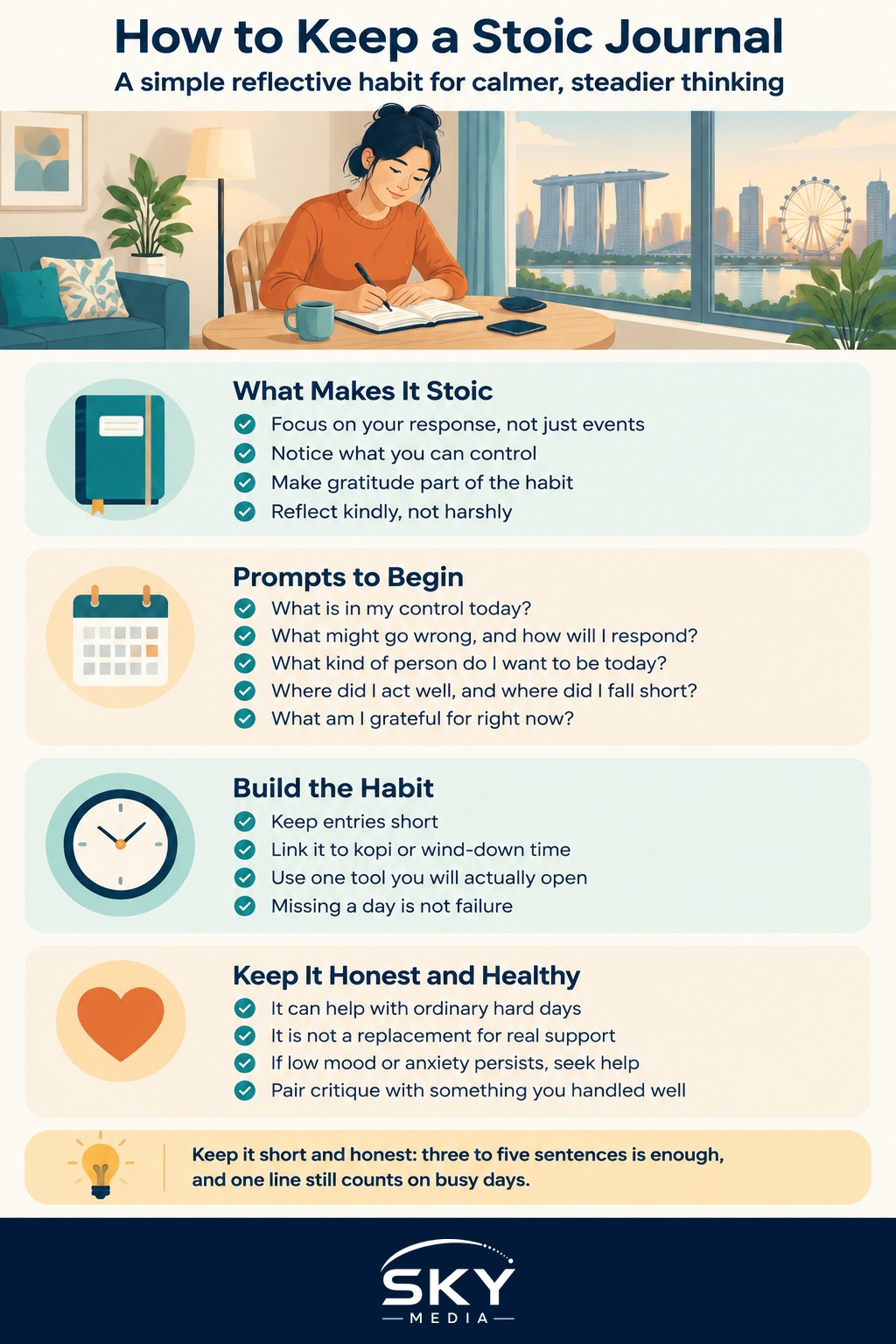
Plenty of people journal to record events or vent feelings, and there is real value in that. A stoic journal has a slightly different aim. It focuses less on what happened and more on how you responded, what was in your control, and how you want to show up next time. The tone is calm and practical rather than dramatic.
Three themes run through most stoic reflection. First, the difference between what you control, mainly your own choices and reactions, and what you do not, such as other people and outcomes. Second, gratitude and appreciation for what you already have. Third, a steady look at your own behaviour, without harsh self-attack. If your writing keeps circling these ideas, you are journalling in a stoic spirit. This overlaps with the wider benefits of journaling, just with a Stoic lens.
Simple Prompts to Start With
You do not need fancy questions. A few repeated prompts work better than a new format every day. Try splitting your entry into morning and evening, or just pick one.
In the morning, when you are still fresh, you might write on:
- What is in my control today, and what is not? Naming this early takes pressure off outcomes you cannot force.
- What might go wrong, and how do I want to respond? A brief, calm look ahead, not anxious worry.
- What kind of person do I want to be today? Patient, honest, kind, focused. Pick one.
In the evening, looking back, you might write on:
- Where did I act well today? Notice it without false modesty.
- Where did I fall short, and what would I do differently? Honest, not harsh.
- What am I grateful for right now? One or two specific things.
These questions are gentle by design. The aim is a steadier mind over time, not a daily performance review. Pairing this with starting a gratitude practice makes the appreciation part easy to build.
How to Build the Habit
The hardest part of any journal is doing it consistently, especially when life gets busy. A few practical moves help.
Keep it short. Three to five sentences is enough. A stoic journal you actually write beats a beautiful one you abandon. Attach it to something you already do, like your morning kopi or your evening wind-down before sleep. This kind of anchoring, where a new habit rides on top of an existing one, makes consistency far easier.
Lower the bar on bad days. If you only manage one line, that counts. Missing a day is not failure, it is just Tuesday. The point is the ongoing relationship with your own thinking, not a perfect streak. Choose whatever tool you will actually use, whether a cheap notebook you carry on the MRT or a notes app on your phone.
Keeping It Honest and Healthy
A stoic journal is a reflective tool, not therapy. It can help you process an ordinary hard day, notice patterns, and respond more calmly. It is not a treatment for serious mental health struggles. If your writing keeps surfacing persistent low mood, heavy anxiety, or a sense of hopelessness that does not lift, please treat that as important. Reach out to someone you trust, or speak with a professional such as your GP or a counsellor. Journalling can sit alongside real support. It should never replace it when you genuinely need help.
Watch your tone as you write, too. Stoic self-examination is meant to be honest but kind. If your entries turn into a list of everything you did wrong, gently rebalance. Pair every honest critique with something you handled well. This connects to how to practise self-compassion, which keeps reflection from curdling into self-blame.
Making It Stick in Singapore Life
You do not need a quiet cabin to journal. A stoic journal fits the real texture of life here. You might write two lines on your phone during the commute, jot a gratitude note at a hawker table, or reflect for a few minutes before bed in a shared HDB flat. The setting does not matter. The honest pause does.
Over weeks and months, small entries compound. You start catching your reactions sooner, worrying a little less about what you cannot control, and appreciating the ordinary good in your days. That slow steadiness is exactly what the Stoics were after. If this way of thinking draws you in, explore it further with an introduction to Stoicism, and let your stoic journal become the private space where those ideas quietly take root.
Further reading: The Bullet Journal Method Explained