

“Where do you see yourself in five years?” is one of the most common interview questions in Singapore, and one of the most awkward. Fresh graduates worry they have no idea. Career switchers worry that an honest answer will reveal they might move on. Some candidates over-prepare and give a speech about becoming the CEO.
The good news is that interviewers are not asking you to predict the future. They are testing a few specific things, and once you know what those are, you can give a confident, honest answer in under a minute. This guide covers what is really being assessed, common mistakes, and model answers you can adapt.
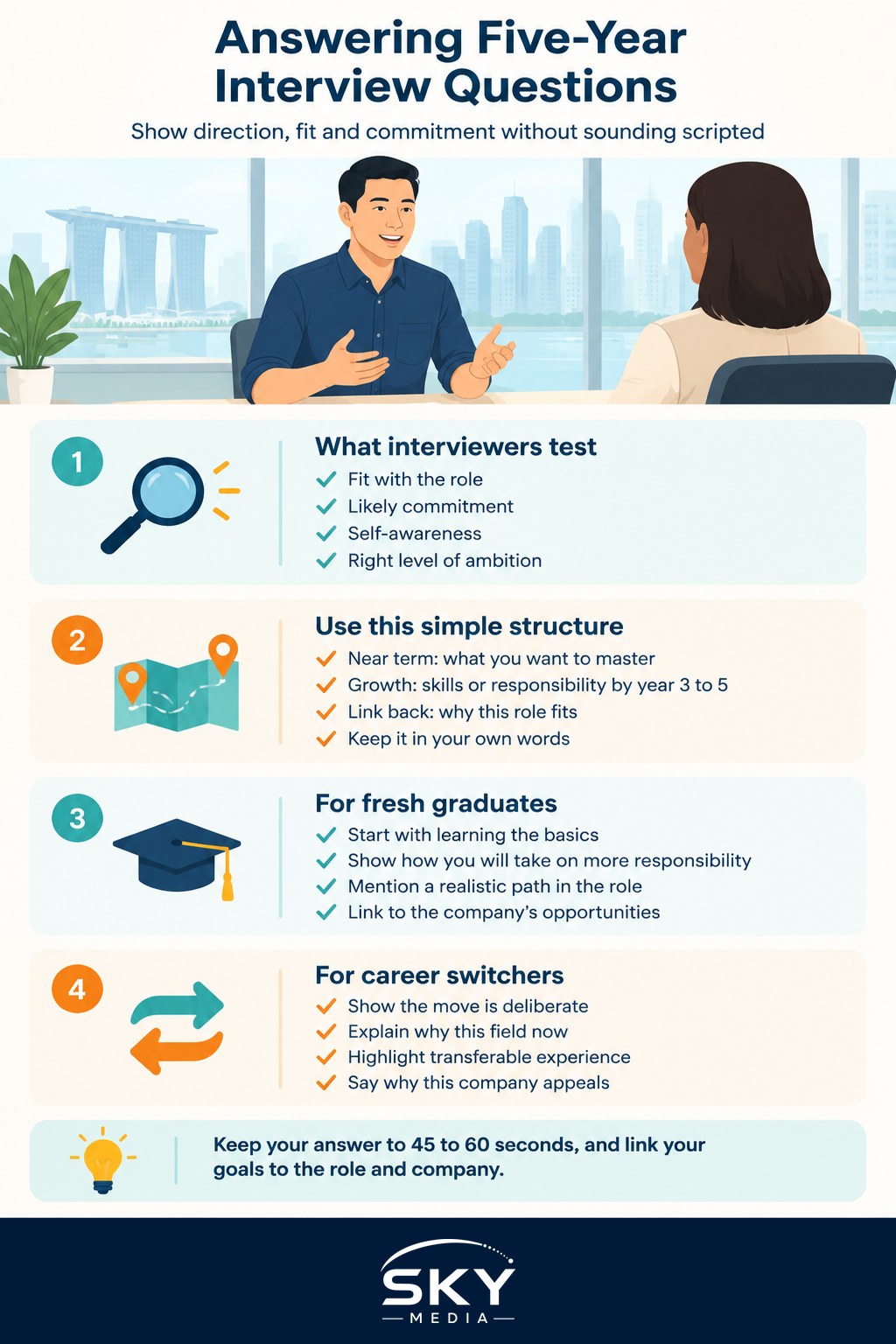
What Interviewers Are Really Testing
When a hiring manager asks this question, they are usually trying to learn four things:
- Fit with the role: does the path you describe make sense from this job? If you want to be a data scientist and you are applying for a sales role, they will wonder why you are here.
- Commitment: are you likely to stay long enough to be worth training? Employers invest time and money in new hires.
- Self-awareness: do you understand your strengths and the skills you still need to build?
- Ambition at the right level: do you want to grow, without expecting a promotion every six months?
Notice that none of these requires a precise job title. Interviewers know plans change. What they want is a sensible direction that overlaps with what the company can offer.
Strong Answers vs Weak Answers
This comparison shows how small changes in framing make a big difference.
| Weak answer | Why it hurts | Stronger approach |
|---|---|---|
| “I don’t really know yet.” | Sounds unprepared or uninterested | Name the skills and areas you want to grow in |
| “In your seat.” | Can sound arrogant or like a rehearsed joke | Talk about taking on more responsibility over time |
| “Running my own business.” | Suggests you will leave soon | Focus on the expertise you want to build here |
| “Managing a big team.” | May not match the role’s real path | Mention leadership interest, linked to proving yourself first |
| A detailed ten-step plan | Rigid and unrealistic | A clear direction with flexibility |
A Simple Structure for Your Answer
A reliable way to build your answer has three parts:
- Near term: what you want to master in the first year or two in this role.
- Growth: the kind of responsibility or expertise you hope to build by around year three to five.
- Link back: why this company and role are a good place to make that happen.
Keep it to about 45 to 60 seconds. Say it in your own words rather than reciting a memorised paragraph.
Before the interview, research the company’s typical career paths. Look at the job description, the company’s careers page and the profiles of people in similar roles on professional networking sites. This helps you describe a realistic path, such as moving from analyst to senior analyst, or from executive to team lead, without guessing wildly.
Model Answers for Fresh Graduates
Fresh graduates often feel they lack the experience to answer. You do not need experience to show direction. Adapt these to your field.
Example: graduate applying for a marketing executive role
“In the first couple of years, I want to get really solid at the fundamentals: running campaigns end to end, understanding the data behind them and learning how your team works with sales. By around five years, I would like to be someone the team relies on for a particular area, maybe digital performance, and to have started mentoring newer colleagues. Your structured graduate programme and the range of brands you handle is a big part of why I applied, because it gives me room to grow in that direction.”
Example: engineering graduate
“My immediate goal is to build strong technical foundations and get my hands dirty on real projects. Over the next few years I would like to take on more ownership, perhaps leading a small workstream, and work towards relevant professional accreditation. I noticed your engineers rotate across project types, and that exposure is exactly what I am looking for.”
Notice what these answers do: they show learning first, then responsibility, then link to something specific about the employer.
Model Answers for Career Switchers
Switchers face an extra question in the interviewer’s mind: will this person stick with the new field? Your answer should show that the switch is deliberate.
Example: teacher moving into learning and development
“I made this move because I enjoy helping people learn, and I want to do that in a corporate setting. In the first year or two, I want to get familiar with your business and learn how to design training that links to measurable outcomes. In five years, I see myself as a capable L&D (learning and development) specialist who can own programmes from needs analysis to evaluation. My classroom experience gives me a head start on delivery, and this role lets me build the business side.”
Example: mid-career switch into tech
“I completed a conversion programme because I want to build a long-term career in software, not just try it out. My focus for the next couple of years is becoming a reliable developer on your team and deepening my skills in the stack you use. Further out, I would like to combine my previous industry knowledge with technical skills, perhaps working on products for that sector. That is one reason this company appeals to me.”
If you took a structured career conversion route, mentioning it briefly shows commitment. Check details of any such programme with the official provider, such as the Skills and Workforce Development Agency (SWDA, formed in 2026 from Workforce Singapore and SkillsFuture Singapore), rather than relying on hearsay.
Mistakes to Avoid
- Mentioning further study that implies leaving. Saying you plan to go overseas for a full-time master’s in two years signals a short stay. Part-time upskilling is fine to mention.
- Being vague about everything. “I just want to be happy and successful” says nothing.
- Talking only about pay or titles. Growth in skills and responsibility sounds better than “a higher salary”.
- Copying an online answer word for word. Experienced interviewers recognise scripts.
- Contradicting your other answers. Make sure your five-year answer matches what you said in “Tell me about yourself” and “Why do you want this job?”
Our guides on how to answer “Tell me about yourself” and how to answer “Why do you want this job?” help you keep your story consistent.
Handling Honest Uncertainty
What if you genuinely do not know? That is common, and it is fine to say so carefully. You might say: “I’m still exploring which specialisation suits me best, but I know I want to grow in this field, become strong at the core skills of this role and take on more responsibility. Being here would help me figure out where I add the most value.” This is honest, shows direction, and keeps the focus on the role.
If you want to think more deeply about your own plans outside the interview room, our guide on how to plan your next five years is a useful starting point.
Prepared well, “where do you see yourself in five years” becomes a chance to show that you have thought about your growth and that this job is a sensible step on that path.
Further reading: How to Answer “Why Did You Leave Your Last Job?”