
A good stock is quiet work that rewards you every time you cook. It sits under the surface of a bowl of noodles, a pot of soup, or a braise, adding depth without ever shouting for attention. Across Asia, cooks have built their own approaches to this savoury base, from the clean, smoky notes of Japanese dashi singapore home cooks are increasingly making themselves, to the long, patient pork and chicken stocks of Chinese kitchens.
This guide walks through how to make dashi and a handful of other Asian stocks from scratch. You will find the core ingredients, clear methods, practical tips, and ideas for using what you make. If you want a broader grounding in the craft first, our companion piece on how to make stock and broth from scratch covers the general principles that apply to every pot.
Understanding Dashi and Its Ingredients
Dashi is the backbone of Japanese cooking. Unlike a Western stock that simmers for hours, a basic dashi comes together in under half an hour, because its flavour comes from concentrated dried ingredients rather than long extraction.
The two classic components are kombu, a dried kelp, and katsuobushi, shavings of dried, smoked, fermented bonito fish. Kombu brings a deep savoury quality, often described as umami, while katsuobushi adds a smoky, oceanic top note. In Singapore you can find both in Japanese grocers and the imported section of larger supermarkets.
Allergen note: katsuobushi is fish, so any dashi made with it is unsuitable for people with fish allergies and for most vegetarians. A kombu-only dashi, or one made with dried shiitake mushrooms, gives a plant based alternative. Always check labels, as some packaged bonito flakes are processed alongside other seafood.
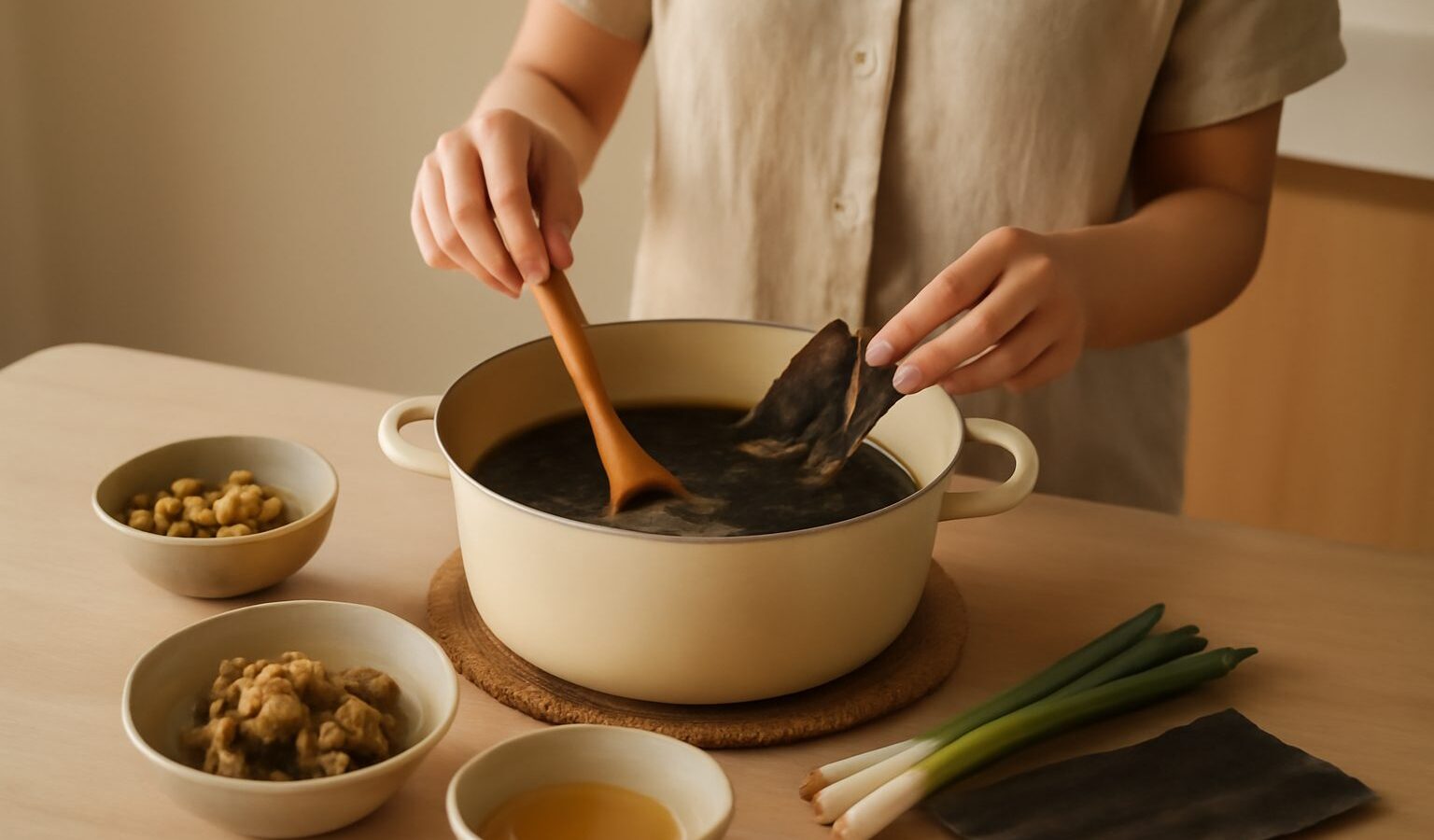
To make a simple dashi, wipe a piece of kombu lightly with a damp cloth, but do not scrub off the white powder, as that is where much of the flavour lives. Place it in a pot with cold water and let it soak for twenty to thirty minutes. Heat the water slowly and remove the kombu just before it reaches a boil, as boiling kombu can turn the liquid slippery and bitter. Bring the water to a gentle boil, turn off the heat, and add a generous handful of katsuobushi. Let it steep for a few minutes, then strain through a fine sieve or a cloth. The result is a clear, golden, deeply savoury liquid.
For a vegetarian version, soak dried shiitake and kombu together in cold water in the fridge for several hours or overnight, then warm gently and strain. The soaking water becomes a fragrant, meat free base.
Other Asian Stocks Worth Making
Beyond dashi, a few other stocks will cover most of your everyday cooking.
A Chinese superior stock, often used for wonton soup and clear noodle broths, usually combines chicken bones and pork bones. Blanch the bones first by covering them with cold water, bringing them to a boil for a few minutes, then draining and rinsing away the scum. This blanching step is what gives a clean, clear stock. Return the bones to fresh water, add a knob of ginger and a couple of spring onions, and simmer gently for a couple of hours. Keep the heat low so the liquid barely trembles, as a hard boil makes a cloudy stock.
An anchovy or ikan bilis stock is a Southeast Asian staple, quick and punchy. Dry fry a handful of dried anchovies briefly to deepen their flavour, then simmer them in water for around twenty minutes and strain. It forms the base of many local soups and is a familiar starting point in Malay and Peranakan cooking. Anchovies are fish, so flag this as an allergen.
A simple vegetable stock rounds out the set. Simmer carrot, onion, celery, and a piece of kombu or a few dried mushrooms for flavour, then strain. It is light and flexible.
Safety, Storage, and Uses
Food safety matters most once a stock is made. Cool it quickly, ideally by sitting the pot in a sink of iced water, because warm stock left at room temperature in Singapore’s climate is an easy home for bacteria. Refrigerate within two hours. Use refrigerated stock within three to four days, or freeze it in portions for up to three months. Reheat only what you need, and bring it to a rolling boil before serving. Never refreeze stock that has been thawed and reheated.
The uses are endless. Dashi becomes miso soup when whisked with miso paste, or the simmering liquid for udon and soba. It also lifts a simple bowl of steamed rice topped with egg. Chinese stock is the natural home for wonton, fish ball, and noodle soups, and you can build many of these into a full meal alongside our guide to cooking noodles perfectly at home. Anchovy stock underpins local favourites, while vegetable stock keeps everyday soups and risottos light.
Once you have made your own stock a few times, the boxed versions start to taste flat by comparison. Start with dashi, since it is the fastest, and let the habit grow from there. For more everyday inspiration, browse our roundup of must try hawker food in Singapore to see how these bases show up on the plate.