

You bought your policies through someone you trusted. Then one day a letter arrives from the insurer telling you a new person will now “service” your account, or your agent sends a farewell message saying they are leaving the industry. If your insurance agent left and you now hold what the industry calls an orphan policy, the first thing to know is that your cover does not disappear with them. This guide explains what actually changes, what stays the same, and how to decide whether to keep the new adviser or choose your own.
This is general information, not financial advice. Your policy documents and your insurer are the final word on your specific situation.
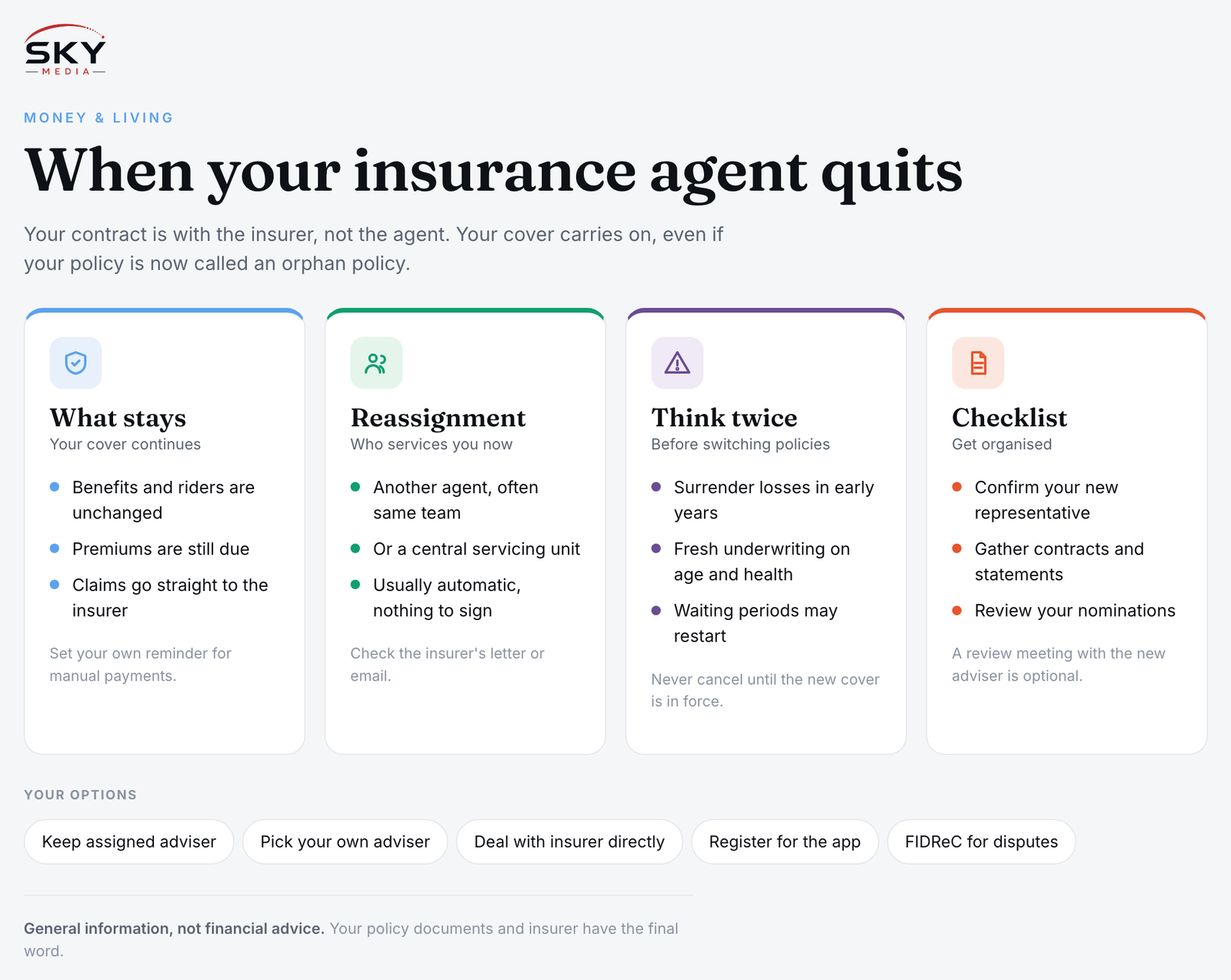
Your Contract Is With the Insurer, Not the Agent
An insurance agent, often called a financial adviser representative in Singapore, sells and services policies on behalf of an insurer or a financial advisory firm. The legal contract, however, is between you and the insurance company. That has three practical consequences:
- Your cover continues. Benefits, sum assured, riders and exclusions are exactly as written in the policy contract. An agent leaving does not alter any of them.
- Premiums are still due. If you pay by GIRO or credit card, deductions carry on as normal. If your agent used to remind you about manual payments, set your own reminder now, because missed premiums can lead to a lapse. Our guide on what happens when your insurance policy lapses explains the grace period and reinstatement in more detail.
- Claims go to the insurer. You can submit claims directly through the insurer’s app, website or customer service centre without any agent involved.
The term “orphan policy” simply means a policy whose original servicing representative is no longer attached to it. It is an administrative label, not a sign that anything is wrong with your plan.
How Orphaned Policies Get Reassigned
Insurers and advisory firms handle agent departures in a few common ways. The exact process varies by company, so check the letter or email you receive.
- Reassignment to another representative. Many insurers allocate your policies to a different agent, often someone in the departing agent’s former team or agency. You will usually receive a notice with the new person’s name and contact details.
- Servicing by a central team. Some insurers place orphan policies with an in-house customer service or dedicated servicing unit rather than a named individual.
- The agent moves to another firm. If your agent joins a different insurer or a financial advisory firm, they generally cannot keep servicing policies issued through their old company as your official representative. Your policies stay with the original insurer, which assigns a new servicing contact.
Reassignment is usually automatic. You do not need to sign anything for your cover to continue, although you may be invited to meet the new representative for a review.
What “Servicing Rights” Means for You
The servicing representative is the person the insurer records as your point of contact. They can help you:
- update personal details, nominations and payment methods
- understand your coverage and benefit illustrations
- guide you through a claim, a policy loan or a surrender
- review whether your coverage still fits your life stage
They cannot change your contract terms on their own. Anything that alters your policy, such as adding a rider, reducing the sum assured or making a withdrawal, still needs your signed instruction and the insurer’s approval.
A useful point to understand is that the new representative did not originally sell you the policy. Whether they receive any ongoing payment for servicing it depends on the insurer’s own arrangements, which are not something customers usually see.
Keeping the New Adviser or Choosing Your Own
You are generally free to ask the insurer to change your servicing representative. Many people do this when they already know a trusted adviser at the same company, or when the assigned person is unresponsive. The table below compares the main options.
| Option | What it involves | Good fit if |
|---|---|---|
| Keep the assigned representative | Do nothing; the insurer’s choice stands | They are responsive and you are happy with their review |
| Request a specific adviser at the same insurer | Submit a change of servicing representative request to the insurer | You know and trust another agent there |
| Deal directly with the insurer | Use the insurer’s app, hotline or customer centre for servicing | You prefer self-service and your needs are simple |
| Follow the old agent to a new firm | Buy any new cover through them; existing policies stay with the old insurer | You value the relationship and need fresh coverage anyway |
Ask the insurer how to request a change, since each has its own form and process. Changing your servicing contact does not change your premiums or benefits.
When Switching Policies Is a Bad Idea
The biggest risk after an agent change is not the change itself. It is being persuaded to cancel existing policies and buy new ones. This can happen if your former agent joins a new company and recommends their new products, or if a new adviser suggests “restructuring” your portfolio.
Replacing a policy can cost you in several ways:
- Surrender losses. Whole life and investment-linked plans often return less than you paid in, especially in the early years. See what happens if you surrender a whole life policy before agreeing to anything.
- Fresh underwriting. A new policy is priced on your current age and health. Conditions diagnosed since you first bought cover may now be excluded or attract higher premiums.
- New waiting periods. Some benefits, such as critical illness cover, may have waiting periods that restart with a new policy.
- Gaps in cover. Cancelling before the new policy is in force can leave you unprotected.
Financial advisers in Singapore are expected by the Monetary Authority of Singapore (MAS) to explain the disadvantages of replacing a policy and to have a reasonable basis for any recommendation. If someone urges you to switch, ask them to put the comparison in writing, including surrender values, new premiums and any changed exclusions. Never cancel an existing policy until the replacement has been approved and is in force.
A Simple Checklist After Your Agent Leaves
Use this list to get organised within a few weeks of hearing the news.
- Confirm who your servicing representative now is by checking the insurer’s notice or logging in to the insurer’s customer portal.
- Gather your documents. Locate policy contracts, benefit illustrations and the latest annual statements. Download digital copies if available.
- Check premium payments. Make sure GIRO or card instructions are active and note due dates for any manually paid policies.
- Review your nominations. Confirm that beneficiaries are up to date, especially after marriage, divorce or the birth of a child.
- Register for the insurer’s app or portal so you can view policies and submit claims yourself.
- Book a review only if you want one. A meeting with the new adviser is optional. If you go, treat it as a check of your current coverage, not a sales meeting.
- Note any outstanding matters. If your old agent was helping with a claim or a policy change, contact the insurer to confirm its status.
If you would prefer to manage things without an agent going forward, our guide on buying insurance without an agent covers direct purchase options for future cover.
If Something Goes Wrong
Most transitions are smooth, but occasionally a customer discovers a missed premium, an unprocessed request or advice they feel was unsuitable. Start by raising the issue with the insurer’s customer service or complaints team in writing, keeping copies of all correspondence. If the matter is not resolved, the Financial Industry Disputes Resolution Centre (FIDReC) handles disputes between consumers and financial institutions in Singapore. Check FIDReC’s website for its current process and eligibility.
An agent leaving can feel unsettling, but your policies were never really tied to one person. Confirm your new contact, keep premiums flowing, and resist pressure to switch without a clear written comparison.
Explore more: Reviewing Your Insurance Policies in Retirement
Official sources: Monetary Authority of Singapore (MAS)