
Isra’ Mi’raj in Singapore is a quieter occasion than Hari Raya, but for many Muslims it is one of the most meaningful nights of the Islamic year. It commemorates the Night Journey and Ascension of the Prophet Muhammad, peace be upon him, an event closely linked to the five daily prayers that shape a Muslim’s day. In the Malay-speaking community it is often called Israk Mikraj, and you may see mosques around the island advertising talks or special programmes in the days around it.
This guide explains what the occasion means, when it falls, and how it is commonly observed in Singapore. Practices vary between families, mosques and schools of thought, so treat what follows as a general introduction rather than a rulebook.
The Story of the Night Journey and Ascension
The name combines two parts of a single night’s journey, as described in Islamic tradition:
- Isra’ (the Night Journey): the Prophet is described as travelling by night from the Sacred Mosque (Masjid al-Haram) in Mecca to the Farthest Mosque (Masjid al-Aqsa) in Jerusalem. Tradition describes him being carried on a heavenly steed called the Buraq, and leading earlier prophets in prayer at al-Aqsa.
- Mi’raj (the Ascension): from Jerusalem, he is described as ascending through the seven heavens, meeting earlier prophets along the way, and coming into the divine presence.
The journey is referred to at the opening of the Qur’anic chapter Surah al-Isra’, and the details are expanded in hadith, the recorded sayings and accounts of the Prophet’s life.
The event took place during a difficult period in the Prophet’s life, after the loss of his beloved wife Khadijah and his uncle Abu Talib, a time often called the “Year of Sorrow”. Many speakers frame the journey as a source of comfort and reassurance after hardship, which is part of why it resonates with people today.
Why the Five Daily Prayers Are Central
For many Muslims, the most significant part of the story is the gift of solat (the daily ritual prayer, called salah in Arabic). According to tradition, the obligation of prayer was given during the Ascension. The account describes the number of daily prayers being reduced from fifty to five, while carrying the reward of fifty.
That is why Isra’ Mi’raj talks in Singapore often return to the theme of prayer: its meaning, its discipline, and how to keep it consistent amid work, school and family life. For many families, the occasion is a reminder to recommit to praying on time rather than a celebration with festive food or decorations.
When Isra’ Mi’raj Falls
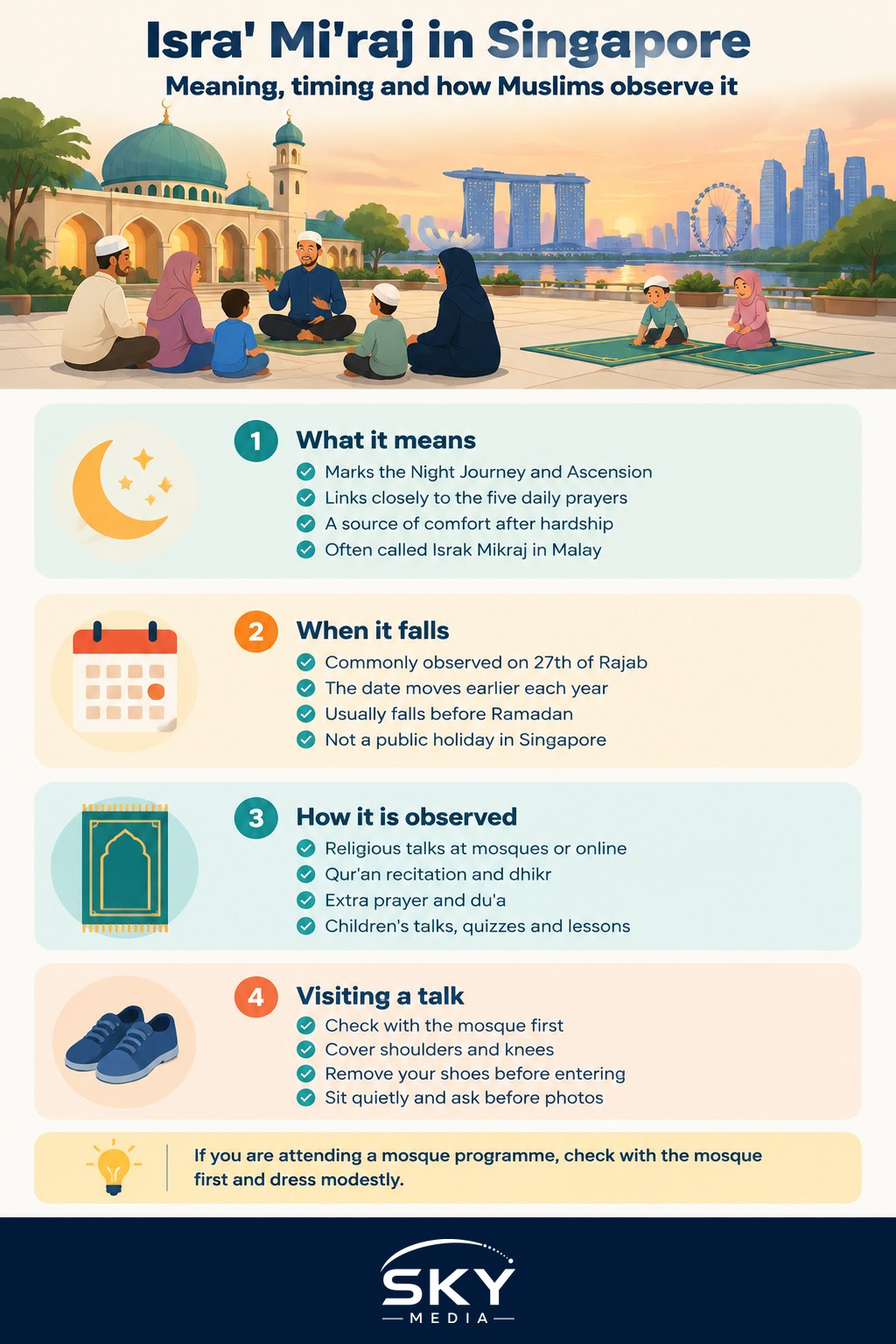
Isra’ Mi’raj is commonly observed on the 27th of Rajab, the seventh month of the Islamic lunar calendar. Some scholars hold different views on the exact date, but the 27th of Rajab is the widely marked date in Singapore and much of Southeast Asia.
Because the Islamic calendar is lunar and around 11 days shorter than the Gregorian (solar) year, the occasion moves earlier each year on the Western calendar. It also usually falls a couple of months before Ramadan, so many people see it as an early signal to prepare spiritually for the fasting month.
For the date in any given year, check the Islamic calendar published by MUIS (the Islamic Religious Council of Singapore) or announcements from your local mosque.
Isra’ Mi’raj is not a public holiday in Singapore. Muslims who wish to attend evening programmes usually do so after work or school.
How It Is Commonly Observed in Singapore
Observance is generally reflective and community-centred. Common practices include:
- Religious talks (ceramah): many mosques hold lectures on the evening of the 27th of Rajab or the nearest weekend, retelling the story and drawing lessons from it. Talks are commonly in Malay, with some in English.
- Qur’an recitation and remembrance: reading Surah al-Isra’ or other passages, and dhikr (remembrance of God through repeated phrases).
- Extra voluntary prayers and supplication: some people spend part of the night in personal prayer and du’a (supplication).
- Children’s programmes: madrasahs, mosque classes and some Muslim community groups use the occasion for storytelling, quizzes and lessons about prayer for young learners.
- Online talks: many mosques and religious teachers stream talks, which makes them accessible to people who cannot attend in person.
Some Muslims also choose to fast or perform special acts of worship on the day, while others do not, because scholars differ on whether specific rituals are recommended for this date. These differences are a normal part of Islamic scholarship, and families generally follow the guidance of the teachers or mosque they trust.
Ways People Mark the Occasion Compared
| Practice | Where it usually happens | What it focuses on |
|---|---|---|
| Ceramah or religious talk | Mosques, community halls or online | Retelling the Night Journey and its lessons |
| Qur’an recitation and dhikr | Mosques or at home | Reflection and remembrance of God |
| Voluntary prayer and du’a | Mostly at home or in the mosque | Personal devotion and renewing commitment to prayer |
| Children’s activities | Madrasahs, mosque classes, community groups | Teaching the story and the value of solat |
Visiting a Mosque Talk as a Non-Muslim
Some mosques in Singapore welcome visitors at public programmes, though talks on religious occasions are mainly organised for the congregation. If you are curious, it is best to check with the mosque first, or join one of the mosque visitor programmes many mosques offer at other times.
If you do attend, a few courtesies help:
- Dress modestly, covering shoulders and knees; women may be asked to cover their hair inside prayer areas, and some mosques lend robes or scarves.
- Remove your shoes before entering carpeted prayer spaces.
- Sit quietly at the back or in the area staff point you to, and avoid walking in front of people who are praying.
- Ask before taking photos.
Muslim friends and colleagues generally appreciate a simple, respectful interest in the occasion, such as asking what it means to them.
A Quiet Night With Lasting Meaning
Unlike Hari Raya with its open houses and new clothes, Isra’ Mi’raj is marked mainly through learning and prayer. For many families in Singapore, it is a moment to reflect on the Prophet’s journey through grief to reassurance, and to recommit to the daily prayers at the heart of Muslim life.
If you would like to understand more about Muslim life events in Singapore, read our guides to Muslim weddings in Singapore and the Muslim nikah ceremony.
Frequently Asked Questions
How is Isra’ Mi’raj different from Hari Raya Puasa and Hari Raya Haji? Hari Raya Puasa and Hari Raya Haji are major festivals with congregational prayers, family visits and public holidays. Isra’ Mi’raj is a quiet commemoration marked mainly through talks, prayer and reflection, with no festive meals or public holiday. It is observed in the month of Rajab.
How can I explain Isra’ Mi’raj to my child? Keep it simple: tell the story of the Prophet’s night journey to Jerusalem and ascension, and explain that it is when the five daily prayers were given. Use picture books or a mosque children’s programme if you like, and let your child ask questions at their own pace.
Is it appropriate to wish a Muslim friend a happy Isra’ Mi’raj? It is not a festive occasion with a set greeting, so a warm, respectful acknowledgement works better than festive wishes. You could ask what the night means to them or say you are thinking of them. Muslim friends generally appreciate genuine interest.
Can I take time off work to attend an Isra’ Mi’raj talk? It is not a public holiday, so you would arrange it with your employer like any other leave, or go to a talk after work. Many programmes are held in the evening or at weekends, and some mosques stream them online.
Where can I find Isra’ Mi’raj talks and programmes in Singapore? Check your nearest mosque’s announcements and social media, as many hold talks around the 27th of Rajab. MUIS also publishes the Islamic calendar and mosque information. Programmes are mainly for the congregation, so non-Muslims should ask the mosque before attending.
Further reading: Maulidur Rasul and the Prophet’s Birthday