

Japan is one of the most popular holiday destinations for Singaporeans, and trains are the obvious way to get around. Sooner or later, every trip planner asks the same question: should I buy a Japan Rail Pass? Booking a Japan Rail Pass from Singapore is straightforward, but whether it actually saves money depends heavily on your route. Since the nationwide pass became considerably more expensive a few years ago, many travellers now come out ahead with regional passes or individual tickets instead.
This is a planning guide, not a destination guide. It explains how the passes work, how to decide, and how to book and activate one without stress.
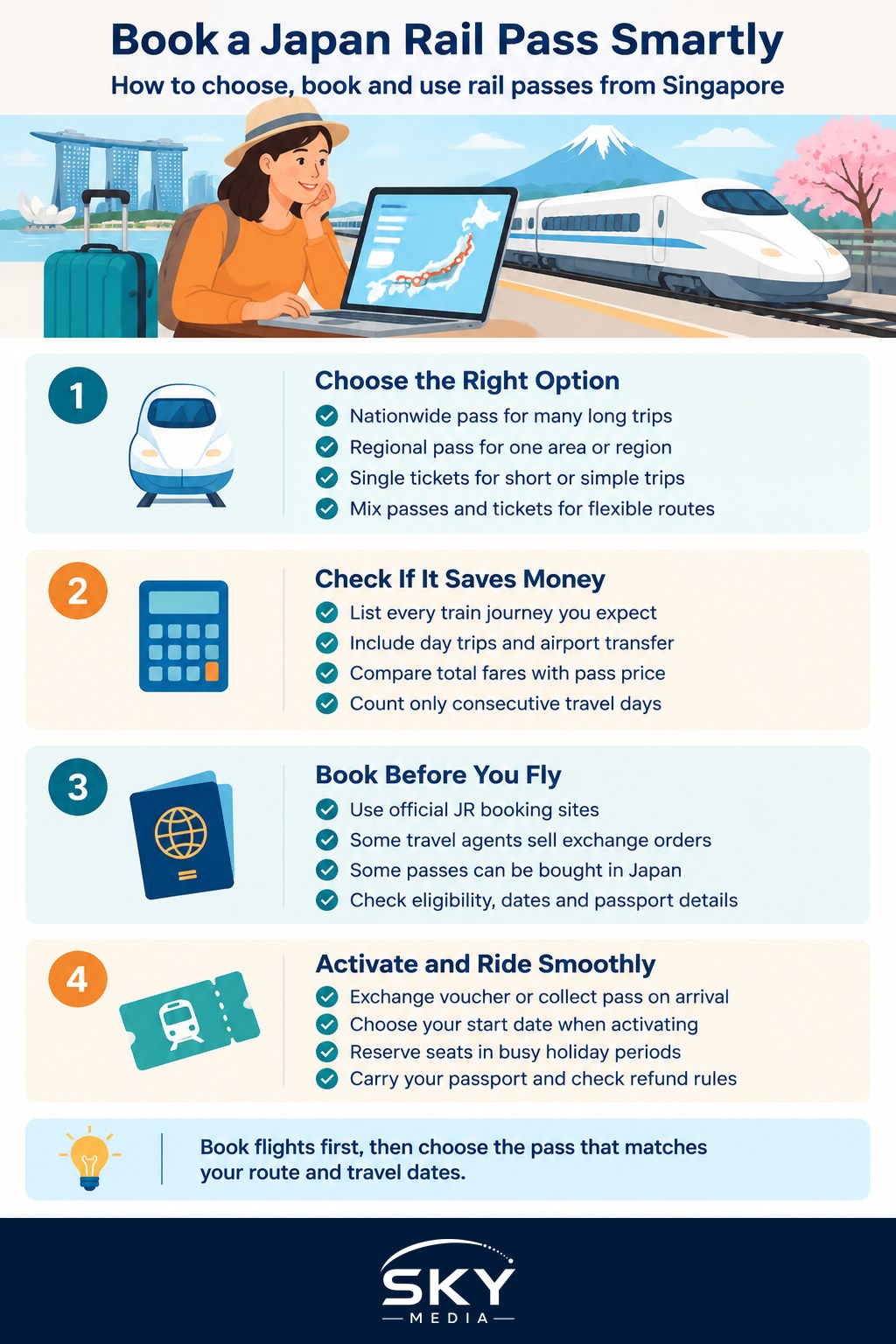
Nationwide Pass vs Regional Passes vs Single Tickets
There are three broad ways to pay for long-distance train travel in Japan.
- The nationwide Japan Rail Pass covers most JR trains across the country, including most shinkansen (bullet train) services, for a set number of consecutive days. It comes in ordinary and Green Car (first class) versions.
- Regional passes are issued by individual JR companies, such as JR East, JR West, JR Central and JR Kyushu. They cover a specific area and are often far cheaper than the nationwide pass.
- Point-to-point tickets are bought for each journey, at a station machine, counter or online.
| Option | Best for | Main limitation |
|---|---|---|
| Nationwide JR Pass | Long-distance trips covering several regions in one go | High upfront cost; only worth it with lots of shinkansen travel |
| Regional pass | Trips focused on one area, such as Kansai or Kyushu | Only valid within its region and listed routes |
| Single tickets | Short trips, one base city, or only one or two long journeys | No savings from bundling, more ticket purchases |
| Mix of regional pass and single tickets | Trips starting in Tokyo and ending in Osaka or similar | Requires a bit more planning |
How to Work Out If a Pass Is Worth It
Do the maths before you buy. It takes about 15 minutes.
- List every train journey you expect to take, including day trips and the airport transfer.
- Look up the single-ticket fare for each using an official JR website or a reputable route planner.
- Add them up and compare the total with the current price of the pass that covers those days.
- Count only consecutive days. A seven-day pass runs for seven calendar days in a row from the day you start it, so days spent in one city still use up validity.
As a rough guide, a nationwide pass tends to make sense when you travel long distances on several days, for example Tokyo to Hiroshima and on to Fukuoka. A simple Tokyo and Osaka return trip is often cheaper with single tickets. Pass prices and fares are set by the JR companies and can change, so always use current figures.
Booking From Singapore: Your Options
You can usually buy rail passes before you fly in a few ways:
- Official JR online booking sites. The nationwide pass and many regional passes can be bought on official JR platforms. Some let you reserve shinkansen seats online too.
- Authorised travel agents. Some Singapore travel agencies sell passes as an exchange order or voucher, which you swap for the actual pass in Japan.
- Buying in Japan. Many passes can also be bought at major stations after arrival, sometimes at a different price. Check the rules for your specific pass.
Before you book, confirm these points on the official site:
- Eligibility. Most passes for foreign visitors require you to enter Japan as a temporary visitor and show your passport. Singapore citizens and foreign residents of Singapore travelling on a non-Japanese passport generally qualify, but read the current terms.
- Validity window for exchange. Exchange orders usually have to be exchanged within a set period after purchase.
- Name and passport details. These must match your passport exactly. Typos can cause problems at the counter.
Activating Your Pass and Reserving Seats
When you arrive, you will usually exchange your voucher or collect your pass at a JR ticket office or a designated machine, often at the airport or a major station. Expect queues at peak times. If your trip starts on arrival day, allow extra time.
You choose the start date when you activate. If your first few days are spent in one city, consider starting the pass later so you do not waste days.
Seat reservations on the shinkansen are worth making during busy periods, such as Golden Week in late April and early May, the Obon holiday in August, and the New Year period. You can reserve at ticket machines, staffed counters or, for some passes, online.
A few things to note:
- Nozomi and Mizuho, the fastest services on the main Tokaido, Sanyo and Kyushu lines, have historically not been fully covered by the nationwide pass, though a supplementary ticket option has been introduced. Check the current rules before relying on them.
- Oversized luggage on some shinkansen lines needs a reserved space. If you are carrying a large suitcase, book the seat with luggage space.
- Non-JR lines, including private railways and city subways, are not covered.
Pairing Passes With an IC Card
For local travel inside cities, a rechargeable IC card is usually more convenient than a rail pass. Many visitors set one up on their phone wallet before or after arriving, or buy a physical card at a station, subject to availability. Use the pass for long journeys and the IC card for subways, buses and convenience stores.
If you plan a Kansai trip, a regional pass combined with an IC card often works well for hopping between Osaka, Kyoto and port cities like Kobe. Our guide to Kobe from Singapore covers what to do there once you arrive.
Tips for a Smooth Japan Rail Trip
- Book flights first, passes second. Your rail plan depends on where you land and leave.
- Consider open-jaw flights, such as landing in Tokyo and leaving from Osaka or Fukuoka, which can remove the need for an expensive return journey.
- Keep your passport handy. Staff may ask to see it alongside the pass.
- Screenshot your bookings in case mobile data is patchy.
- Check refund rules before buying. Unused passes may be refundable with a fee, but only under specific conditions.
Train lovers will enjoy the trip planning as much as the ride. If you are a railway fan, you may also like exploring Singapore’s own heritage at the Rail Corridor before or after your trip.
Frequently Asked Questions
Do Singapore passport holders need a visa to visit Japan? Singapore citizens are generally allowed short tourist stays without a visa, but entry rules can change and depend on your purpose and length of stay. Check the Japanese embassy’s website or MFA’s travel advisories before booking. Other passport holders living in Singapore should check their own nationality’s requirements.
Does the Japan Rail Pass cover airport trains like the Narita Express? JR-operated services, including some airport trains, are generally covered, but private railway lines are not, so the answer depends on which train you take. Check the pass’s official coverage list for your route. Having an IC card for subways and non-JR trains helps.
What happens if I miss the shinkansen I reserved a seat on? Rules vary by pass and train, so ask at a JR station counter as soon as possible. Staff can usually advise whether you can change your reservation or ride a non-reserved car. Allow extra time for connections, especially during busy periods like Golden Week.
What is the easiest way to deal with my suitcase on a rail trip? Many travellers send large luggage ahead to their next hotel with a luggage forwarding service, then travel with a small bag. This avoids the reserved-space rule for oversized bags on some shinkansen lines. Ask your hotel how forwarding works and how far ahead to book.
Is a Green Car pass worth it for a Singapore family trip? It depends on how much comfort matters to you and how many long journeys you take. Green Car seats are roomier and quieter but cost more. For short or occasional rides, ordinary reserved seats are usually enough. Compare the current prices before deciding.
Further reading: Staying at a Japanese Ryokan: What to Know Before You Book · Visiting Japan in Summer From Singapore: Heat, Festivals and Crowds · Using Visit Japan Web for a Faster Arrival From Singapore