
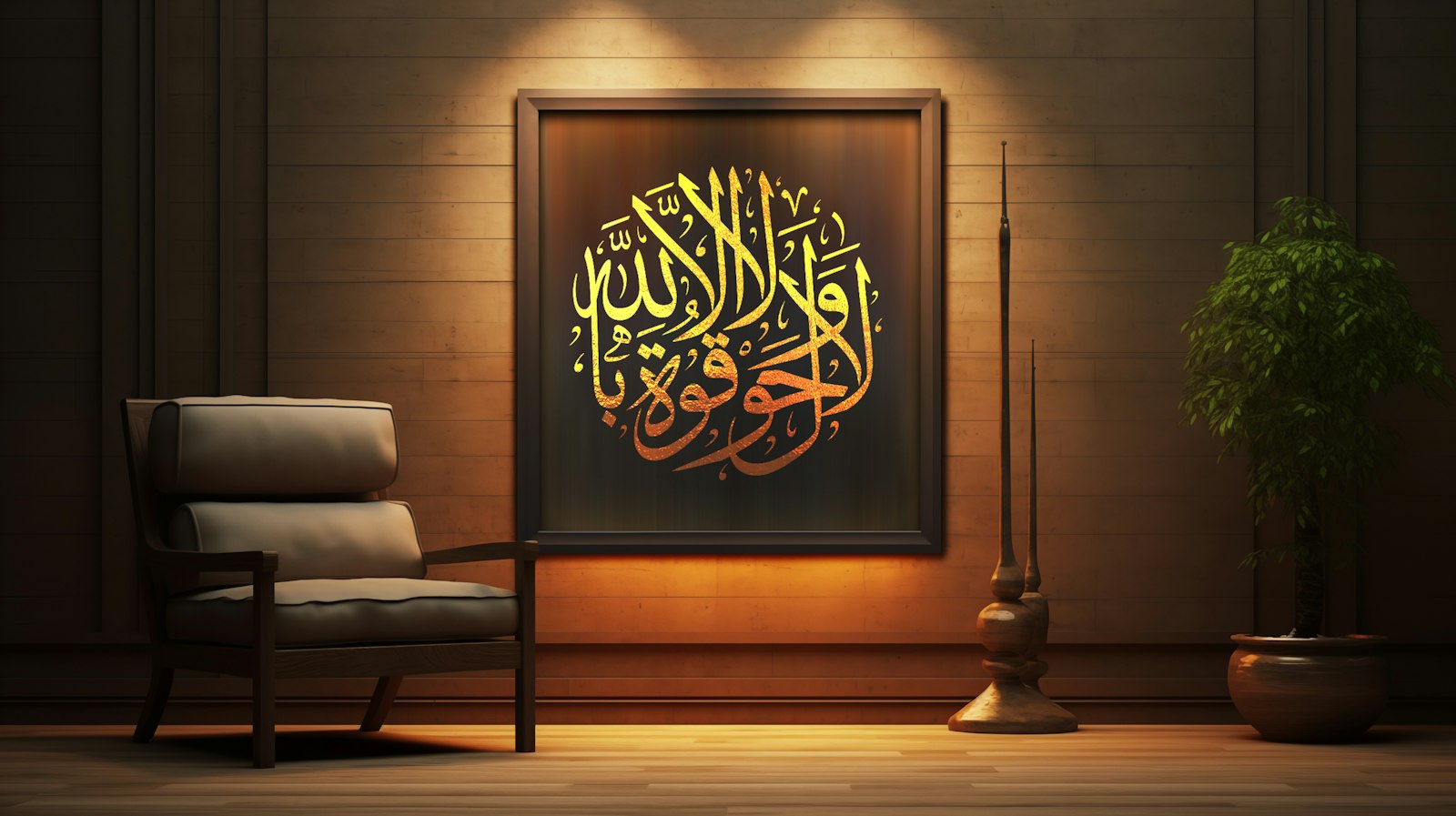
Arabic calligraphy, known as khat in Malay, is one of the most beautiful writing traditions in the world, and it has a long history in Singapore through the Malay community’s use of Jawi script. If you have admired the flowing lettering on a mosque wall, a wedding invitation or a framed verse in a friend’s home, you may have wondered how to start. Arabic calligraphy classes in Singapore are offered through mosques, community centres, cultural organisations and private teachers, and the hobby is open to anyone willing to practise patiently.
This guide covers the tools, the main scripts, how Jawi fits in, practice routines that actually work, and how to choose a class. It focuses on the Arabic-script tradition; for Western and Chinese brush styles, see our other calligraphy guides.
Jawi and Arabic Script: How They Connect
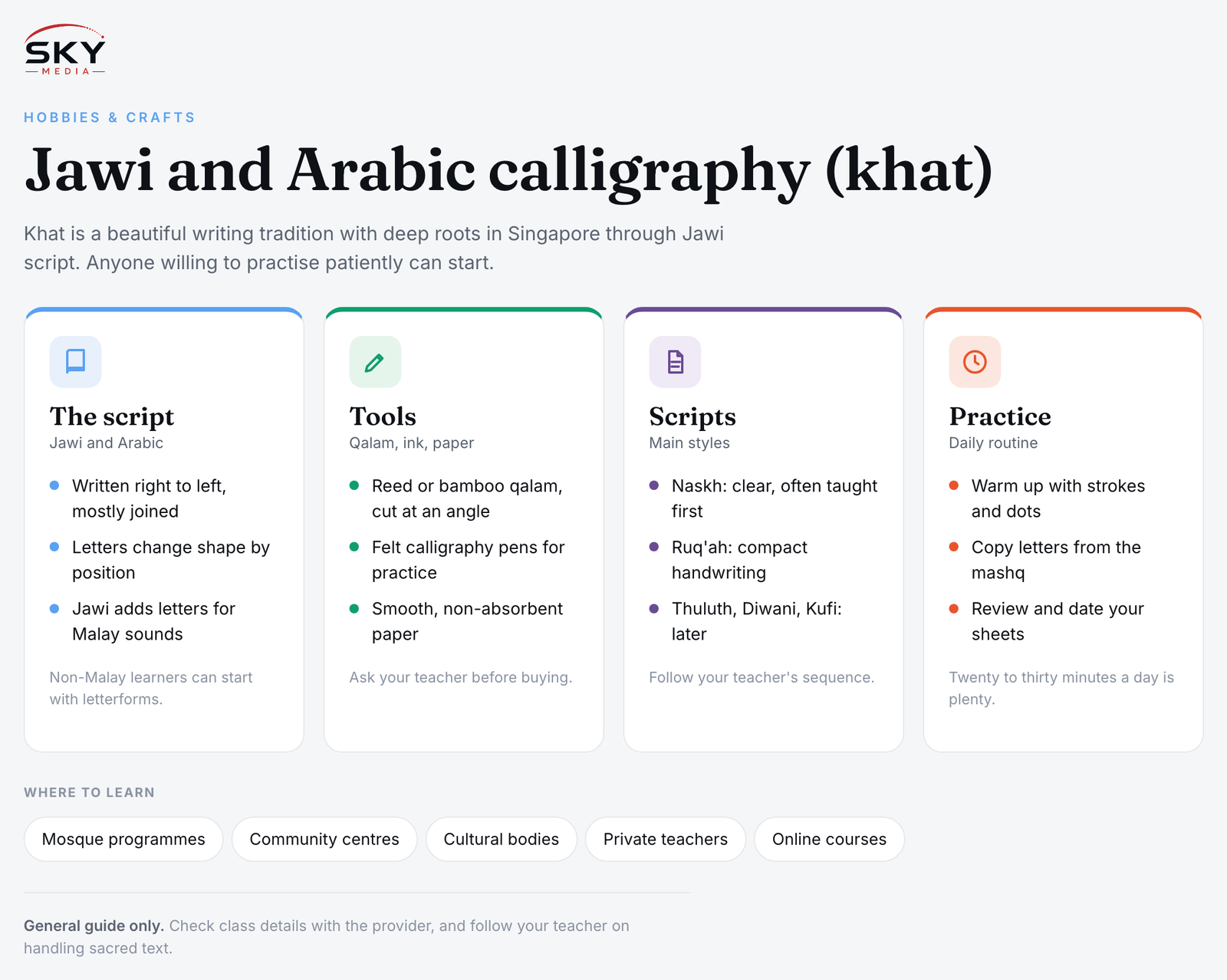
Arabic script is written right to left, and most letters join to their neighbours in a cursive flow. Letters change shape depending on whether they stand alone or sit at the start, middle or end of a word.
Jawi is the Arabic-based script used to write Malay. It uses the Arabic alphabet plus a handful of extra letters for Malay sounds that Arabic lacks. For generations, Malay newspapers, letters and religious texts in this region were written in Jawi, and it is still taught in religious classes and seen on signage and heritage items.
For a calligraphy learner, this means:
- The pen techniques and letter proportions are shared with Arabic calligraphy
- Jawi gives Malay-speaking learners meaningful words and phrases to practise
- Non-Malay learners can still learn the letterforms first and add vocabulary later
If you want to understand the language as well as the letters, our beginner’s guide to learning Arabic in Singapore is a good companion.
Tools of the Khat: Qalam, Ink and Paper
Traditional Arabic calligraphy uses a few simple tools, and beginners do not need to buy expensive versions.
- Qalam (reed or bamboo pen). The classic tool is a cut reed or bamboo pen with a nib sliced at an angle. The cut angle and width shape every stroke. Many teachers show students how to cut and sharpen their own qalam, which is a skill in itself.
- Practice alternatives. Beginners often start with broad-edged felt or cartridge calligraphy pens, which are easier to control and less messy, then move to the qalam.
- Ink. Traditional calligraphers use carbon-based black ink, sometimes with a few silk fibres (called liqa) in the inkwell to control how much ink the pen picks up. A ready-made calligraphy ink is fine for starting.
- Paper. Smooth, non-absorbent paper prevents ink from bleeding. Traditionally, paper was burnished and coated so the pen glides and mistakes can be scraped off. Beginners can use smooth layout or marker paper.
- Rhombic dots. Not a tool, but a measuring system. Letter heights are measured in diamond-shaped dots made by pressing the pen nib on the paper, so the size of your pen sets the proportions of your letters.
Ask your teacher before buying anything, as many classes use specific pen widths for each script.
The Main Scripts to Know
Arabic calligraphy has several classical scripts, each with its own rules and feel. You usually start with one and spend a long time on it before moving on.
| Script | Look and feel | Typical use | Beginner friendliness |
|---|---|---|---|
| Naskh | Clear, rounded, balanced | Books, Quran copies, everyday text | Often taught first for its readability |
| Ruq’ah | Compact, quick, few flourishes | Handwriting and notes | Approachable once basic shapes are learned |
| Thuluth | Large, sweeping, highly decorative | Mosque inscriptions, titles, panels | Advanced; needs strong basics |
| Diwani | Flowing, tightly packed, ornate | Official documents and decorative pieces | Intermediate to advanced |
| Kufi | Angular, geometric | Architecture, logos, early manuscripts | Geometric forms are easy to start, mastery takes time |
Teachers and traditions differ in where they start students, so follow your teacher’s sequence. Jawi writing for everyday Malay text is commonly practised in Naskh or a Ruq’ah-like hand.
A Practice Routine That Builds Real Skill
Calligraphy rewards short, regular practice far more than occasional long sessions. A realistic beginner routine might look like this:
- Warm up for five minutes. Draw straight strokes, curves and the single dot shape to settle your hand and pen angle.
- Practise one or two letters. Copy them from your teacher’s model sheet (called a mashq), checking proportions with your dot measurements.
- Join letters into simple words. Work on how each letter connects at the start, middle and end positions.
- Review honestly. Compare your work side by side with the model. Circle one thing to fix tomorrow.
- Keep your sheets. Date them so you can see progress over weeks.
Twenty to thirty minutes a day is plenty for most beginners. Expect slow progress: the traditional path can take years under a teacher, and many learners find that patience is part of the appeal. Sit comfortably, keep the paper at a slight angle, and rest your hand often to avoid strain.
Finding Arabic Calligraphy Classes in Singapore
Classes come in several forms, and the best one depends on your goals and schedule:
- Mosque and Islamic education programmes. Some mosques and religious education centres run khat or Jawi classes, often in Malay or English. Check notices or the mosque’s official channels.
- Community centres and cultural bodies. Community clubs, libraries and heritage institutions sometimes offer short workshops or courses, which suit curious beginners.
- Private teachers and studios. Offer more personal feedback and structured progression, sometimes with a path towards traditional certification (ijazah) under a recognised master.
- Online courses. Useful for flexible learning, but in-person correction of pen angle and posture is hard to replace.
When comparing classes, ask about:
- Which script is taught first and how lessons progress
- Class size and how much individual correction you get
- Whether tools are provided or you must buy specific pens
- Language of instruction, and whether non-Muslims and non-Malay speakers are welcome (many classes are open to all)
- Fees, schedules and cancellation policies, which vary by provider
Being respectful matters: Arabic calligraphy is closely tied to the Quran and Islamic art, and many teachers use verses as practice texts. Ask how practice sheets with sacred text should be handled and disposed of, and follow your teacher’s guidance.
Taking Your Hobby Further
Once you are comfortable with the basics, you might explore illumination (decorative borders), composition of full panels, or combining calligraphy with geometric patterns. Some learners enjoy creating personalised pieces with names in Jawi for family gifts, Hari Raya cards or wedding keepsakes.
If you enjoy brush and pen work generally, comparing traditions can be eye-opening. Our guides to Chinese calligraphy classes for adults and calligraphy and lettering workshops in Singapore show how other scripts approach rhythm, spacing and the meditative focus that draws so many people to the art.