
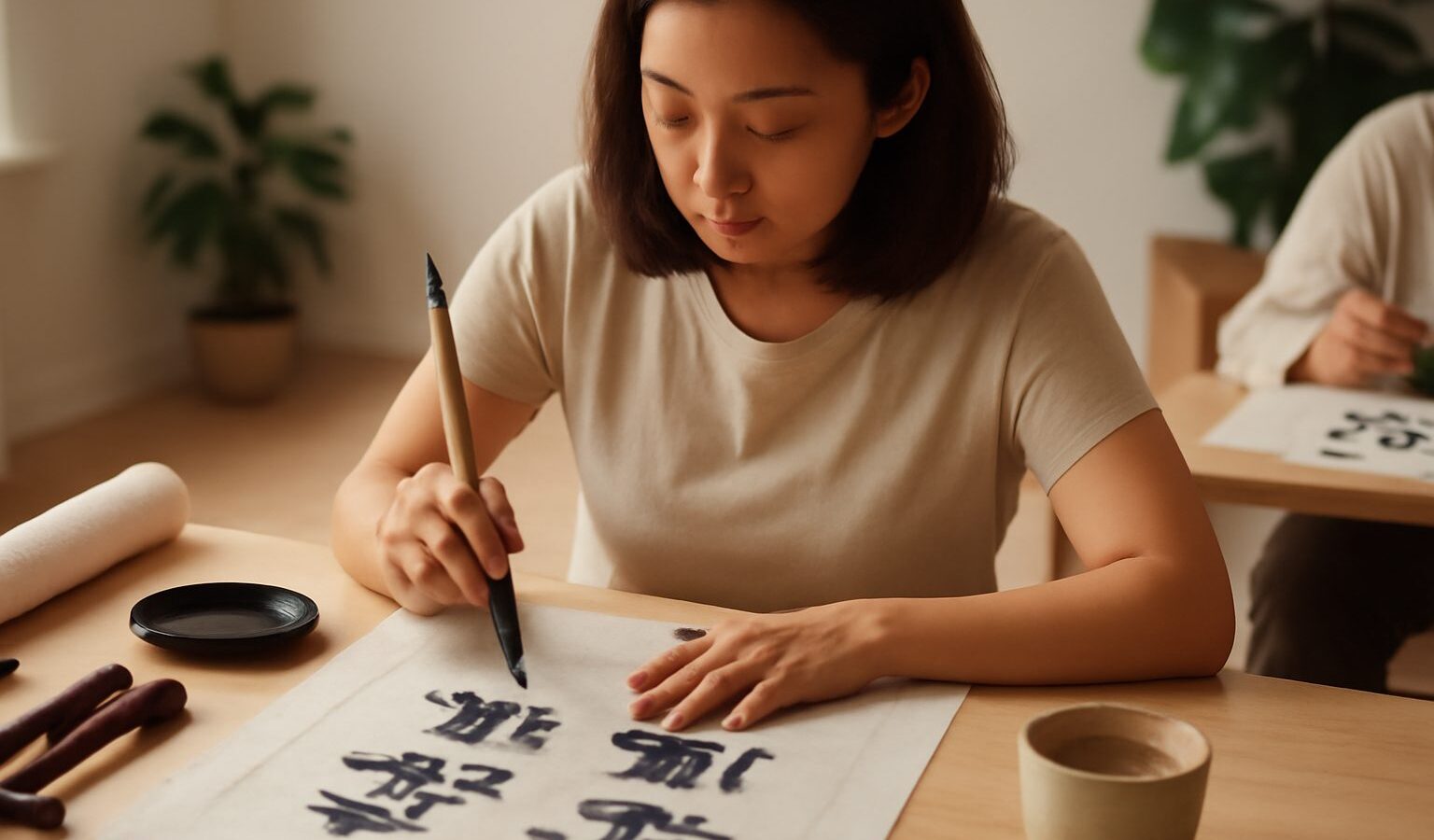
If you grew up practising 书法 (shufa, brush calligraphy) at school in China, you may have stopped once exams took over. Moving to Singapore can be a good time to pick the brush up again, or to start properly for the first time. The city has a steady community of adult learners, and finding a Chinese calligraphy class in Singapore is easier than many newcomers expect, once you know where classes are usually run and how they differ.
This guide is for adults who want structured, formal learning rather than a one-off taster. It explains the main types of classes, how they compare with what you may know from home, and what to ask before you pay for a term.

How Calligraphy Learning in Singapore Compares With Home
For newcomers from mainland China, a few differences are worth knowing:
- Simplified characters are standard in daily life here, as in China, but many calligraphy teachers also work with traditional characters, especially when copying classical model works. This will feel familiar if you studied 字帖 (zitie, model copybooks) before.
- Classes are usually taught in Mandarin, sometimes with English explanations for mixed groups. If you prefer full Mandarin instruction, ask when enquiring.
- There is no single national grading path for adults. Unlike the structured grading exams some learners take in China, most adult classes here are for personal development. A few societies or schools may organise exhibitions or internal assessments.
- Weekday evening and weekend classes are the norm, designed around working adults.
Where Adults Usually Find Calligraphy Classes
You will mostly find formal adult classes in four kinds of places. Here is how they typically compare.
| Type of class | Typical setting | Best for | What to check |
|---|---|---|---|
| Community centre or community club course | Neighbourhood community clubs, booked through the onePA portal | Beginners wanting an affordable, local start | Class size, teacher background, materials included or not |
| Private calligraphy studio | Small studio or teacher’s own space | Learners wanting closer feedback and a clear progression | Fees per term, trial lesson, makeup class policy |
| Calligraphy society or association | Long-running arts groups and clan associations | Intermediate learners wanting community and exhibitions | Membership requirements, meeting schedule, language used |
| Arts school or institution short course | Arts schools, cultural centres, libraries | Structured multi-week courses, sometimes with certificates | Course length, prerequisites, intake dates |
Community club courses are the most common starting point. The People’s Association (PA) runs community clubs across Singapore, and their courses are listed on the onePA website. Search for calligraphy, then filter by location and timing. Courses are usually run term by term and fill up quickly, so check intake dates early.
Private studios suit people who want a teacher to correct their strokes closely. Many teachers run small group classes, which gives more personal attention than a large community course.
Societies and clan associations have long supported Chinese calligraphy in Singapore. Some run classes, practice sessions or annual exhibitions. They can be a welcoming way to meet older practitioners and other newcomers. For background on this tradition, read our piece on Chinese calligraphy heritage in Singapore.
Arts schools, cultural centres and libraries sometimes offer short courses or workshops, particularly around Chinese New Year when demand for 春联 (chunlian, couplets) writing rises. Check the National Library Board’s programme listings and arts institutions’ websites for current offerings.
Choosing a Script and Level That Suits You
Most adult beginners start with 楷书 (kaishu, regular script), which builds the stroke control everything else depends on. If you already have that foundation, you might move to:
- 行书 (xingshu, running script), the semi-cursive style many adults find rewarding
- 隶书 (lishu, clerical script), with its broad, flat strokes
- 篆书 (zhuanshu, seal script), the oldest and most graphic style; see our guide to seal script calligraphy for beginners
- 草书 (caoshu, cursive script), usually for experienced learners
Be honest with the teacher about your level. Adults returning after a long gap often benefit from a few weeks of regular script before jumping to running script, even if they practised it as a child.
Questions to Ask Before You Sign Up
Before paying for a term, ask:
- What is the teacher’s background? Ask how long they have taught adults and which model works they use.
- How many students are in each class? Smaller groups mean more one-to-one correction.
- Are materials included? Some classes provide brushes, ink and paper; others expect you to bring your own.
- What language is used? Mandarin, English or both.
- Is there a trial lesson? Many private teachers allow one.
- What happens if you miss a class? Check the makeup and refund policy.
- Is there homework? Good classes usually expect daily practice at home, even for fifteen minutes.
Fees vary widely by type of class, teacher and duration, so compare current rates directly with each provider rather than relying on old listings.
Setting Up to Practise at Home
Progress comes from practice between lessons. A small home setup is enough:
- Brush: start with a medium brush recommended by your teacher. Soft goat hair and mixed hair brushes behave differently.
- Ink: bottled ink is more convenient than grinding an inkstick for daily practice.
- Paper: 毛边纸 (maobianzhi, practice paper) or grid paper for beginners, saving 宣纸 (xuanzhi, rice paper) for finished pieces.
- Felt mat and paperweights to keep paper flat.
- Water-writing cloth: a reusable cloth that you write on with plain water. It dries in minutes, so it saves paper and suits small flats.
Singapore’s humidity means paper can curl and brushes take longer to dry. Rinse brushes well, reshape the tip and hang them to dry with the tip pointing down.
Joining the Wider Calligraphy Community
A class gives you technique; a community keeps you going. Look out for calligraphy exhibitions, Chinese New Year couplet-writing events and practice groups. Our guide to Chinese calligraphy groups in Singapore explains how to find informal groups once you have some basics.
For newcomers, a calligraphy class can also be a gentle way to build a social circle. You share a quiet focus with classmates, and the conversation after class often turns to food, family and settling into life here. Start with one term, practise a little every day, and see where the brush takes you.
Further reading: Sip and Paint Classes in Singapore for Adults · Jawi and Arabic Calligraphy (Khat) as a Hobby in Singapore