
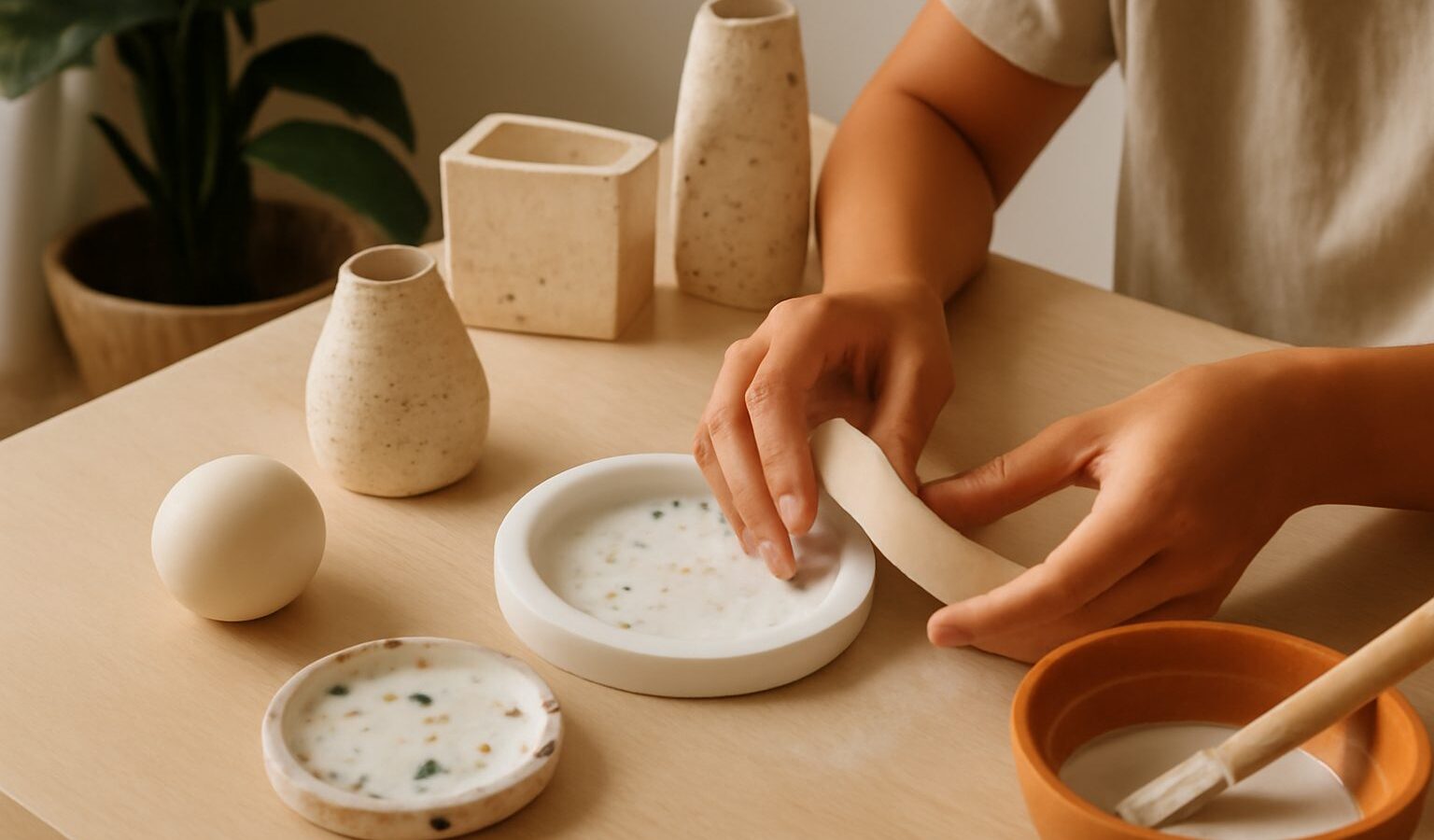
If you have seen speckled terrazzo coasters, marbled trinket trays or smooth pastel candle holders on social media, there is a good chance they were made with jesmonite. Jesmonite craft in Singapore has grown quickly as a hobby, thanks to its clean, modern look and the fact that it can be done at a dining table with a few simple tools.
This beginner’s guide explains what jesmonite is, how it differs from crafts you may already know, what you need to start, a basic casting process and how to work safely in a typical Singapore home.

What Jesmonite Is and Why Crafters Like It
Jesmonite is a brand name for a water-based composite material. It comes as two parts: a mineral powder (gypsum-based in the most common craft grades) and a liquid acrylic resin. When you mix them, you get a pourable slurry that sets hard in a mould, producing something that looks and feels like stone or ceramic but weighs less.
Crafters tend to like it because:
- It is water-based. Unlike many epoxy resins, it does not have a strong solvent smell during mixing, which suits small flats.
- It sets relatively quickly. Many projects can be demoulded the same day, depending on the product, mix and conditions.
- It takes pigment well. You can create solid colours, swirls, marbling and terrazzo chips.
- It needs no kiln. Unlike ceramics, there is no firing step.
- It can be sanded and sealed to a smooth, matte finish.
How Jesmonite Compares With Other Casting and Making Crafts
The site already covers resin, clay and candle crafts, and jesmonite overlaps with each a little. This table helps you see where it fits.
| Craft | Main material | How it sets | Typical finish | Good for |
|---|---|---|---|---|
| Jesmonite casting | Mineral powder plus acrylic liquid | Chemical setting at room temperature | Stone-like, matte, opaque | Terrazzo coasters, trays, planters, candle holders |
| Epoxy resin art | Two-part epoxy resin and hardener | Chemical curing, often slower | Glossy, can be clear | Clear coasters, encapsulated flowers, river tables |
| Polymer clay | Oven-bake PVC clay | Baked in a home oven | Smooth, colourful, small detail | Earrings, charms, figurines |
| Pottery and ceramics | Natural clay | Kiln firing | Glazed or raw ceramic | Mugs, bowls, functional tableware |
| Plaster casting | Plaster of Paris | Sets with water | Chalky, more fragile | Simple moulds, practice pieces |
If you enjoy shaping by hand, our guide to polymer clay crafts for beginners may also appeal. Jesmonite is closer to casting than modelling: the mould does most of the shaping.
Tools and Materials You Need to Start
Craft shops and online marketplaces in Singapore sell starter kits as well as separate supplies. A basic setup includes:
- Jesmonite powder and liquid. Buy from a seller who supplies the product’s technical or safety data sheet.
- Silicone moulds. Coasters, trays, small bowls and geometric shapes are popular first projects. Silicone flexes for easy release.
- A digital kitchen scale. Jesmonite is usually measured by weight, using the ratio stated by the manufacturer.
- Mixing cups and stirring sticks. Disposable or reusable silicone cups.
- Pigments made for jesmonite or water-based materials. Use only small amounts; a little goes a long way.
- Terrazzo chips (optional). You can make these by casting thin coloured sheets and breaking them up.
- Sandpaper or sanding sponges in a range of grits for smoothing edges.
- A sealer suitable for jesmonite if items will touch water or drinks.
- Protective gear: nitrile gloves, a dust mask, safety glasses and an apron.
- A protected work surface: a silicone mat, plastic sheet or old tray.
A Simple First Project: Terrazzo Coasters
This outline gives you a feel for the process. Always follow the instructions that come with your specific product, as mixing ratios, working times and curing guidance differ.
- Prepare your space. Lay down protection, set out moulds on a level surface and put on gloves, a mask and glasses.
- Make or gather chips. If making your own terrazzo chips, cast thin coloured layers a day earlier and break them into pieces.
- Weigh the liquid and powder according to the manufacturer’s ratio.
- Mix thoroughly. Add the powder to the liquid gradually and stir until smooth, scraping the sides and bottom of the cup. Add pigment if you want a coloured base.
- Place chips and pour. Scatter chips into the mould, then pour the mix slowly over them. Tap the mould gently on the table to release air bubbles.
- Let it set. Leave it undisturbed until it is firm enough to remove, as per the product guidance.
- Demould and dry. Flex the silicone to release the piece. Let it dry further before sanding.
- Sand to reveal the pattern. Sand the surface to expose the terrazzo chips, wetting the sandpaper to reduce dust.
- Seal if needed. Apply a compatible sealer for coasters and anything that will meet moisture.
Expect your first few pieces to have bubbles, uneven edges or patchy colour. That is normal, and imperfect pieces are useful for practising sanding and finishing.
Working Safely in a Singapore Flat
Jesmonite is considered more beginner-friendly than many resins, but it still needs care.
- Protect your lungs from dust. The dry powder and sanding dust should not be inhaled. Wear a suitable mask and sand with water where possible.
- Wear gloves and eye protection. Mixed material can irritate skin and eyes.
- Ventilate. Work near an open window or in a well-ventilated area, even though the smell is mild.
- Do not pour waste down the sink. Leftover mix can set in pipes. Let it harden in the cup, then dispose of it as solid waste.
- Keep supplies away from children, pets and food prep areas. Do not use kitchen bowls for mixing and then for food.
- Read the safety data sheet for the exact product you buy.
- Consider humidity. Singapore’s damp air can affect drying times and finishes, so allow extra drying time and store powder sealed.
Taking a Class or Joining a Community
If you would rather try before buying supplies, look for jesmonite or terrazzo-making sessions run by craft studios. When choosing one, check what is included (materials, moulds, number of pieces), the class size, whether items need to be collected later after curing, age limits for children and the cancellation terms. Our overviews of pottery and craft workshops and pottery and craft studios in Singapore explain how local studios typically organise classes.
Online maker communities are also useful for troubleshooting bubbles, colour and sealing. Share your first attempts; most crafters are happy to help.
Ideas for Your Next Jesmonite Projects
Once you are comfortable, try:
- Marbled trinket trays and ring dishes
- Small planters for succulents (seal well and allow for drainage)
- Candle holders and incense trays
- Bookends and decorative objects
- Personalised gifts in a recipient’s favourite colours
Jesmonite craft rewards patience and experimentation. Start small, keep notes on what works, and you will soon be producing pieces you are proud to display or give away.
Further reading: Concrete Crafts at Home: Making Planters, Trays and Coasters