

Keratin treatments come up often in humid places like Singapore, where frizz can undo a good hair day within minutes of stepping outside. If you have spent any time reading about smoothing services, you have probably met a wall of confusing claims. This guide takes a calmer view. It explains in plain terms what keratin treatments generally are, what they can and cannot do, and the sensible questions to ask before you book. What it will not do is promise a specific result, price or timeline, because those genuinely vary from salon to salon and from head to head. For anything definite, the right person to speak to is a trained, reputable stylist.
Think of this as background reading so you walk into a consultation informed rather than sold to.
What a Keratin Treatment Actually Is
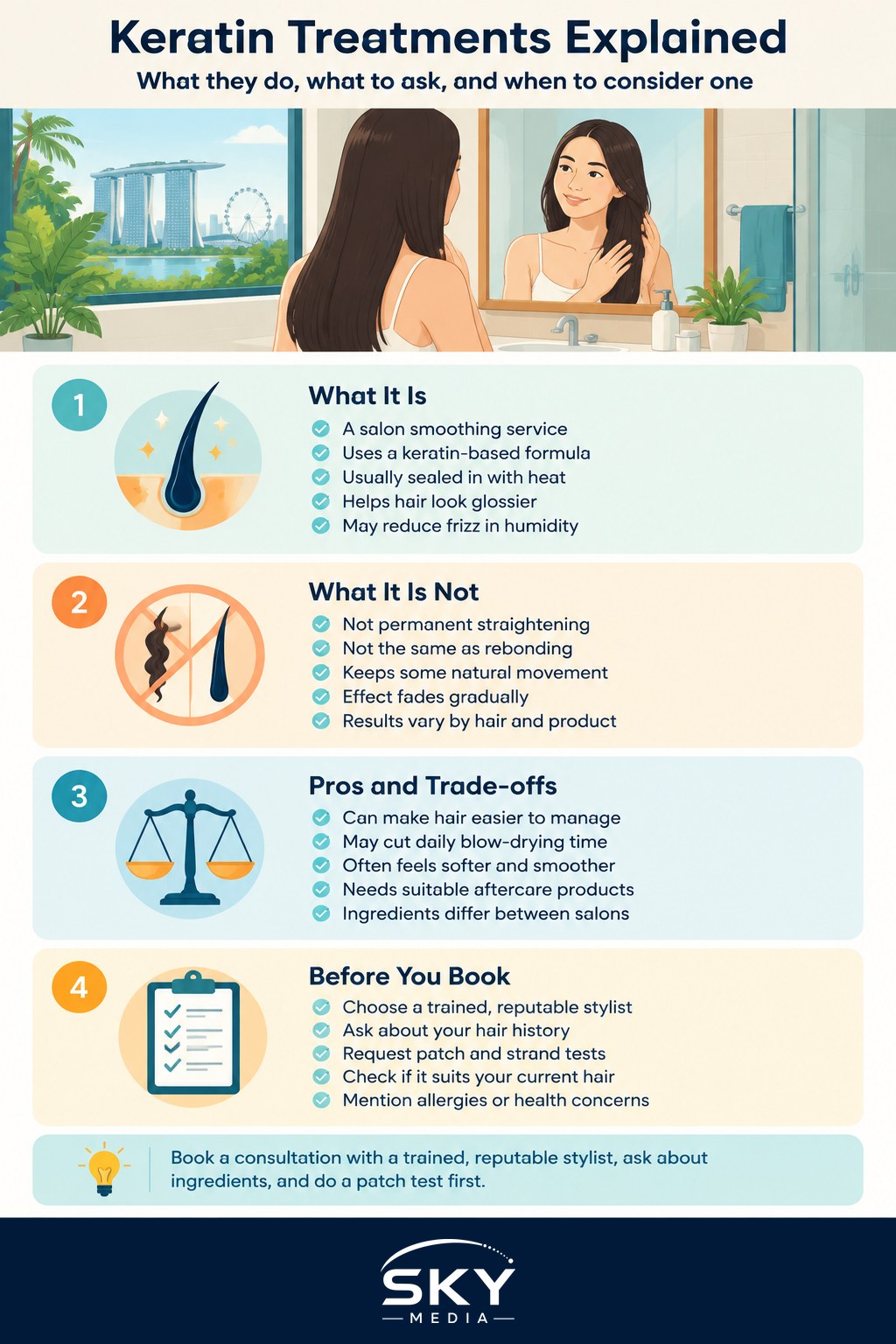
Keratin is the protein your hair is naturally made of. A keratin treatment, sometimes called a smoothing or blow-dry treatment, is a salon service that coats and infuses the hair with a keratin-based formula, which is then usually sealed in with heat. The aim is to smooth the outer layer of the strand so hair looks glossier, feels softer and resists frizz and humidity for a period of time.
It is worth being clear about what a keratin treatment is not. It is not the same as permanent straightening or rebonding, which chemically restructures the hair to make it stick-straight. A keratin treatment is generally described as smoothing rather than straightening. It tends to relax the wave and reduce frizz while leaving some of your natural movement, though how much depends on your hair and the specific product used. Because it is not permanent, the effect fades gradually rather than leaving a hard regrowth line.
Crucially, formulations differ a great deal between brands and salons. Some contain ingredients that people prefer to avoid, and the exact chemistry, and how gentle or harsh it is, is not something you can judge from the name alone. This is exactly why asking about the specific product and its ingredients matters so much.
Weighing the General Pros and Cons
No hair service suits everyone, and a keratin treatment is a commitment of time and money. Looking at the general trade-offs helps you decide whether a consultation is even worth booking. The points below are broad tendencies, not guarantees, and your own stylist is best placed to say how they apply to your hair.
| Consideration | Potential upside | Worth thinking about |
|---|---|---|
| Frizz in humidity | Can make hair smoother and easier to manage | Effect is temporary and fades over time |
| Styling time | Many find daily blow-drying quicker afterwards | You may still need some styling effort |
| Hair feel | Often looks glossier and feels softer | Results vary by hair type and formula |
| Upkeep | Reduces day-to-day frizz fighting | Usually needs specific aftercare products |
| Formulation | Some options are gentler than others | Ingredients differ, so always ask |
Notice that almost every row comes with a caveat. That is the honest picture of keratin treatments: they can be genuinely helpful for the right person, but they are not a miracle, and the experience depends heavily on your hair and the salon you choose.
Why a Professional Consultation Comes First
This is the part to take seriously. A keratin treatment involves applying a chemical formula and often sealing it with high heat, so it is not a service to rush or to attempt casually at home. The single most important step is a proper consultation with a trained, reputable stylist, ideally at an established salon or a provider you can verify.
A good consultation should cover several things. The stylist should look at your hair’s condition and history, especially if it is coloured, bleached, previously rebonded or chemically treated, because those factors change what is safe and sensible. They should explain the specific product they use and be willing to talk you through its ingredients if you ask. And they should carry out a patch test and, where relevant, a strand test before committing to your whole head, so you can check how your skin and hair respond first.
Ask direct questions and expect clear answers:
- What is in the formula you use, and are gentler options available?
- Is this suitable for my hair given its current condition and colour history?
- What does the aftercare involve, and which products will I need?
- What are the realistic pros and cons for hair like mine?
If a provider is vague, dismissive of a patch test, or unwilling to discuss ingredients, treat that as a reason to look elsewhere. For anything involving your health or safety, choose an accredited, trained practitioner or a suitably licensed provider rather than the cheapest or fastest option.
Deciding If It Suits Your Hair and Life
Beyond the salon chair, it helps to think about whether a smoothing treatment fits your routine. In Singapore’s constant humidity, many people are drawn to anything that promises fewer frizz battles, which is understandable. But a keratin treatment asks something in return.
- Aftercare is part of the deal. These treatments usually last longer and look their best when paired with suitable shampoos and gentle handling. Factor that upkeep in.
- Your starting hair matters. Very damaged, heavily bleached or previously rebonded hair may not be a good candidate, and only a professional assessment can tell you that.
- Manage your expectations. It is a smoothing service, not a magic wand. Results, longevity and feel all differ between people, so avoid fixing your hopes on a specific outcome.
- There are gentler daily alternatives. If you are not ready to commit, good conditioning habits, humidity-friendly styling and the right products can reduce frizz too, with far less commitment.
If you have a sensitive scalp, allergies, breathing issues, or you are pregnant or breastfeeding, mention this at the consultation, and check with your doctor if you have any health concerns about a chemical service. A responsible stylist will welcome the conversation.
A Sensible Way to Approach It
Keratin treatments can be a real help for people who struggle with frizz in a humid climate, but they are a personalised service, not an off-the-shelf fix. Because formulas, suitability, results, cost and longevity all vary so much, the wise move is to treat any figure or claim you read online, this guide included, as general background only. Book a consultation with a trained, reputable salon or a suitably licensed provider, insist on a patch test, ask exactly what is in the product, and let a professional who has seen your hair give you the specifics. That way you make an informed choice rather than a hopeful one.
Explore more
If you are weighing up your options, our guides on deep conditioning and hair masks and hair oiling and scalp treatments cover gentler ways to tame frizz and boost shine at home. For everyday humidity, our tips on easy hairstyles for humid weather can keep frizz in check between salon visits.
Frequently Asked Questions
How long does a keratin treatment last? It varies, because the effect is temporary and fades gradually rather than leaving a hard regrowth line. How long it lasts depends on your hair, the product used and your aftercare. Ask your stylist for a realistic idea for your hair type before you book.
Is a keratin treatment the same as rebonding? No, they are different services. Rebonding chemically restructures the hair to make it stick-straight, while a keratin treatment is generally a smoothing service that relaxes the wave and reduces frizz. It tends to leave some natural movement.
Can I get a keratin treatment if my hair is bleached or coloured? Possibly, but it needs a professional assessment first. Coloured, bleached or previously rebonded hair may react differently, and very damaged hair may not be a good candidate. A stylist should check your hair history and do a strand test before treating the whole head.
Is it safe to get a keratin treatment while pregnant? Check with your doctor before booking, and tell the stylist you are pregnant or breastfeeding. Treatments involve chemical formulas and often high heat, and ingredients differ between products. A responsible salon will welcome the question.
What should I do to look after hair after a keratin treatment? Follow the aftercare your stylist gives you, which usually involves suitable shampoos and gentle handling. Ask which products you need and any rules about washing or tying your hair in the first few days. Good aftercare is part of getting the most from the treatment.