
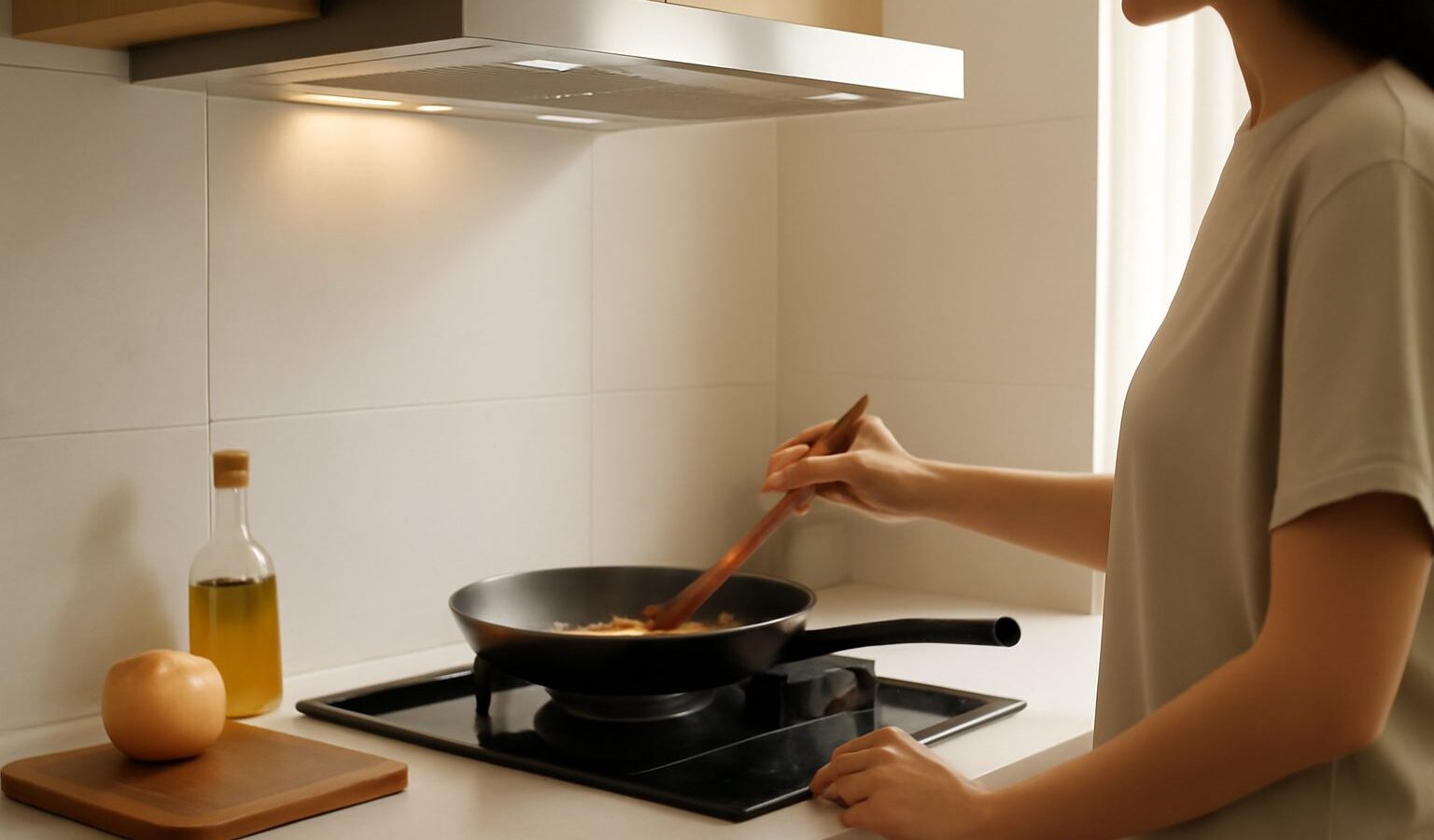
Choosing a kitchen hob and hood in Singapore is one of the more consequential decisions in a renovation, because it shapes how you cook every day and how much grease ends up on your walls. We fry, we stir over high heat, and we cook dishes that throw off steam and oil, so the pair has to handle real local cooking, not just the occasional pasta. Between gas, induction, and electric hobs, and a wall of hood styles from slim to chimney, the choice can feel overwhelming. This guide breaks down the options so you can match a hob and hood to how your household actually cooks and to the constraints of an HDB flat or condo kitchen.
Gas, Induction and Electric Hobs
The hob is the heart of the kitchen, and the three main types each suit a different cook. Your gas supply, your cooking style, and your renovation plans all steer the choice.
Gas hobs give the instant, visible flame many home cooks here prefer, with responsive control for tossing a wok and searing over high heat. They work whether you are on piped town gas or LPG cylinders, and many hawker-style cooks swear by them. The important point is safety and installation: a gas hob must be installed and connected by a licensed gas service worker, never by a handyman or by yourself. For piped gas, work with your gas supplier’s approved process, and in an HDB flat check HDB renovation rules before making changes to the gas point.
Induction hobs heat the pan directly through a magnetic field, so they are fast, precise, and stay cool around the pan, which makes them easy to wipe clean and safer around children. They need compatible flat-bottomed magnetic cookware and a dedicated power supply, so adding one may mean an electrician wiring a suitable point. Electric radiant or ceramic hobs are the budget middle ground: a smooth glass top with heating elements beneath, cheaper to buy than induction but slower to respond and slower to cool. Whichever you choose, remember that new power points or gas connections are professional work.
| Hob type | Heat control | Installation need | Best for |
|---|---|---|---|
| Gas | Instant flame, great for wok hei | Licensed gas service worker | High-heat frying, traditional cooking |
| Induction | Fast and precise, easy to clean | Electrician for a dedicated point | Safety, sleek look, quick clean-up |
| Electric ceramic | Slower to heat and cool | Suitable power point | Lighter cooking on a tighter budget |
Prices and models change constantly, so compare current ranges at Courts, Harvey Norman, or the appliance shops rather than relying on any fixed figure. Match the hob to your cooking first, then to your budget.
Choosing the Right Hood for Local Cooking
A hood matters more here than in cooler climates, because heavy frying and stir-frying release oil and steam that will otherwise settle on every surface. The style you pick affects extraction power, noise, and how the kitchen looks.
The main hood styles you will see:
- Chimney hood: the tall, wall-mounted style with strong extraction, a good match for open or semi-open kitchens and for households that fry often.
- Slimline or telescopic hood: tucks under a cabinet and pulls out when needed, saving space in a compact HDB galley kitchen.
- Semi-integrated or built-in hood: hidden within carpentry for a clean look, suited to lighter cooks who value a seamless finish.
- Island hood: hangs above a kitchen island in larger condo or landed kitchens, more of a design statement.
For the way many Singapore households cook, extraction strength and easy-clean filters matter more than looks. If you regularly fry fish, stir-fry over high heat, or cook curries, lean towards a hood with strong suction and accessible grease filters you can wash. A quiet hood is a bonus, but do not trade away the power you need to keep oil off your cabinets.
Ducted Versus Recirculating Hoods
Beyond style, hoods split into two ways of dealing with the air they pull in, and this choice has real consequences in a flat.
A ducted hood vents cooking air and smells outside through a duct, which is the most effective at clearing grease and odours. The catch is that it needs a viable external vent route, and in many HDB flats and condos there simply is not an approved path to duct outdoors, or the layout makes the run long and awkward. Check what your building and HDB rules allow before assuming you can duct out.
A recirculating hood pulls air through grease and carbon filters and pushes the cleaned air back into the kitchen. It needs no external duct, which makes it the practical default for many flats, but the filters must be cleaned and replaced on schedule or performance drops off. For heavy local cooking, a recirculating hood works but demands more filter maintenance, so factor that into your decision. Whichever you choose, any structural change, ducting through a wall, or new wiring should be planned with your contractor and, where it touches gas, electrical, or the building fabric, a licensed professional.
Matching Your Hob and Hood
Buying the hob and hood as a matched pair, rather than two separate impulse buys, saves grief later. They have to work together over the same cooking zone.
Keep these points in mind:
- Size the hood to the hob. The hood should be at least as wide as the hob so it captures the plume from the back burners, not just the front.
- Mind the mounting height. Too high and it loses suction, too low and it gets in the way or risks heat exposure over a gas flame. Follow the manufacturer’s clearance, which differs for gas and induction.
- Match the ambition. A powerful gas hob for serious frying deserves a strong hood; pairing it with a weak recirculating unit leaves grease everywhere.
- Plan the services together. Gas connection, power points, and any duct route should be sorted in one renovation stage, not bolted on afterwards.
If you are planning the wider kitchen around these choices, our kitchen-renovation-guide-singapore covers layout, budgeting, and sequencing the trades so the hob, hood, and cabinetry all land in the right place.
Cleaning Grease in a Tropical Kitchen
Our climate and cooking make grease a constant battle, and a clean hood and hob keep the whole kitchen working and safe. Warm, humid air lets oily film cling to surfaces, and neglected grease is both a hygiene and a fire concern.
Habits that keep it manageable:
- Wipe the hob after it cools, every time. Fresh splatter lifts easily; baked-on grease from last week does not.
- Wash or replace hood filters on schedule. Grease-laden filters lose suction and, on a gas hob, a heavily clogged filter is a fire risk, so keep them clean.
- Degrease the hood surfaces regularly. A warm cloth with a suitable kitchen degreaser handles the canopy and controls.
- Ventilate while and after cooking. Open the service yard door or a window to let steam and heat escape, which reduces how much settles.
- Do not let oil pool near the flame. Keep the area around a gas burner clean, and follow sensible fire-safety practice; SCDF offers general home fire-safety guidance worth reading.
Stubborn build-up on ageing units sometimes means it is time to replace rather than scrub, especially if extraction has faded. When you are restocking the pots, pans, and tools that go with a new hob, buying-kitchenware-singapore points you to where to shop.
Explore more
If the hob and hood are part of a bigger project, start with our kitchen renovation guide for Singapore to plan the layout, budget, and trades in the right order. When it is time to fill the cabinets with cookware that suits your new hob, whether magnetic pans for induction or a trusty wok for gas, buying kitchenware in Singapore shows you where to look and what to prioritise.