
Stand in front of the egg shelf at any Singapore supermarket and you will see a surprising range: local farm eggs, cage-free, free-range, organic, omega-3 enriched, pasteurised, and imports from several countries. Prices vary a lot, and the labels are not always self-explanatory. If you have been wondering whether cage free eggs in Singapore are worth paying more for, or whether local eggs are fresher, this guide breaks it down.
It explains what common egg labels mean, how local and imported eggs differ, and how to judge freshness and store eggs safely, so you can pick what suits your budget, cooking and values.
Where Singapore’s Eggs Come From
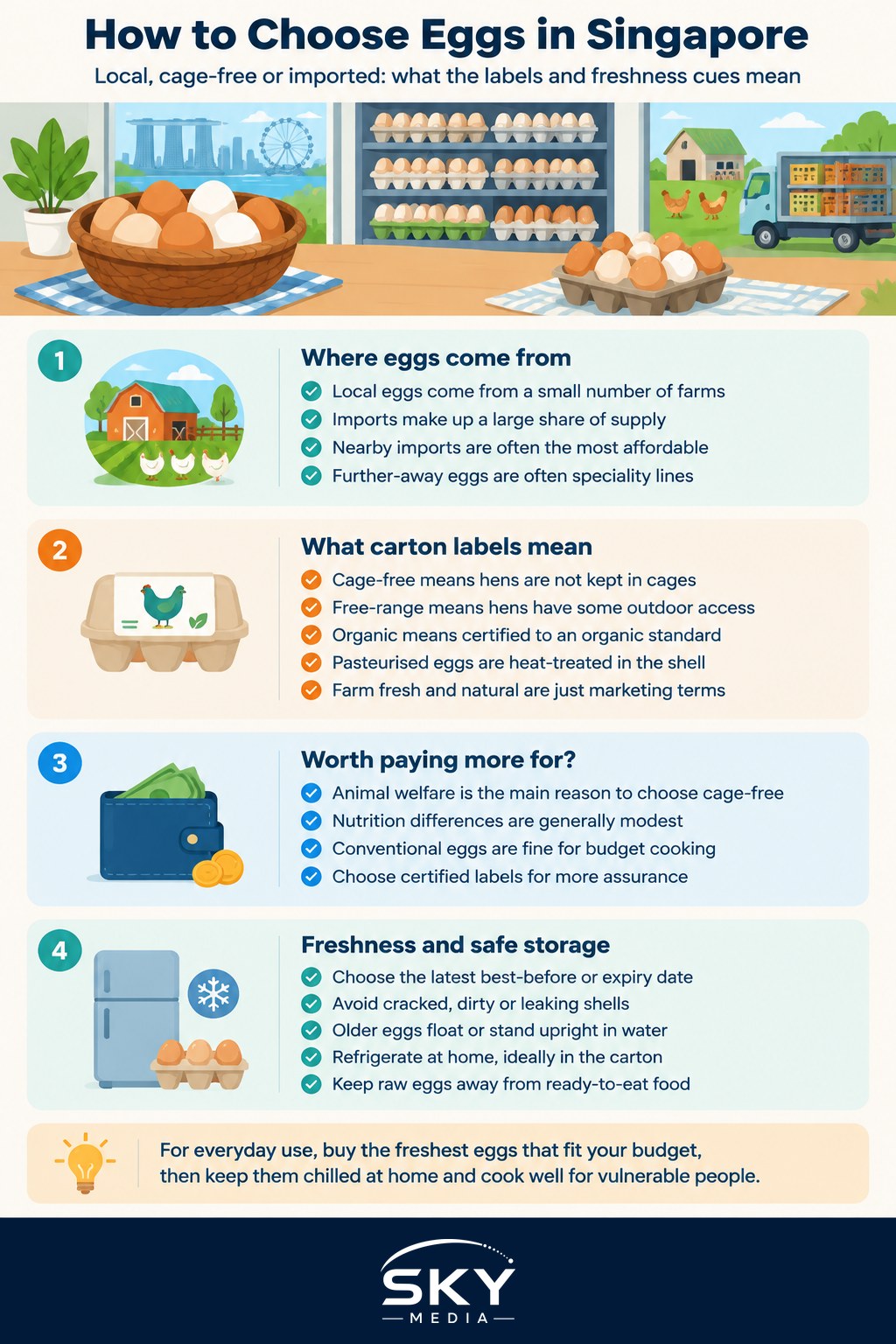
Singapore produces some of its own eggs at a small number of local layer farms, and imports the rest. Imports come mainly from nearby countries, with smaller volumes from further away. Building up local egg production is part of the country’s wider food security efforts, and the Singapore Food Agency (SFA), which oversees food safety and supply, regulates both local farms and imported eggs.
For shoppers, this means:
- Local eggs usually reach shelves quickly because they travel a short distance. Cartons often state the farm or say the eggs are from Singapore.
- Imported eggs from neighbouring countries are a large share of everyday supply and are often among the most affordable options.
- Eggs from further afield tend to be speciality or premium products, such as certain organic or branded lines.
All eggs legally sold here, local or imported, have to meet SFA’s food safety requirements. Origin is a matter of preference, freshness and price rather than safety alone. For the latest on sourcing and egg safety rules, check SFA’s website.
What Egg Carton Labels Actually Mean
Labels describe how hens are kept or fed, or how eggs are treated. Definitions and certification standards differ by country and brand, so read the small print and look for a named certification body where one is claimed.
| Label | What it generally means | What it does not tell you |
|---|---|---|
| Cage-free | Hens are not kept in cages, usually housed in a barn or shed where they can move around | Whether hens go outdoors, or how much space each hen has |
| Free-range | Hens have some access to an outdoor area | How much outdoor time or space, which varies by standard |
| Organic | Produced to an organic standard, usually covering feed and housing, often certified | That the eggs are more nutritious; check which certifier is named |
| Omega-3 or enriched | Hens are fed a diet designed to raise certain nutrients in the yolk | Animal welfare or housing conditions |
| Pasteurised | Eggs are gently heat-treated in the shell to reduce bacteria | How hens are kept; useful for dishes with raw or runny egg |
| Conventional (no claim) | Standard production, often caged systems | Freshness or quality, which depend on handling |
A few points worth knowing:
- “Farm fresh” and “natural” are marketing phrases with no fixed meaning. They do not tell you about housing or age.
- Shell colour (brown or white) depends on the breed of hen, not on nutrition or quality.
- Yolk colour is influenced mainly by the hen’s feed. A deeper orange yolk is not automatically healthier.
Is Cage-Free Worth the Extra Cost?
The case for cage-free and free-range eggs is mainly about animal welfare. Hens in these systems have more room to move and behave naturally than in conventional cages. Many shoppers, food businesses and hotels have moved towards cage-free eggs for this reason.
Nutritionally, the differences between cage-free, free-range and conventional eggs are generally modest. An egg is a good source of protein whichever system it came from. If your priority is nutrition on a budget, conventional eggs are fine. If welfare matters to you, cage-free or free-range is the meaningful upgrade, and certified labels give you more assurance than a brand’s own wording.
A practical approach many households take:
- Everyday cooking and baking: buy what fits the budget.
- Dishes where eggs are the star (soft-boiled eggs with kaya toast, onsen eggs, tamagoyaki): choose the freshest eggs you can find, and consider pasteurised eggs if anyone vulnerable is eating them runny.
- Values-led shopping: pick cage-free or free-range and look for a recognised certification.
How to Check Egg Freshness
Freshness matters most for poached eggs, soft-boiled eggs and anything where the egg holds its shape.
- Read the date. Cartons carry a best-before or expiry date. Choose the latest date on the shelf and buy only what you will use.
- Look at the shells. Avoid cracked, dirty or leaking eggs. Open the carton in the shop to check.
- Crack test at home. A fresh egg has a firm, rounded yolk and a thick white that stays close to it. An older egg has a flatter yolk and a runnier, spreading white.
- The float test, with care. Older eggs tend to float or stand upright in water because the air cell inside grows over time. This tells you about age, not safety, and any egg that smells off when cracked should be thrown away.
Storing Eggs Safely in a Hot, Humid Climate
Singapore’s heat means storage matters. Supermarkets here commonly keep eggs on unchilled shelves, but at home the fridge is the safer choice.
- Refrigerate eggs once home, ideally in their carton on a shelf rather than in the door, where temperatures swing each time you open it.
- Do not wash eggs before storing. Washing can remove the protective outer layer. Wipe off any dirt just before use if needed.
- Keep raw eggs away from ready-to-eat food, and wash hands and surfaces after handling.
- Cook eggs well for vulnerable people such as young children, pregnant women, older adults and those with weakened immunity, unless you use pasteurised eggs.
SFA publishes general food safety advice for households on its website, including guidance on handling raw eggs, and it is worth a read if you cook for young children or older relatives.
Buying Direct From Local Farms
Some local farms sell eggs through supermarkets, online shops or occasional farm events. Visiting a farming area can be a fun way to learn where food comes from. Our guide to Kranji countryside and farms covers what to expect in Singapore’s farming belt, and community and hydroponic farms shows other ways locals are growing food closer to home.
Buying local supports domestic production and usually gets you eggs with a short journey to your kitchen. Check each farm’s own channels for current sales and visit arrangements, as these change.
Explore more: Kranji Countryside and Farms in Singapore · Farm-to-Table Restaurants: A Guide · Salted Egg Dishes: A Guide
Frequently Asked Questions
Are pasteurised eggs better for dishes with runny yolks? They are a good choice when anyone vulnerable is eating eggs runny. Pasteurised eggs are gently heat-treated in the shell to reduce bacteria. This suits young children, pregnant women, older adults and people with weakened immunity.
Does a deeper orange yolk mean a healthier egg? No. Yolk colour is influenced mainly by the hen’s feed, so a deeper orange yolk is not automatically healthier. Shell colour depends on the breed of hen, not nutrition or quality.
Should I keep eggs in the fridge door or on a shelf? A shelf is better, ideally in the carton, since the door’s temperature swings each time you open it. Do not wash eggs before storing, as that can remove the protective outer layer.
Is an egg that floats in water unsafe to eat? Not necessarily. Older eggs tend to float or stand upright because the air cell grows over time, so the test tells you about age, not safety. Throw away any egg that smells off when cracked.
Are imported eggs less safe than local farm eggs? No. All eggs legally sold in Singapore, local or imported, must meet SFA’s food safety requirements. Origin is a matter of preference, freshness and price. Local eggs travel a short distance, which usually means shorter journeys to the shelf.