
If you have walked past a food court in the evening and caught a wave of chilli, cumin and something that made your nose tingle, you have already met mala. In Singapore, mala has gone from niche Sichuan speciality to everyday craving, and it now sits comfortably alongside chicken rice and laksa as a dish people plan their week around. Whether you are a local who queues for it after work or a newcomer trying to decode the trays and spice charts, this guide walks you through what mala actually is, the two main formats you will meet, and exactly how to order without freezing at the counter.
What “mala” actually means
The word “mala” (ma la, 麻辣) is two sensations rolled into one. “Ma” is the tingly, numbing, almost fizzy feeling on your lips and tongue. “La” is the familiar burn of chilli heat. Put them together and you get the signature Sichuan experience: a mouth that is buzzing and warm at the same time, in a way that is oddly moreish once you get used to it.
That numbing quality is the part most people cannot place at first. It comes from Sichuan peppercorns, which are not really peppercorns at all but the dried husks of a small citrusy berry. They release a compound that gently numbs the nerve endings in your mouth, which is why an authentic bowl of Sichuan food in Singapore can feel electric rather than simply hot. The chilli heat comes from dried chillies and chilli oil, and the aroma you smell from across the room usually owes a lot to garlic, cumin, star anise and fermented bean paste simmered into the oil.
Understanding this matters when you order. If a dish feels overwhelmingly numbing, that is the peppercorn talking. If it is pure fire, that is the chilli. Good mala balances the two so neither bullies the other.
The two main formats
Mala in Singapore comes in two very different shapes, and knowing which one you are walking into saves a lot of confusion.
Mala xiang guo (the dry stir-fry)
Mala xiang guo (ma la xiang guo, 麻辣香锅) is the everyday hero, the one you find in food courts, hawker centres and casual shopfronts across the island. It is a dry, wok-tossed stir-fry rather than a soup. You choose your raw ingredients, hand them over, and they are stir-fried together with mala seasoning, chilli oil, garlic and dried chillies until fragrant and glossy. The result is a big, shareable bowl of noodles, vegetables, meat and tofu coated in that numbing, spicy oil. It is quick, portable and usually priced by weight, which we will come back to.
Ma la hotpot (the soup version)
Ma la hotpot is the sit-down, social version. Here the mala lives in a bubbling pot of chilli-and-peppercorn broth set into the middle of your table, and you cook raw ingredients in it yourself. Many places offer a divided pot so one side can be fiery mala and the other a mild, soothing broth for people at the table who want a break. Hotpot is slower, more of an occasion, and closely related to the wider world of steamboat that Singaporeans already know and love. If you enjoy the communal, cook-as-you-go rhythm, this is your format.
The short version: xiang guo is a fast, dry, one-bowl meal you order at a counter, while hotpot is a leisurely, soupy, cook-it-yourself gathering. Same flavour family, completely different pace.
How to order mala xiang guo, step by step
The counter can look intimidating the first time, with its wall of raw ingredients and a scale on the side. It is actually a simple system once you know the moves.
- Grab a tray or bowl and pick your ingredients. The fridge or display holds skewers, sliced meats, seafood, vegetables, tofu, mushrooms and various noodles. Load up what you fancy. Almost everything is raw, ready to be cooked for you.
- Hand it over to be weighed. Most stalls price mala xiang guo by weight, so your final cost depends on how much you pile on. Meat and seafood are usually the heaviest items, so if you are watching the price, lean on vegetables, tofu and noodles. As a rough guide, a comfortable single portion often lands in the mid-single-digit to low-double-digit dollar range, but let the scale, not a fixed figure, be your guide.
- Choose dry or with gravy. “Dry” (gan guo) gives you that concentrated, oily, wok-fried finish. Some stalls also offer a soupier or saucier version if you prefer a little liquid to spoon over rice.
- Choose your spice level. This is the big one, and it deserves its own section below.
- Add carbs and extras if you like. Many people add rice on the side, or build enough noodles into the tray to make it a full meal on its own.
Reading the spice levels
Spice is usually offered on a simple ladder, most often written in Mandarin. The three you will see most are:
- Xiao la (小辣): small spicy. Gentle, flavour-forward, a sensible starting point if it is your first time or you are ordering for the table.
- Zhong la (中辣): medium spicy. A proper kick with plenty of numbing tingle, still enjoyable for regular spice eaters.
- Da la (大辣): big spicy. Serious heat. Delicious if you are built for it, humbling if you are not.
Some stalls add a “no spice” or “extra spicy” option at either end, and a few let you adjust the numbing peppercorn level separately from the chilli. When in doubt, start one level below where you think you belong. You can always order braver next time, but you cannot un-order a bowl that has defeated you.
A friendly rule of thumb: if it is your first proper mala, go xiao la and dry, with a plain drink and some rice on standby. You will taste the layers far better when your mouth is not on fire.
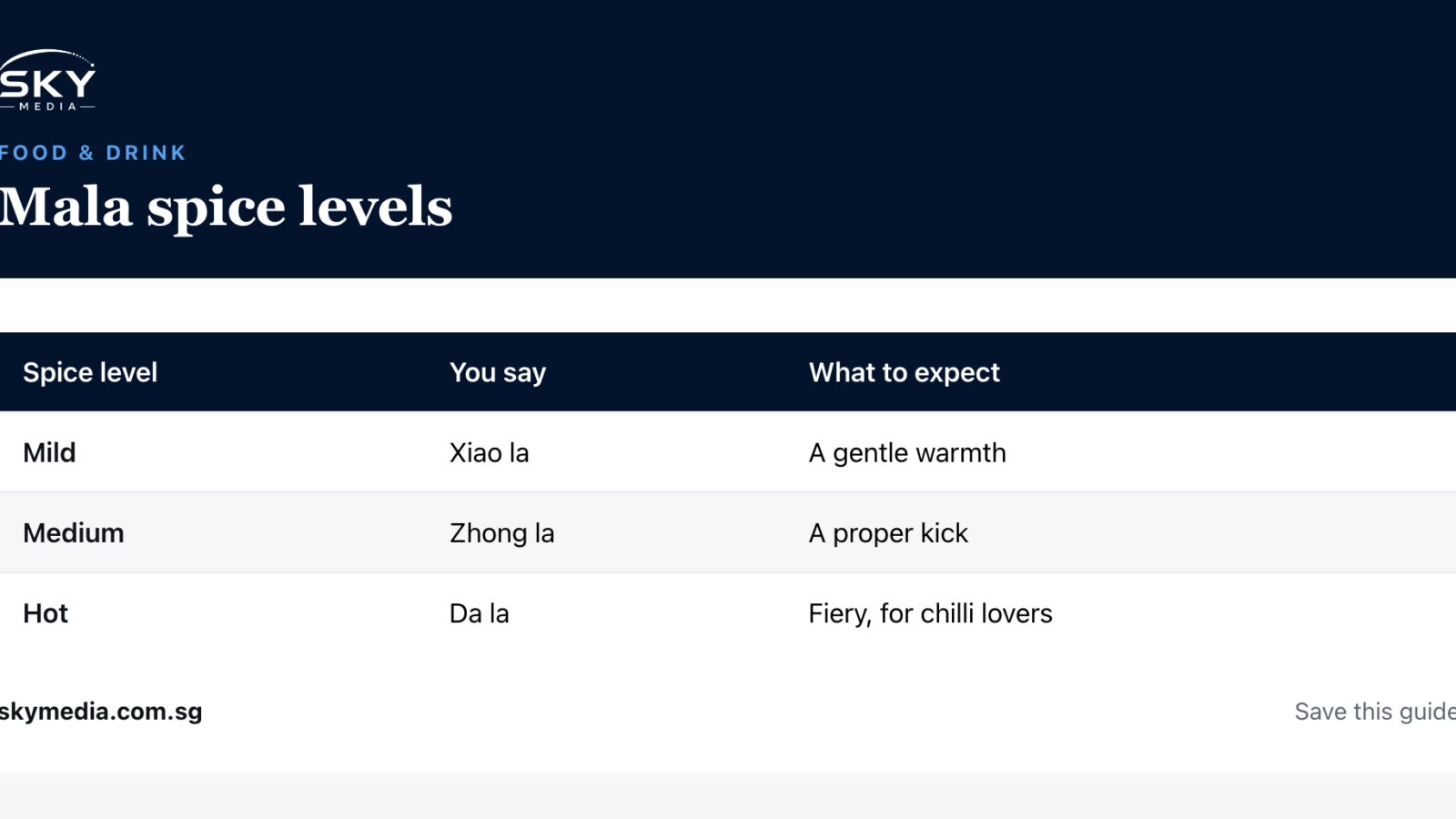
Mala heat usually comes in three levels, and you can ask for exactly what you want:
| Spice level | You say | What to expect |
|---|---|---|
| Mild | Xiao la | A gentle warmth |
| Medium | Zhong la | A proper kick |
| Hot | Da la | Fiery, for chilli lovers |
Remember that the tingly, numbing sensation is the “ma” from Sichuan peppercorns, which is separate from the chilli heat, so a bowl can be numbing without being fiery.
Popular ingredients to build your bowl
Half the fun of mala is composing your own plate. Some perennial favourites you will spot in the trays:
- Noodles and carbs: instant-style ramen, glass or sweet potato vermicelli (they soak up the oil beautifully), rice cakes and wide flat noodles.
- Proteins: thin-sliced pork or beef, luncheon meat, chicken, fish balls, prawns, squid and various fish slices.
- Tofu family: firm tofu, tau pok (fried tofu puffs), tofu skin and dried beancurd, all excellent sponges for the sauce.
- Vegetables: lotus root, cauliflower, enoki and other mushrooms, cabbage, xiao bai cai, kang kong and broccoli.
- The chewy bits: quail eggs, crab sticks, black fungus and various fish-paste products.
A balanced bowl usually mixes one or two proteins, a starch, a couple of vegetables and something for texture. Lotus root and enoki mushrooms in particular have near-cult status among regulars.
Why mala took over Singapore
Mala’s rise here is a genuinely local story. Sichuan food in Singapore found an audience partly through the growing mainland-Chinese community, who brought a taste for authentic ma la with them and kept demand high for the real, tongue-numbing version rather than a watered-down one. Stalls responded by keeping the peppercorn levels honest.
At the same time, mala slotted perfectly into how Singaporeans already like to eat: customisable, shareable, available late, and endlessly repeatable because no two bowls are the same. It rewards the local love of ordering exactly what you want, and it fits neatly into the country’s deep culture of communal eating. The dish now bridges communities, which is a big part of why it feels so at home. It is comfort food for newcomers and an adopted favourite for locals at once.
Quick tips before you queue
- Start one spice level below your ego, especially at a new stall.
- Watch the weight if you are on a budget; proteins add up fastest.
- Ask for dry (gan guo) for the classic, intense texture.
- Have a drink and plain rice ready to tame the burn.
- Sharing a large bowl beats over-ordering a giant solo one.
- Numbing lips are normal, not a sign anything is wrong.
Mala rewards curiosity. Order modestly the first time, learn which ingredients you love, nudge your spice level up as you go, and before long you will have your own regular combination that you can rattle off at the counter like you have been eating it for years.
Explore more: Steamboat and hotpot in Singapore · Must-try hawker food in Singapore · The Chinese community in Singapore