

Walk along East Coast Park on a weekend morning and you will spot runners with a thin band wrapped around the back of the head and nothing in their ears. That band is usually a pair of bone conduction headphones, and in Singapore they have moved from niche gadget to a common sight on park connectors, in gyms and even in open-plan offices. This guide looks at bone conduction headphones in Singapore alongside their close cousins, open-ear air conduction earbuds, and asks a narrower question than a general buying guide: who actually benefits from leaving the ear canal open, and who will be disappointed?
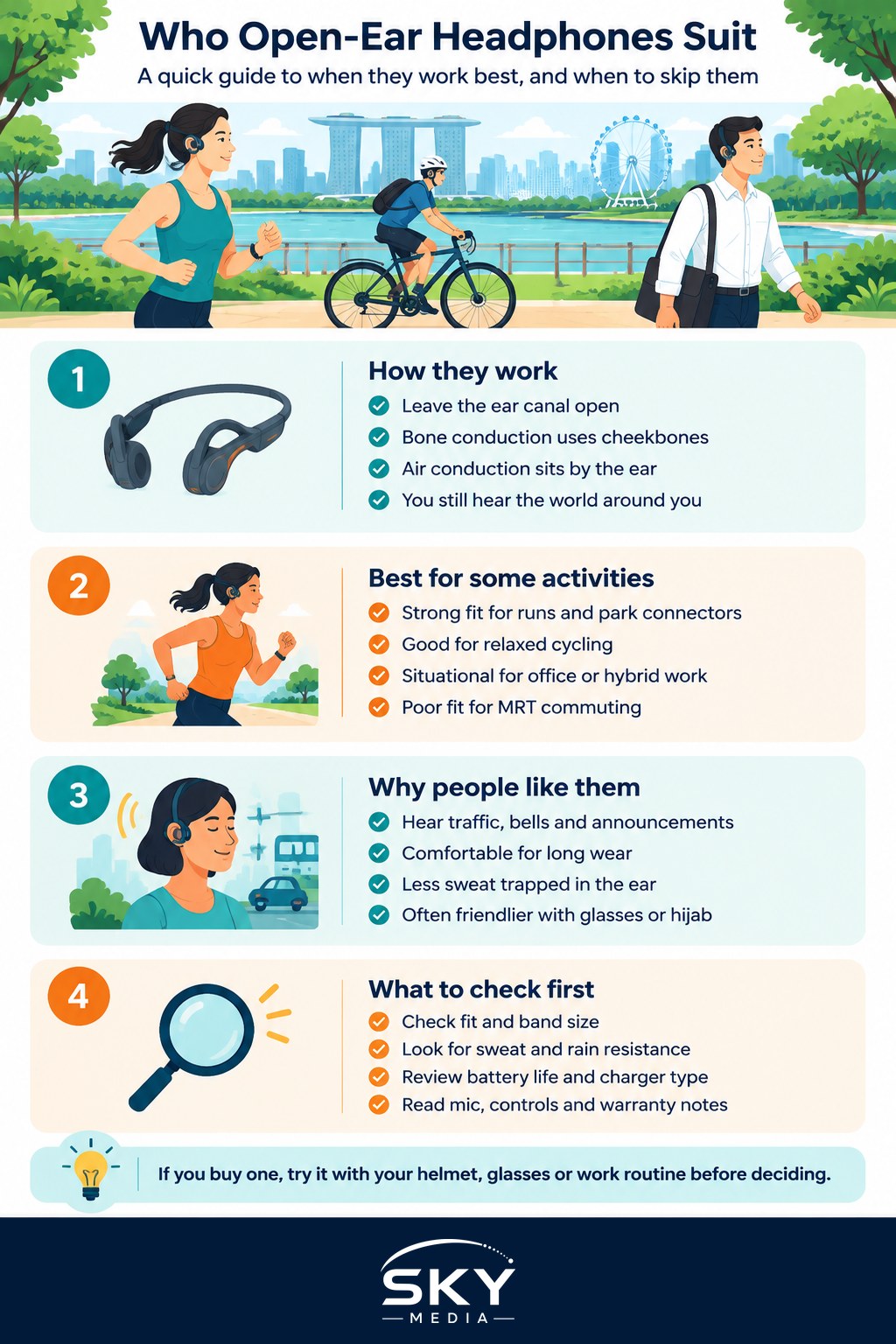
How Open-Ear Audio Works
Ordinary earbuds and headphones push sound straight into or over the ear canal. Open-ear designs leave the canal clear, and they come in two main types.
- Bone conduction. Small transducers sit on your cheekbones just in front of the ears. They vibrate, and those vibrations travel through the bones of the skull to the inner ear. Your eardrum is largely bypassed, which is why you can still hear traffic and conversation clearly.
- Open-ear air conduction. Tiny speakers hang just outside the ear canal, usually held by an ear hook or a clip that sits on the ear. They fire sound towards the canal through the air, much like a very small personal speaker.
Both types share the same core idea: you hear your music or podcast layered on top of the world around you, rather than replacing it. The difference lies in sound quality, comfort and how much leaks out to people nearby.
Runners, Cyclists and Office Workers Compared
The value of open-ear audio depends heavily on what you are doing. The table below summarises how it tends to play out for the three groups who ask about it most.
| Use case | Main benefit | Main drawback | Verdict |
|---|---|---|---|
| Running on park connectors and roads | Hear cyclists’ bells, PMDs and traffic; nothing to fall out or trap sweat in the ear | Weaker bass; music can be drowned out on busy roads | Strong fit |
| Cycling | Keeps awareness of vehicles and other riders | Wind noise at speed can mask audio; a band may clash with some helmets | Good fit, check helmet comfort |
| Office or hybrid work | Hear colleagues, doorbells and your child while on calls | Sound leaks at higher volume; less privacy and focus | Situational fit |
| Commuting on the MRT | Comfortable for long rides | Train noise overwhelms audio, tempting you to turn it up | Poor fit |
Runners
Runners are the classic audience. Singapore’s park connector network is shared with cyclists, personal mobility device users and walkers, and hearing a bell or a shout from behind is genuinely useful. Open-ear designs also avoid the problem of sweat pooling inside the ear during humid runs, and there is no seal to break when you bounce. Many models are rated for sweat and rain resistance, which matters when a sudden afternoon shower arrives. The trade-off is bass: without a seal, the deep thump that drives a tempo playlist is noticeably thinner.
Cyclists
For cyclists, awareness of traffic is the whole point. Check LTA’s current guidance on road and path safety, and remember that no headphone makes it safe to stop paying attention. In practice, wind noise above moderate speeds can make audio hard to hear, so open-ear headphones suit relaxed rides and park connector loops better than fast road sessions. Try the band with your own helmet before buying, because some helmet straps and retention cradles press on the headband.
Office and Hybrid Workers
In an office, open-ear audio lets you take a call while still hearing a colleague walk up, which some people find less isolating than noise-cancelling headphones. At home, parents like being able to hear a toddler while listening to a podcast. The catch is sound leakage. At moderate to high volume, people next to you can hear a tinny version of your audio, which can be awkward in a quiet office. If you need deep focus, closed-back or noise-cancelling headphones remain the better tool; our guide to open-back vs closed-back headphones explains that trade-off for desk listening.
Pros and Cons Worth Weighing
Before buying, be honest about which of these matters most to you.
Advantages
- Situational awareness: you can hear traffic, announcements and people speaking to you.
- Comfort for long sessions: nothing inside the ear canal, which suits people who find earbuds itchy or painful.
- Hygiene in the heat: less sweat and moisture trapped in the ear.
- Glasses and hijab friendly in many cases, since the band sits behind the head and the transducers rest lightly on the face.
Disadvantages
- Thinner bass and less detail than sealed earbuds or good over-ear headphones.
- Sound leakage at higher volumes.
- Poor performance in loud places such as trains, buses and hawker centres.
- Some bone conduction users notice a tickling vibration on the cheekbones at high volume.
- Phone call quality varies by model, especially outdoors in wind.
A useful tip: many bone conduction users carry a pair of foam earplugs. Inserting them blocks outside noise and makes the audio sound fuller, which helps on a noisy bus ride home after a run.
What to Check Before You Buy
Retailers in Singapore, from electronics chains to sports shops and online marketplaces, stock a range of open-ear models. Prices and line-ups change often, so focus on features rather than brand hype.
- Fit and band size. Bands come in standard and smaller sizes on some models. A loose band bounces when you run; a tight one presses on the head. Try them on in store if you can.
- Water and sweat rating. Look for an IP rating suited to sweat and rain. Swimmers need models specifically designed for swimming, often with onboard storage, since Bluetooth does not travel well underwater.
- Battery life and charging. Check the claimed hours and whether the charger is a proprietary magnetic cable, which is easy to lose.
- Microphone quality. If you will take work calls, read reviews that test calls in wind and noise.
- Controls. Physical buttons are easier than touch controls with sweaty fingers.
- Warranty and local support. Buying from an authorised local seller usually makes warranty claims simpler than a parallel import.
Because open-ear headphones sit against your skin in a sweaty climate, cleaning matters. Wipe the band and pads after workouts and follow the steps in our guide on how to clean and maintain your headphones.
Hearing Safety and Common Myths
Bone conduction is sometimes marketed as “safer” for your hearing. It does avoid sealing loud sound into the ear canal, but sound still reaches your inner ear, and very loud listening over long periods can still contribute to hearing damage. Keep the volume moderate and take breaks. If you notice ringing in the ears or muffled hearing, stop and see a doctor or audiologist.
Another myth is that open-ear headphones work for people with all types of hearing loss. Some people with certain conductive hearing issues do find bone conduction helpful, but this depends on the individual, and a consumer headset is not a hearing aid. Anyone with hearing concerns should get assessed by a doctor or an audiologist before relying on any device.
Who Should Skip Them
Open-ear headphones are not for everyone. If most of your listening happens on the MRT, in a busy open-plan office or on flights, you will spend your time fighting background noise. Music lovers who care about rich bass and fine detail will also be happier elsewhere; our guide to choosing headphones and earbuds in Singapore covers sealed earbuds, noise cancelling and over-ear options that suit those situations.
The simplest approach for many people is to own two pairs: an open-ear headset for runs, rides and keeping an ear on the household, and a sealed pair for commuting and focused work.
Explore more: Headphones for Audiophiles Explained
Frequently Asked Questions
Can I swim with bone conduction headphones? Only with models designed specifically for swimming, often with onboard storage, because Bluetooth does not travel well underwater. Ordinary sport models are rated for sweat and rain, not for being submerged. Check the water rating before you buy.
Do bone conduction headphones work with glasses or a hijab? In many cases yes, because the band sits behind the head and the transducers rest lightly on the face. Fit varies by model and by how thick your frames or fabric are, so try them on in store if possible before committing.
Will people around me hear what I am listening to? At moderate to high volume, yes, particularly with open-ear air conduction designs, where people next to you can hear a tinny version. In a quiet office that can be awkward. Keep the volume low, or choose sealed headphones for shared spaces.
Can bone conduction headphones help someone with hearing loss? Some people with certain conductive hearing issues find them useful, but it varies by individual and a consumer headset is not a hearing aid. Get assessed by a doctor or audiologist before relying on any device.
Are open-ear headphones okay to use while cycling on the road? They keep you aware of vehicles, but they are no substitute for paying attention. Wind noise at higher speeds can mask audio, so they suit relaxed rides better. Check LTA’s guidance on road safety, and test the band with your helmet first.