
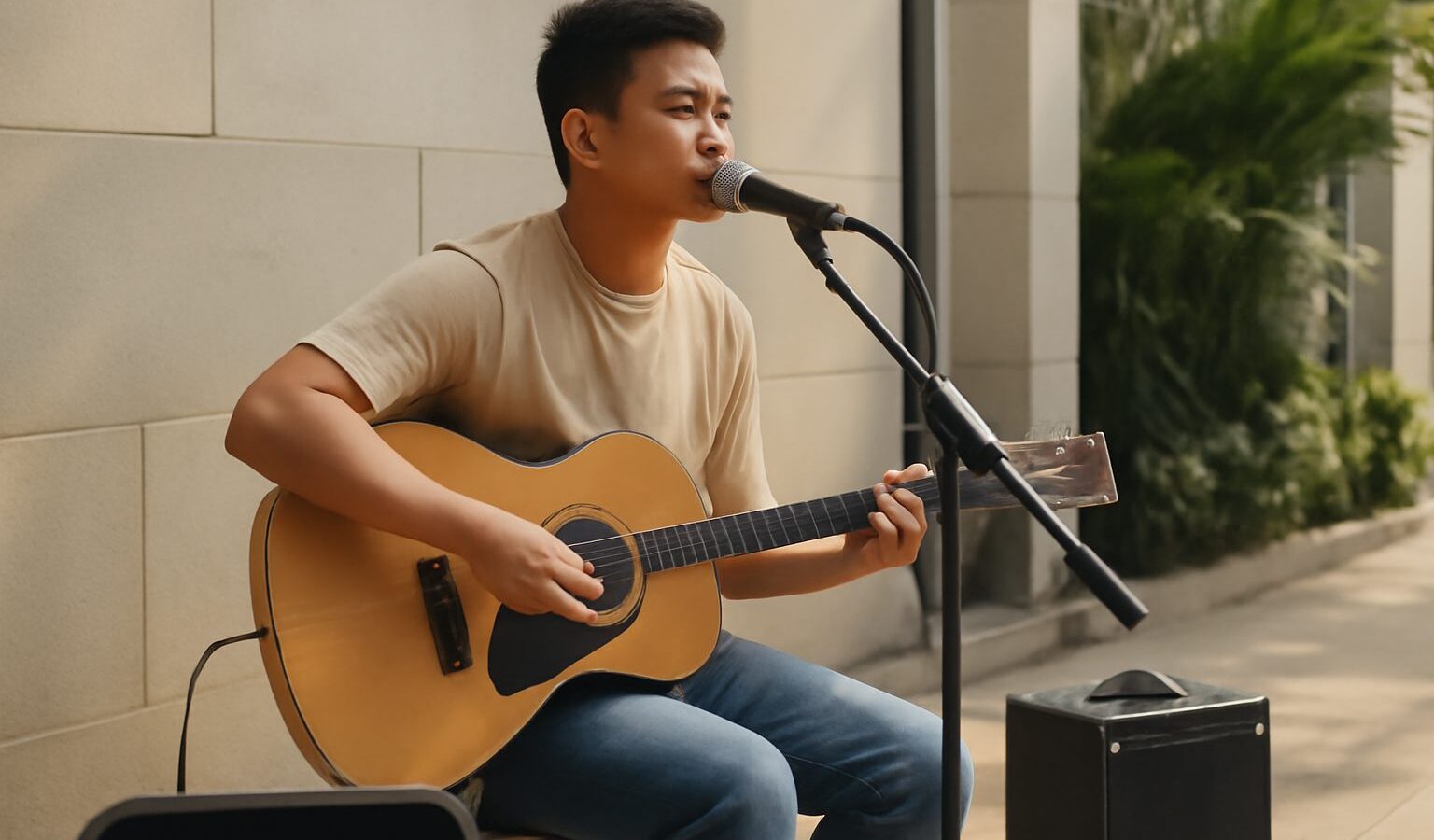
Playing your first song in front of strangers is one of the most rewarding steps a new musician can take, and you do not need a record deal or a big venue to do it. Open mics and busking in Singapore give beginners a low-pressure way to test songs, build confidence and meet other players. This guide explains the difference between the two, how the official busking scheme works, where to find open mics, and how to prepare a short set, whatever your instrument.
Open Mics Versus Busking: What Is the Difference
Both let you perform in public, but they work quite differently, and knowing which suits you helps you start in the right place.
An open mic is an organised event, usually at a cafe, bar or community space, where anyone can sign up to play a short slot, often two or three songs. There is a proper stage or corner, a small sound system, and a friendly crowd who came expecting live music. You do not need a licence to play an open mic, because the venue is hosting it on private premises.
Busking means performing in a public place, such as a walkway or a park, often with your instrument case open for tips. In Singapore this is not a free-for-all: street performing is managed under an official scheme so that public spaces stay safe and pleasant for everyone. That is the key thing to understand before you carry a guitar down to Orchard Road.
The table below sums up when each option makes sense.
| Situation | Try an open mic | Try busking |
|---|---|---|
| You are nervous and want a warm, seated crowd | Yes, the audience is there to listen | Less ideal, passers-by come and go |
| You want to practise performing regularly | Yes, sign up week after week | Yes, once you have your pass |
| You have not sorted a licence yet | Fine, no licence needed | Not yet, sort the scheme first |
| You want to earn tips outdoors | No, open mics rarely pay | Yes, that is the point |
| You want feedback from other musicians | Yes, players often stay and chat | Less so, the crowd is transient |
How the NAC Busking Scheme Works
Busking on public land in Singapore is administered through the National Arts Council (NAC) Busking Scheme. This is the part beginners most often get wrong, so treat the NAC as your single source of truth here rather than any secondhand advice, including this article.
In broad terms, the scheme involves an audition to show you can perform at a reasonable standard, and, if you pass, a busking pass or endorsement that lets you perform at designated public locations under a set of rules. The audition process, the eligibility criteria, the approved locations, any fees and the conduct rules can all change from time to time. Because of that, this guide does not quote specific figures or requirements.
What you should do is straightforward:
- Search for the “NAC Busking Scheme” on the National Arts Council’s official website and read the current details in full.
- Note the audition steps, what you need to prepare, and the closing dates for any application windows.
- Check the list of approved busking locations and the code of conduct, including rules on amplification and hours.
- Only busk in public once you hold a current, valid pass and are at an approved spot.
Playing an open mic while you wait for your audition is a smart way to keep performing legally in the meantime. It also gives you a polished two or three song set to bring to the audition itself.
Where to Find Open Mics Around Singapore
Open mics move around as venues open and close, so the trick is knowing where to look rather than memorising a fixed list. Cafes and bars in areas with a live-music culture are a good starting point, and community and arts spaces sometimes run beginner-friendly nights.
Try these approaches:
- Ask at independent cafes and bars. Many smaller venues host a weekly or monthly open mic. Look for a chalkboard sign, or simply ask the staff.
- Search social media locally. Instagram and Facebook listings for “open mic Singapore” surface current nights, with sign-up details.
- Check community and arts spaces. Community clubs, libraries and arts venues occasionally run open sessions that welcome all ages.
- Turn up early and listen first. Watching a session before you play tells you the vibe, the typical song length and how to sign up, and you will meet players who know the wider circuit.
Message the organiser ahead of time to confirm what backline is provided, whether you plug in or play acoustically, and how long each slot runs. That one message saves a lot of first-night uncertainty.
Choosing Your Songs and Preparing a Set
A short, well-rehearsed set beats a long, shaky one. For a first outing, prepare two or three songs you can play in your sleep, since nerves always take the edge off your polish.
Keep these principles in mind:
- Play to your strengths. Pick songs comfortably within your range and skill, not the hardest thing you know.
- Open strong. Lead with the song you are most confident in to settle your nerves in the first thirty seconds.
- Mix familiar and original. A recognisable cover warms up a crowd, while an original shows who you are. Playing covers at open mics is generally welcomed, but do not record or release one without checking the rules first.
- Time it. Rehearse to the clock so you fit your slot and do not overrun.
- Rehearse the transitions. Practise walking to the mic, tuning quietly and saying one friendly line between songs, not just the playing.
Gear, the Weather and Staying Comfortable
You do not need expensive equipment to start. An acoustic guitar or a portable keyboard, plus your voice, is plenty. If a venue provides a microphone and small PA system (the speakers and amplifier that make you louder), you may need to bring only your instrument. Confirm this with the organiser first.
Singapore’s climate deserves a mention. Heat and humidity affect both you and your gear, so a few habits help:
- Keep instruments out of direct sun and sudden temperature swings, and wipe strings down after playing to slow corrosion in the humid air.
- Carry water and a small towel, especially for outdoor busking slots with no air-conditioning.
- Bring cheap spares that save a set: strings, a capo, picks and a charged power bank for any battery-powered gear.
- For any outdoor amplification, follow the volume and equipment rules in the busking scheme rather than guessing.
Buy from local music shops so you can try instruments and get advice, and always check current prices and specifications yourself, as these change.
Playing Well and Building Confidence
Your first performance will not be flawless, and that is completely normal. The musicians you admire all started with a shaky first set. What matters is turning up, finishing your songs and coming back next time.
A few small things make a big difference. Make eye contact and smile, because a warm connection covers a lot of small mistakes. If you fluff a chord, keep going, since most listeners will not notice unless you flag it. Thank the crowd and the organiser at the end, as good manners get you invited back, and jot down one thing that went well and one to improve.
Over time, open mics and busking build stage skills that carry over to every gig. Treat each slot as practice, be patient, and enjoy sharing music with people who are glad you did.
Explore more
Warm up your voice with our guide to learning to sing and keep it healthy over many gigs with caring for your singing voice. When nerves hit before a slot, our tips on overcoming stage fright and the wider walkthrough of how to perform live music will steady you. If you would rather play with others, see joining a band or jamming in Singapore, and if you want original material for your set, start with writing your first song.