

Not every team needs a ballroom dinner and dance to close the year. For most departments, a relaxed lunch does the job better: it happens during working hours, nobody has to arrange childcare, and people actually talk to each other. If you have been handed the job of organising it, this guide gathers practical team lunch ideas Singapore offices use, plus the unglamorous parts that decide whether the day goes smoothly: dietary needs, bookings, who pays and how to make sure nobody feels left out.
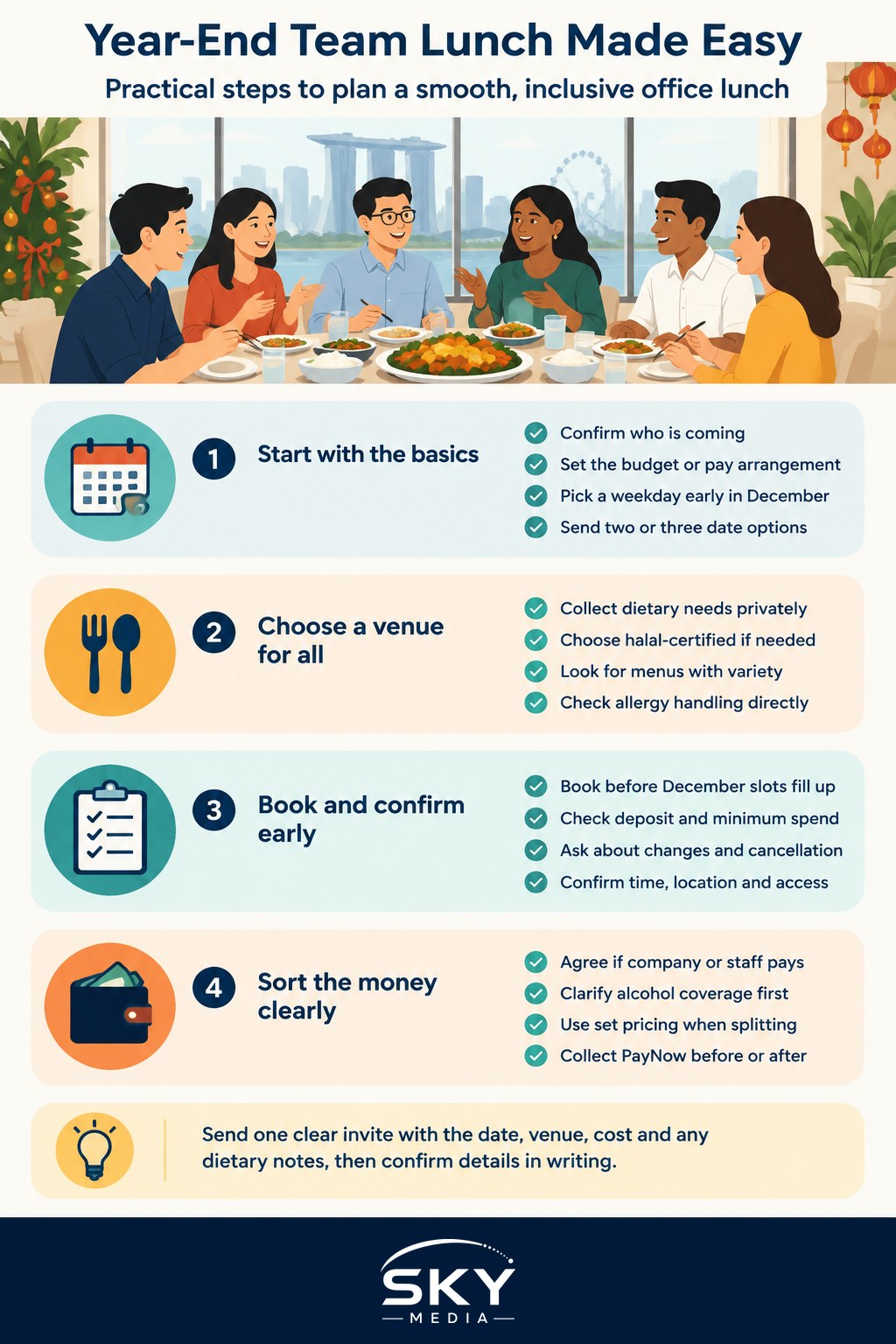
Start With the Basics: Headcount, Budget and Date
Before you browse a single menu, pin down three things.
- Who is coming. Is it just your immediate team, or the wider department, interns and contract staff too? Decide early and say so clearly, because an invitation that quietly skips some people causes more hurt than no lunch at all.
- Who is paying. Ask your manager or HR whether there is a team bonding or staff welfare budget, how much is available per head, and what the claim process looks like. Some companies reimburse after the event with receipts, others prefer the venue to invoice the company directly. If there is no budget, the lunch becomes “everyone pays for themselves”, which changes your venue choice.
- When. December fills up quickly. Weekday lunches in the first two weeks of the month are usually easier to book than the days just before Christmas, when many people are on leave. Send a quick poll with two or three date options rather than an open question.
Once you know the headcount range, the per-head figure and the date, the rest of the planning becomes a process of elimination.
Choosing a Venue That Works for Every Diet
Singapore teams are rarely uniform in what they eat. A typical group of fifteen may include colleagues who eat halal, vegetarians, someone who avoids beef, someone with a nut or shellfish allergy and someone who simply does not do spicy food. The venue has to cope with all of them without anyone feeling like an afterthought.
Practical ways to handle this:
- Collect dietary needs privately. Add a short optional field to your sign-up form instead of asking in the group chat. People are more comfortable sharing allergies or religious requirements one to one.
- Halal first if anyone needs it. If even one colleague eats halal, choosing a halal-certified venue is the simplest way to let everyone share the same dishes. You can check a restaurant’s status on the MUIS (Islamic Religious Council of Singapore) website, since a “no pork, no lard” sign is not the same as certification.
- Look for menus with natural variety. Cuisines with plenty of vegetable, seafood and chicken dishes make it easier to cater for mixed tables than a set menu built around one meat.
- Ask the venue directly. Call or email and list the requirements. A good restaurant will tell you honestly what they can and cannot do, including whether they can manage cross-contamination for serious allergies.
| Format | Works well for | Watch out for |
|---|---|---|
| Restaurant set lunch | Teams of 10 to 30 who want a sit-down meal | Fixed menus may not suit every diet; confirm swaps in advance |
| Private room booking | Teams who want speeches, games or privacy | Minimum spend requirements and earlier booking deadlines |
| Catered lunch in the office | Large or dietary-diverse teams, tight budgets | Needs a clean pantry or meeting room and someone to manage set-up |
| Potluck or food court outing | Casual teams with little or no budget | Can feel less special; agree on who handles halal-friendly dishes |
If your team is health-conscious or half of them are training for a race, our ideas for healthy lunches at work can help you pick a menu that will not leave people sleepy all afternoon.
Booking Without Last-Minute Panic
Once you have shortlisted a venue, book early and confirm in writing. Things to check before you commit:
- Deposit and minimum spend. Many restaurants ask for a deposit for group bookings in December, especially for private rooms. Find out whether it is refundable and by when.
- Cancellation and headcount changes. Ask how late you can adjust the final number. In December, colleagues fall sick, get pulled into client meetings or take leave at short notice.
- Time limits. Some venues allocate a fixed slot for lunch groups. If your team plans to do a gift exchange or a short speech, make sure the slot is long enough.
- Location and travel. Choose somewhere reachable within the lunch break, ideally walking distance or one MRT stop away. If people must travel, factor that into the time you ask for.
- Accessibility. Check for step-free access if anyone uses a wheelchair, is pregnant or has a temporary injury.
Send a calendar invite with the address, time, dress code (usually “office wear is fine”) and a reminder of any gift exchange rules. One clear message saves a dozen questions.
Splitting the Bill or Claiming the Budget
Money is where team lunches most often get awkward. Make the arrangement explicit from the start.
If the company is paying:
- Ask the finance or admin team how they want it billed. Some prefer a single tax invoice in the company’s name, others want the organiser to pay first and claim.
- If you are paying upfront, keep the itemised receipt and any invoice, and submit the claim promptly according to your company’s expense policy. December claims can get caught by year-end cut-offs.
- Clarify whether alcohol is covered. Some company budgets exclude it, in which case drinks are paid separately.
- If the bill comes in over budget, know beforehand whether staff top up the difference or whether you need to choose a cheaper set.
If everyone is paying their own share:
- Share the expected cost per person when you send the invitation so nobody is surprised.
- Use a set menu or per-person pricing where possible; it is fairer than dividing an à la carte bill evenly when some people only had soup.
- Collect payments by PayNow before or right after the lunch, and send one friendly reminder rather than chasing in the group chat.
- Be sensitive to junior staff and interns. A senior team member covering a shared dessert or drinks round is a kind gesture, but never make it an expectation.
December is a costly month for many people. If you are watching your own spending too, see our guide on how to budget for the year-end festive season.
Keeping the Lunch Inclusive and Enjoyable
A good year-end lunch makes every person feel they were genuinely part of the team’s year. Small decisions make a big difference.
- Mind the drinks. Not everyone drinks alcohol, for religious, health or personal reasons. Make non-alcoholic options just as easy to order and never comment on what someone chooses.
- Keep any activities light. A short thank-you from the manager, a simple quiz about the year or a low-cost gift exchange works well. Avoid games that single people out or put anyone on the spot.
- Remember remote and hybrid colleagues. If some team members work from another office or country, consider sending them a meal voucher or delivery on the same day, and include them in a quick video call during dessert.
- Seat people thoughtfully. Long tables can split into cliques. Mixing seating loosely, or rotating during dessert, helps newer staff meet people they rarely work with.
- Respect boundaries on time. Make it clear when the lunch ends and that people can return to work. Nobody should feel pressured to linger or to join a second round afterwards.
If colleagues ask what to wear, most team lunches are smart casual, but our note on what to wear to a year-end office party covers dressier occasions too.
A team lunch does not need to be elaborate to be memorable. Clear planning, a menu everyone can enjoy and a fair approach to money are what people will actually remember.
Explore more: A Year-End Bonus Checklist for Singapore Workers