
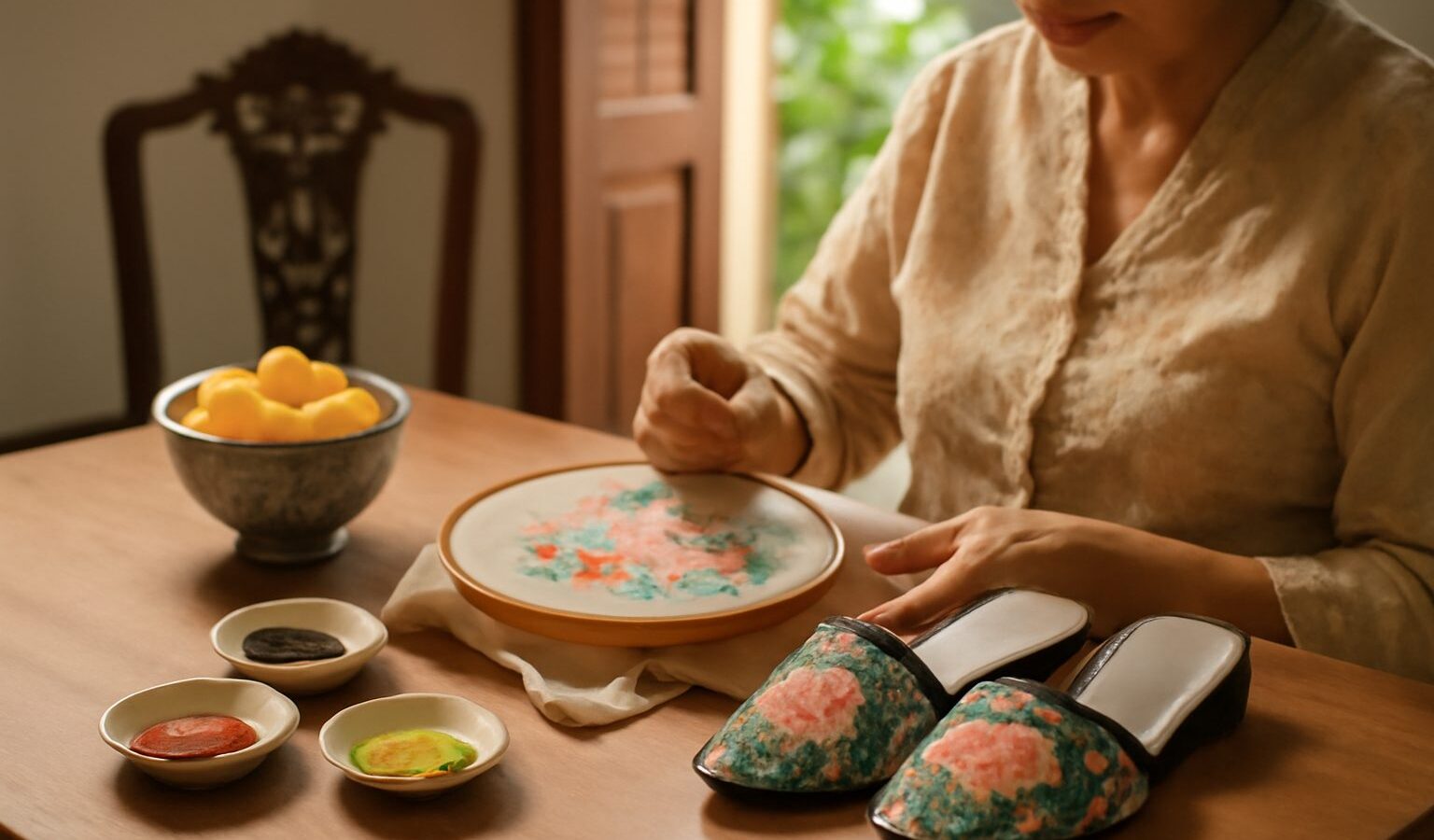
Look closely at a pair of antique nyonya slippers and you may be astonished by what you see: hundreds upon hundreds of tiny glass beads, each stitched by hand into flowers, birds and scrolling leaves. Peranakan beadwork is one of the most delicate and patient of Singapore’s heritage crafts, and its most beloved product is the beaded slipper. For newcomers, it offers a close up view of the artistry and refinement that defined Peranakan home life.
What Peranakan beadwork is
Peranakan beadwork is the craft of decorating cloth with minute glass beads, most famously to create the fronts of slippers. It belongs to the Peranakan community, whose name comes from the Malay word for “locally born” and who blended Chinese ancestry with Malay and wider Southeast Asian influences in language, food, dress and craft. A Peranakan woman is known as a nyonya, and beadwork was traditionally one of her domestic arts.
The signature item is the beaded slipper, known as kasut manek. The term comes from Malay, where “kasut” means shoe and “manek” means bead. These were not everyday footwear but finely made pieces worn with the sarong and kebaya, the embroidered blouse and wrapped cloth that make up traditional nyonya dress. A young woman’s skill with beads was once seen as a mark of patience, taste and accomplishment, qualities admired within the community.
Beyond slippers, the same beading skill decorated purses, belts, cushion covers and other items, especially those prepared for weddings, when a household would display its finest handwork.
How beaded slippers are made
The craft depends on very small, faceted glass beads. Because each bead has cut faces, it catches the light like a tiny gem, which is why a finished slipper front can shimmer and shift in colour as it moves. The beads are counted out by shade and worked one at a time, so the craft rewards steadiness and a good eye more than speed.
A typical process runs roughly like this:
- A design is drawn or traced onto a piece of fabric stretched taut in a frame.
- The maker sews on the beads bead by bead, following the pattern and building up areas of colour.
- Fine gradations of shade are used to give flowers and birds a soft, almost painted appearance.
- The completed beaded panel is taken to a cobbler, who mounts it onto a slipper base.
The motifs are where beadwork shows its character. Favourite designs include roses, peonies and other blooms, along with birds, butterflies and the phoenix, all rich with associations of beauty, love and good fortune. Colours often lean towards soft pastels and jewel like accents, arranged with a strong sense of balance. Because the beads are so small and the shading so subtle, a single pair of slippers can represent a great many hours of work, which is part of what makes genuine handbeaded pieces so prized.
Tastes and techniques also vary from family to family and from one maker to the next, so no two pairs are ever quite the same. Some pieces are densely covered in beads for a jewelled effect, while others leave more of the background showing for a lighter look. Older slippers tend to use especially tiny beads that are hard to source today, which is one reason antique examples are treasured. Learning to notice these differences, the size of the beads, the smoothness of the shading, the neatness of the finishing, is a large part of the pleasure of appreciating the craft.
Where to see Peranakan beadwork in Singapore today
In multiracial Singapore, Peranakan beadwork survives as both a heritage treasure and a craft that dedicated makers still practise. Curious newcomers can encounter it in several ways:
- Museums and heritage houses, where antique slippers, purses and beaded panels are displayed alongside Peranakan furniture and porcelain.
- Weddings and family celebrations, where heirloom or newly made pieces are brought out.
- Craft demonstrations and workshops, where visitors can watch beading up close or try it themselves.
- Specialist makers and boutiques, where beaded slippers are still created and sold.
A natural starting point is the Peranakan Museum, which sets the craft in the wider context of Peranakan life and objects; our Peranakan Museum guide can help you plan a visit. Programmes and demonstrations supported by the National Heritage Board also appear from time to time, so it is best to check current listings rather than rely on fixed dates.
| Feature | Origin of term | What to notice |
|---|---|---|
| Kasut manek | Malay | The beaded slippers at the heart of the craft |
| Manek | Malay | The tiny faceted glass beads used |
| Nyonya | Malay | The Peranakan woman for whom the craft was a domestic art |
| Faceted beads | English | Cut glass beads that sparkle and add depth |
| Cobbler mounting | English | The step where the beaded panel becomes a slipper |
Why the craft matters and how it survives
Peranakan beadwork is a small scale art with a large meaning. Each pair of slippers records hours of patient handwork and a whole aesthetic of refinement, restraint and beauty that shaped the Peranakan home. To see the craft is to understand something essential about the community that made it, and about how skill and taste were once expressed through everyday objects.
Like other fine handcrafts, beadwork is vulnerable. It is slow, exacting and easily replaced by machine made imitation, and the makers who truly master it are few. This is why teaching, displaying and buying genuine work all matter. Heritage institutions, community groups and individual artisans keep the craft alive through exhibitions, workshops and by passing techniques to new hands, while collectors and families sustain it by valuing the real thing.
For newcomers, appreciation itself is a form of support: taking time to look closely, learning to tell handbeaded pieces from printed imitations, or joining a workshop to feel just how demanding the work is. Beadwork also belongs to a wider family of Peranakan and regional crafts worth exploring. Explore more: read our guides to the nyonya kebaya, songket weaving, and chinese calligraphy heritage.
Approached with respect and curiosity, Peranakan beadwork offers newcomers a quiet, dazzling reminder that some of Singapore’s greatest heritage lives not in grand monuments but in the smallest of details, one tiny bead at a time.