
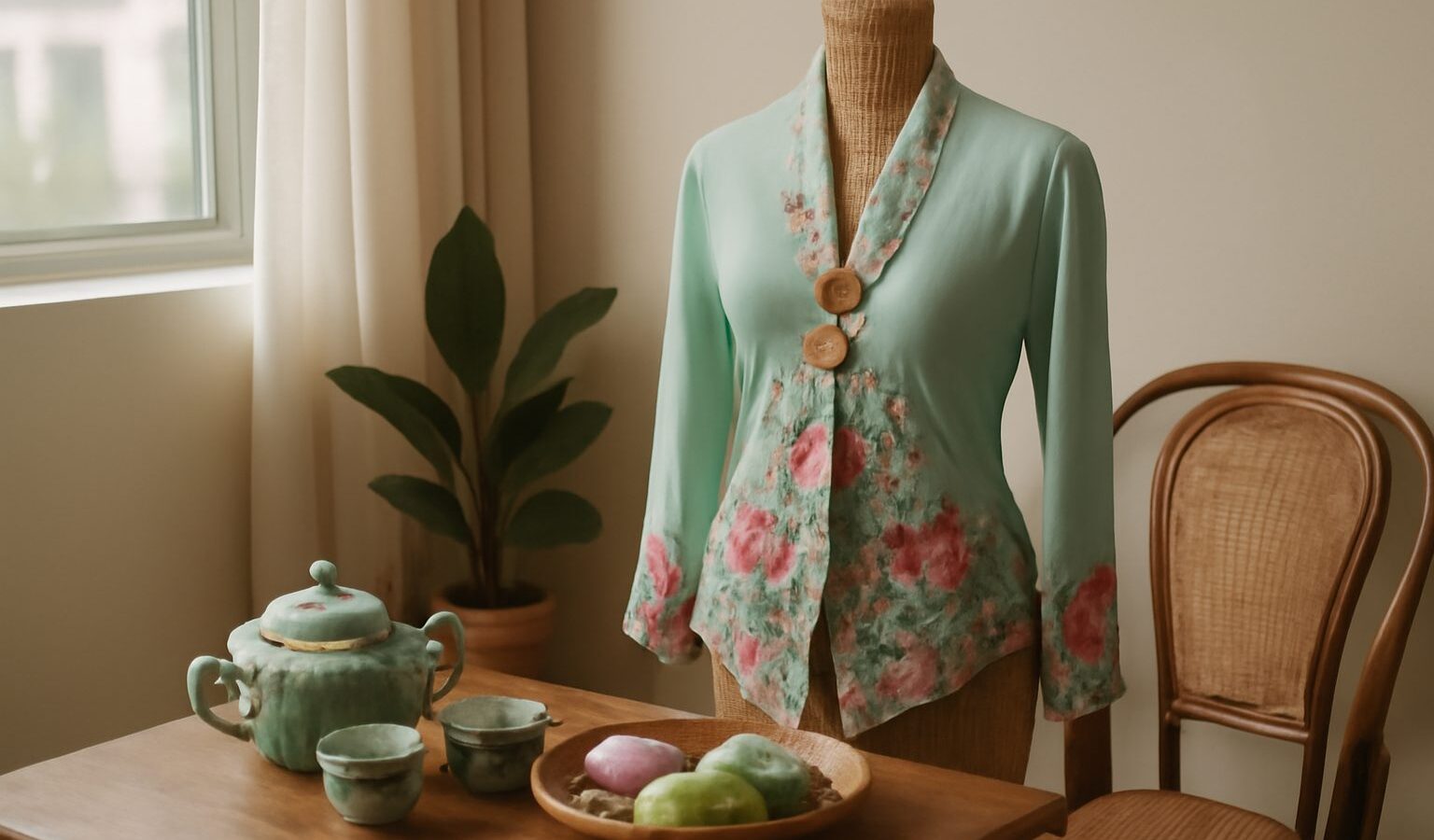
Walk through a Peranakan gallery or a heritage wedding in Singapore and you may catch sight of the nyonya kebaya, a sheer, exquisitely embroidered blouse worn over a colourful sarong. Delicate yet striking, it is one of the most recognisable symbols of Peranakan culture and a beautiful entry point for newcomers into Singapore’s layered heritage. This guide looks at what the nyonya kebaya is, how it is made, and where you can admire it today.
What the nyonya kebaya is
The nyonya kebaya is the traditional dress of Peranakan women. The word “Peranakan” comes from Malay and broadly means “locally born”, describing communities of mixed heritage that grew up over generations in the port cities of the region. Among them, the Straits Chinese Peranakans blended Chinese ancestry with Malay and wider Southeast Asian influences in their language, food, customs and dress. A Peranakan woman is called a nyonya, and a man a baba, both terms drawn from the Malay speaking world.
“Kebaya” is a Malay word for a fitted, open fronted blouse worn across much of maritime Southeast Asia. The nyonya version is its own distinct style: cut close to the body, often in fine, semi transparent fabric, and richly decorated with embroidery. It is worn with a sarong, a length of patterned cloth wrapped around the lower body, usually made using batik, the wax resist dyeing technique of the region. Together the kebaya and sarong form an outfit that is elegant, practical in a tropical climate, and deeply expressive of Peranakan taste.
How the nyonya kebaya is made
The craft of the nyonya kebaya lies in its embroidery. The blouse is typically sewn from light, airy fabric such as fine cotton voile, chosen to suit the heat and to let intricate stitching show to advantage. Onto this the maker works sulam, the Malay term for embroidery, often using a technique of openwork in which tiny holes are cut and finished so that the pattern seems to float within the cloth.
The motifs carry meaning and beauty in equal measure. Common designs include:
- Flowers such as peonies, roses and orchids, symbols of prosperity and grace.
- Birds and butterflies, including the phoenix, associated with good fortune and love.
- Foliage and scrolling vines that frame the neckline, front opening and hems.
Because the kebaya is open at the front, it is not buttoned but fastened with a kerosang, also spelt kerongsang, a set of linked brooches. A typical set has three pieces joined by fine chains, often the work of skilled jewellers and sometimes set with stones or worked in gold. The sarong completes the look, with its batik pattern chosen to complement the colours of the blouse. Traditionally the two were coordinated with great care, so that colour, motif and occasion all spoke to one another.
Styles also vary from family to family and across the wider region, and individuals wear the kebaya to different degrees, from full traditional dress for a wedding to lighter, everyday adaptations. Colour once carried gentle conventions too, with brighter shades for festive days and more restrained tones for solemn ones. None of this is a fixed rule so much as a living sense of taste, passed on within families and adapted by each generation. Part of the pleasure of the kebaya is exactly this play between shared tradition and personal choice, which keeps the dress feeling contemporary rather than fixed in the past.
Where to see the nyonya kebaya in Singapore today
In multiracial Singapore, the nyonya kebaya is both a heritage treasure and a living form of dress. Curious newcomers can encounter it in several ways:
- Museums and heritage houses, where antique kebayas, brooches and sarongs are displayed alongside Peranakan furniture and porcelain.
- Weddings, festive gatherings and National Day, where families bring out the kebaya for special occasions.
- Cultural performances and community events, where the dress is worn with pride.
- Boutiques and tailors specialising in Peranakan wear, where new kebayas are still made and fitted.
Many visitors also recognise a version of the sarong kebaya from the long standing uniform of Singapore’s national airline, a familiar sight that has helped keep the silhouette in the public eye. To understand the dress in its cultural home, the Peranakan Museum is an excellent starting point, and our Peranakan Museum guide can help you plan a visit. Institutions supported by the National Heritage Board also run talks, trails and family activities, so it is worth checking current listings rather than relying on fixed times.
| Feature | Origin of term | What to notice |
|---|---|---|
| Kebaya | Malay | The fitted, open fronted embroidered blouse |
| Sarong | Malay | The wrapped lower garment, often made with batik |
| Sulam | Malay | The embroidery and openwork that decorate the blouse |
| Kerosang | Malay | The linked set of brooches that fastens the front |
| Nyonya | Malay | A Peranakan woman, for whom the outfit is named |
Why the nyonya kebaya matters
The nyonya kebaya is a wearable record of how cultures met and mingled in this part of the world. In a single outfit you can read Chinese motifs, Malay dress, regional batik and the fine handwork of local craftspeople, all brought together in a style that is unmistakably Peranakan. For many families it is also personal, passed down through generations and brought out for the milestones that matter most.
Like other heritage crafts, the kebaya depends on skills that take years to master, and on new makers and wearers to carry it forward. Encouragingly, the kebaya has drawn renewed attention in recent years, including recognition as a shared cultural heritage across several Southeast Asian nations, a reminder that it belongs to a whole region rather than any one place. In Singapore, heritage bodies, community groups and small businesses keep it alive through exhibitions, workshops and everyday wear.
For newcomers, taking an interest is itself a gentle form of support: visiting a gallery, learning the terms, or simply admiring a well made kebaya at a celebration. The dress pairs naturally with other Peranakan and regional crafts, so it rewards deeper exploration. Explore more: read our guides to Peranakan beadwork and slippers, songket weaving, and the chinese calligraphy heritage that shares Singapore’s craft traditions.
Approached with respect and curiosity, the nyonya kebaya offers a graceful, tactile way into Peranakan heritage, and a reminder that some of Singapore’s richest stories are stitched, quite literally, into the clothes people wear.