
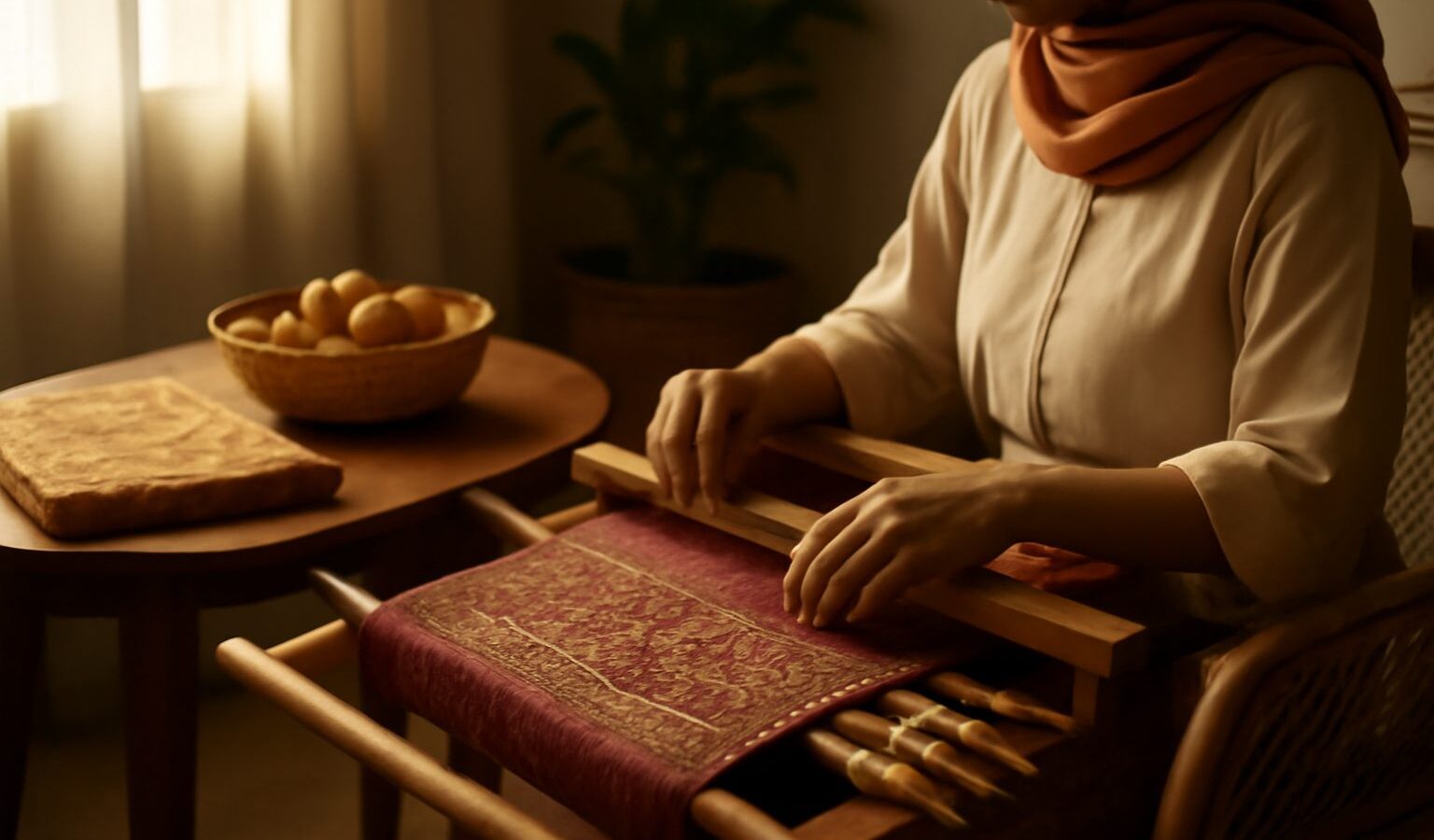
Hold a length of songket up to the light and it seems to catch fire, as threads of gold and silver flicker against deep silk. Songket weaving is one of the most luxurious textile traditions of the Malay world, reserved through history for weddings, ceremonies and moments of importance. For newcomers to Singapore, learning to recognise songket is a lovely way into the region’s craft heritage and into the Malay culture woven through everyday island life.
What songket is and where it comes from
Songket is a handwoven cloth, traditionally of silk or fine cotton, patterned with supplementary threads of gold or silver that are woven directly into the fabric so the design shimmers on the surface. The name is commonly traced to the Malay word “sungkit”, meaning to hook or to pick out, which describes the technique of lifting and inserting the metallic threads by hand.
The craft belongs to the wider Malay Archipelago, with celebrated weaving centres across the Malay Peninsula and the islands of the region. Each area developed its own favoured colours, motifs and ways of laying out a design, so an experienced eye can often tell roughly where a piece comes from. Historically, songket was closely associated with courtly and ceremonial life. Because the materials were costly and the work slow, the cloth signalled status and was worn for the grandest occasions, from royal ceremonies to weddings.
That ceremonial role continues today. In Singapore, songket appears most often at Malay weddings and festive celebrations such as Hari Raya, where it is worn as part of formal dress, adding richness and dignity to the moment.
How songket is woven
Making songket is patient, skilled work carried out on a handloom. The weaver first prepares the base cloth, choosing the ground colour and setting up the vertical warp threads on the loom. The plain weave of the background is built up by passing the weft thread back and forth, exactly as in ordinary weaving.
The magic lies in the extra, or supplementary, weft. To create the golden pattern, the weaver inserts additional metallic threads only where the motif requires them, lifting particular warp threads and slipping the gold thread beneath so that it floats on the surface of the cloth. Because this is done by hand, motif by motif and row by row, a richly patterned piece can take a very long time to complete. The general stages look like this:
- The design and colours are planned, and the metallic and silk threads are prepared.
- The warp is measured and mounted on the loom.
- The plain ground cloth is woven as the foundation.
- The gold or silver pattern is picked out with supplementary weft threads.
- The finished length is checked, cut and prepared for tailoring.
Songket motifs are frequently drawn from nature and geometry, stylised into elegant, repeating forms. A common example is the bamboo shoot motif, a triangular design often used along borders, while flowers, stars and scrolling shapes fill the body of the cloth. The result is a fabric that is both structured and lavish.
The choice of ground colour matters as much as the pattern. Deep reds, purples, greens and blacks are often chosen so the gold or silver stands out, and the overall effect is meant to read well both up close and across a room. Because so much depends on the weaver’s judgement, no two handwoven lengths are ever quite identical, and small variations are a sign of genuine handwork rather than a flaw. Learning to read these details, the density of the gold, the crispness of a motif, the way a border is finished, is part of what makes appreciating songket so rewarding.
Where to see and learn about songket in Singapore today
In multiracial Singapore, songket is best understood as a living part of Malay heritage rather than a museum relic. Curious newcomers can encounter it in several ways:
- Heritage institutions and exhibitions, where antique and contemporary textiles are displayed and explained.
- Malay weddings and festive gatherings, where songket is worn as ceremonial dress.
- Cultural showcases and demonstrations, where visitors can see weaving techniques up close.
- Specialist shops and tailors, where songket is sold and made up into formal outfits.
A natural anchor for exploring this heritage is the Malay Heritage Centre, which interprets the history and culture of Singapore’s Malay community; our Malay Heritage Centre guide can help you plan a visit. Programmes and demonstrations supported by the National Heritage Board also appear from time to time, so it is worth checking current listings rather than assuming fixed dates.
| Feature | Origin of term | What to notice |
|---|---|---|
| Songket | Malay | Cloth woven with shimmering metallic thread |
| Sungkit | Malay | The hooking or picking technique behind the name |
| Supplementary weft | English | The extra gold or silver thread that forms the motif |
| Pucuk rebung | Malay | The bamboo shoot motif often used on borders |
| Ground cloth | English | The silk or cotton base into which the pattern is woven |
Why songket matters and how it is kept alive
Songket is more than a beautiful fabric. It is a record of skill, taste and ceremony carried across generations, and a mark of respect on the occasions where it is worn. To drape a bride or groom in songket, or to bring it out for a family celebration, is to link the present moment to a long line of craft and custom.
Like many handmade traditions, songket faces real pressures. Hand weaving is slow and demanding, machine made imitations are widely available, and skilled weavers take years to train. This is why the work of teaching, displaying and wearing it matters so much. Heritage bodies, community groups and individual artisans keep songket alive through exhibitions, demonstrations and by encouraging new makers, while families sustain it simply by continuing to wear it with pride.
For newcomers, appreciation is a quiet form of support: learning to tell handwoven songket from printed imitations, admiring it respectfully at a celebration, or seeking out a demonstration to watch the technique for yourself. The craft also sits beautifully alongside other regional traditions. Explore more: read our guides to the nyonya kebaya, wayang kulit shadow puppetry, and Peranakan beadwork and slippers.
Seen in this light, songket weaving is not only a textile but a thread of continuity, connecting Singapore’s Malay heritage to the wider region and inviting newcomers to notice the glimmer of gold that still marks life’s most important days.