
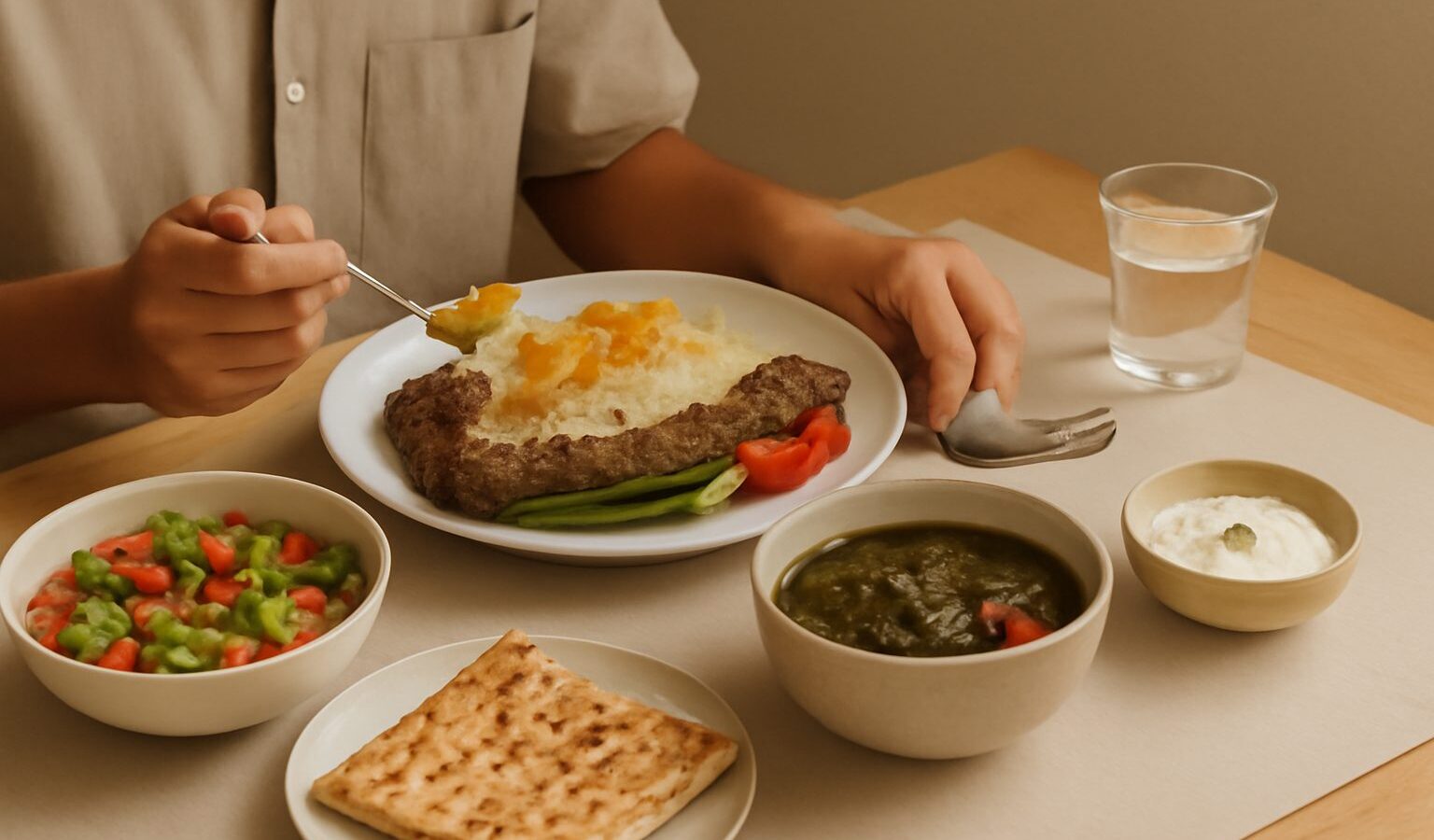
Persian food in Singapore is easy to miss and very rewarding once you find it. Iran has one of the world’s oldest cooking traditions, built on fragrant rice, gentle spicing, slow stews and charcoal-grilled meats, and it sits somewhere quietly between the Middle Eastern and Central Asian flavours many diners already know. If you have only ever had a doner kebab from a late-night stall, real Iranian cooking will feel like a different world: softer, more perfumed, and generous with herbs. This guide explains what the cuisine is about, what to order first, and how to enjoy it here.
What Makes Persian Cooking Distinct
The heart of Persian cooking is balance rather than heat. Where some cuisines chase chilli and punch, Iranian dishes lean on aroma, sourness and a savoury depth built over hours. Saffron, dried lime, rosewater, sumac, cinnamon, turmeric and fresh herbs do most of the work, and chilli plays only a small part. The result is food that tastes rich without being heavy.
Rice is treated with real care. The prized style is a fluffy, separate-grained rice cooked so that a golden crust forms at the bottom of the pot. That crust, called tahdig, is scooped out and shared, and regulars often ask for it specially. Herbs appear everywhere, not just as a garnish but by the handful, folded into rice or simmered down into stews until they turn deep and mellow. Sourness from dried lime or pomegranate gives many dishes their signature tang.
For anyone in Singapore used to bold hawker flavours, the first impression can be that Persian food is mild. Give it a few bites. The subtlety is the point, and the layering of saffron, slow-cooked meat and sour notes becomes more interesting the more you eat.
The Dishes Worth Knowing
A good starting order covers a grill, a stew and a rice dish, so you taste the full range in one sitting. Kebabs are the most familiar entry point. Iranian kebabs are usually seasoned simply and grilled over charcoal, then served with rice or flatbread, grilled tomato and raw onion. The classic pairing of buttered saffron rice with a skewer of grilled meat is a comforting, generous plate and a safe first choice.
The stews, known as khoresh, are where the cuisine shows its depth. They are slow, herb-heavy and often sour, spooned over rice rather than eaten alone. Two are worth seeking out in particular: a dark, herbaceous stew of greens, beans and lamb sharpened with dried lime, and a sweet-sour stew thickened with ground walnuts and pomegranate. Both taste unlike anything on a typical local menu.
Beyond those, look out for:
- Herbed rice with fish or beans, often served around Persian New Year and bright green from fresh herbs.
- Layered saffron rice cakes with chicken or yoghurt, baked until the base turns crisp and golden.
- Flatbread, feta, walnuts and fresh herbs served as a simple opener, meant to be wrapped and eaten by hand.
- Yoghurt sides, sometimes with cucumber or shallots, to cool and refresh between richer bites.
- Rosewater and saffron desserts, along with cardamom-scented tea to finish.
What to Order for Your First Meal
If you are choosing between the highlights, this table sorts a first Persian meal by what each dish delivers, so a table can share a good spread.
| Dish | What it is | Best for |
|---|---|---|
| Chelo kebab | Grilled meat skewer with saffron rice | A safe, satisfying first order |
| Ghormeh sabzi | Slow herb stew with beans and dried lime | Tasting the cuisine’s true depth |
| Fesenjan | Sweet-sour walnut and pomegranate stew | The most unusual, memorable flavour |
| Tahchin | Baked saffron rice cake with chicken | Sharing something a little special |
| Sabzi and feta plate | Herbs, cheese and flatbread | A light, refreshing opener |
Order a couple of grills, one stew to share and a herb plate, and you will have covered the essentials without over-ordering.
Where to Find It in Singapore
Persian and Iranian food is a niche corner of the dining scene here, so you will not stumble on it the way you do with local or Japanese food. It tends to appear in a handful of specialist Middle Eastern restaurants, in a few casual eateries around town and the CBD, and sometimes tucked into the menu of a broader Arab or Persian grill house. Areas with a longer Middle Eastern dining history are a sensible place to begin your search.
Because these places are few and can change hands, it is worth a quick check of current opening hours and menus before you head out, and a call ahead helps for larger stews that may be cooked in limited quantities. Many kitchens are also happy to guide newcomers, so tell them it is your first time and ask what they recommend that day. If you cannot find a dedicated restaurant, some Middle Eastern grocers and delis stock Iranian rice, dried limes, saffron and flatbread, which makes a simple home version very achievable.
Most Persian menus are naturally friendly to a range of diets, with plenty of grilled meats, herb and bean stews and vegetable sides, but always confirm ingredients directly if you are avoiding common allergens such as dairy, nuts or gluten, since walnuts, yoghurt and wheat flatbread feature often.
How to Eat and Enjoy It
Persian meals are relaxed and made for sharing. Rice is the centre of the table, and stews, grills and sides are spooned around it rather than plated individually. Mix a little stew into your rice, add a scrap of crisp tahdig, and alternate rich mouthfuls with cooling yoghurt or a bite of raw onion, which is there to cut through the richness rather than to be eaten whole.
Take your time. This is slow food that rewards a leisurely pace, ideally with cardamom tea afterwards and something sweet and floral to close. Eat with your hands where flatbread is involved, go easy on your first order until you know the portion sizes, and do not be shy about asking for the tahdig. Approached this way, Persian food in Singapore turns from an unfamiliar name into one of the most quietly satisfying meals in the city.
Explore more
If world cuisines are your thing, our guides to Turkish food in Singapore and Greek food in Singapore sit naturally alongside this one. For something closer to home, see how the region compares in Malaysian versus Singaporean food.