
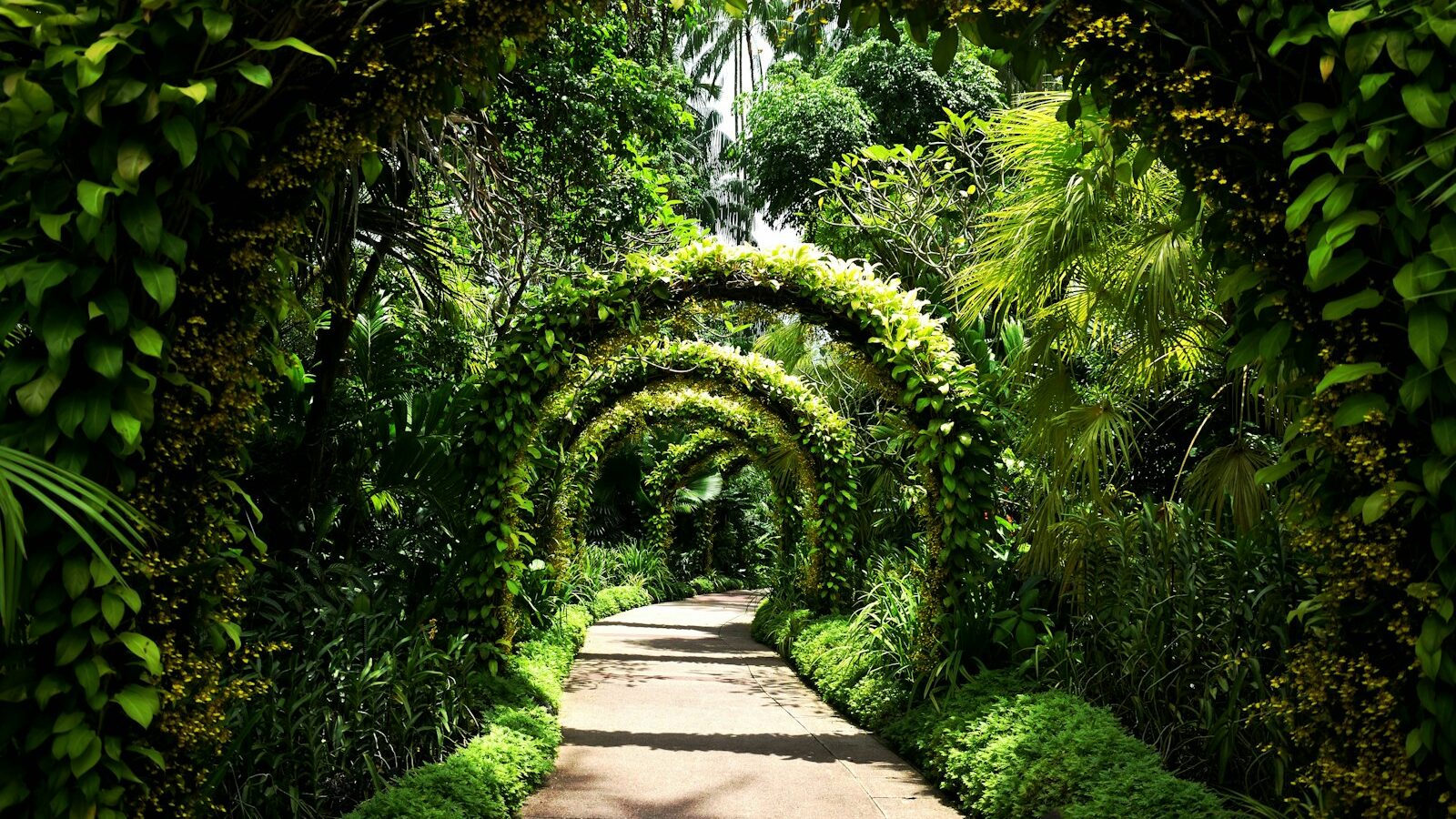
The Singapore Botanic Gardens reward photographers who slow down. Unlike the big, glowing structures elsewhere in the city, this UNESCO World Heritage Site is about soft light, old trees, still water and flowers you can fill the frame with. Good botanic gardens photography here comes down to three things: knowing where to stand, arriving when the light is kind, and carrying the right lens for each part of the grounds.
This guide focuses on three classic areas, Swan Lake, the National Orchid Garden and the Bandstand, with practical notes on timing, composition and gear. If you want the background story of the place first, our heritage highlights guide is a good primer.
Planning Around Singapore’s Light and Weather
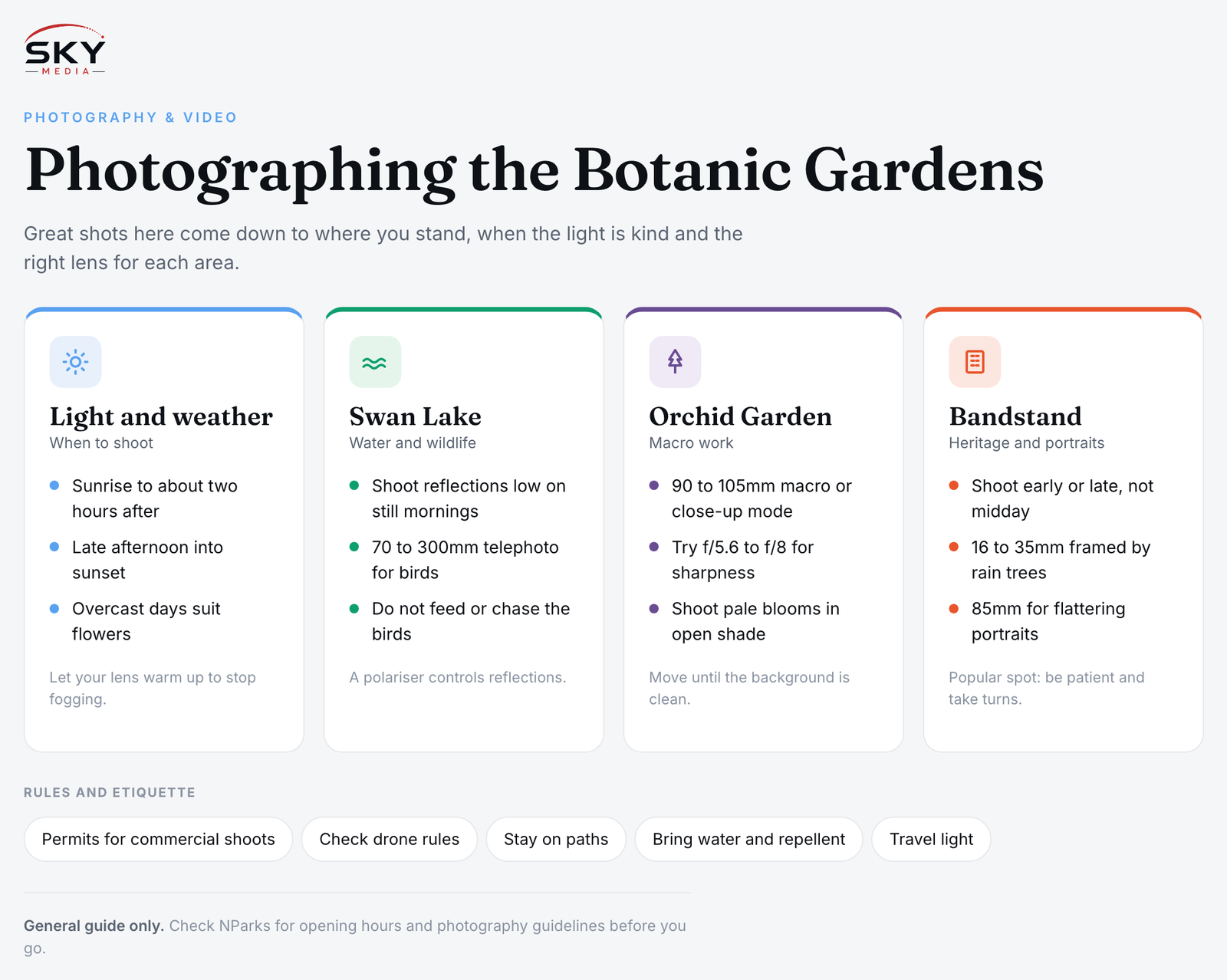
Singapore sits near the equator, so the sun rises and sets at fairly consistent times through the year and climbs high very quickly. By mid-morning the light is hard and overhead, which flattens leaves and blows out white flowers. For most of the Gardens, the best windows are:
- Early morning, from sunrise to roughly two hours after. Light is low and warm, the paths are quieter, and joggers and walkers add life without crowding the frame. Mist sometimes hangs over the water after a night of rain.
- Late afternoon into sunset. The canopy throws long shadows and the light turns golden, which flatters the lawns and the Bandstand.
- Overcast days. Do not write them off. Cloud acts like a giant softbox, which is ideal for flowers, foliage and portraits under trees.
Rain is part of the deal, especially during the monsoon months. Carry a rain cover or a simple plastic bag for your camera, and a microfibre cloth for the lens. When you step out of an air-conditioned car or MRT station, your lens will fog in the humidity. Give it a few minutes to warm up before you start shooting, or keep your bag zipped until you reach the Gardens so the gear adjusts gradually.
Check the official NParks website for current opening hours, any closures for events or maintenance, and the admission details for the paid areas.
Swan Lake: Reflections, Wildlife and Calm Water
Swan Lake sits near the Tanglin end of the Gardens and is one of the most photographed corners of the grounds. The lake, the gazebo, the swans and the surrounding palms give you plenty to work with.
What to shoot:
- Reflections. On a still morning, the water mirrors the trees and the sky. Shoot low, close to the water’s edge, and keep the horizon level. A polarising filter helps you control how much reflection or how much underwater detail shows.
- The swans and other birds. Wildlife needs reach and patience. A telephoto zoom in the 70 to 300mm range lets you fill the frame without disturbing them. Focus on the eye, use a fast shutter speed for movement, and wait for a clean background.
- The lake as a scene. A standard zoom works for wide views that show the lake in its setting of palms and lawns.
Please do not feed or chase the birds, and stay on the paths.
The National Orchid Garden: Colour, Detail and Macro Work
The National Orchid Garden is a ticketed area within the Gardens and holds a large collection of orchid species and hybrids, plus the cool house that recreates a highland climate. It is the best place in the Gardens for close-up work.
Tips for orchids:
- Go macro or near-macro. A dedicated macro lens (around 90 to 105mm on full frame) lets you show petal texture, pollen and patterns. If you do not have one, a standard zoom at its longest end, or a phone’s close-up mode, still works well.
- Watch your depth of field. Up close, depth of field becomes razor thin. Try f/5.6 to f/8 to keep more of the bloom sharp, or open up to f/2.8 for a single sharp petal with a creamy background.
- Find a clean background. Move a step left or right until the bloom sits against dark foliage or shade. A busy background ruins most flower photos.
- Use shade and overcast light. White and pale orchids lose detail in direct sun. Shoot them in open shade, or bring a small diffuser.
- Mind the humidity in the cool house. Moving between areas can fog your lens again, so allow a moment before shooting.
For more ideas on composing plants, see our guide on how to photograph your plants well, and for bark, leaf veins and petal close-ups, textures and details.
The Bandstand: Heritage Charm and Portraits
The white, octagonal Bandstand on its small hill is one of the Gardens’ best-known landmarks, framed by mature rain trees with sprawling, umbrella-shaped crowns. It is popular for portraits, couple shoots and family photos.
How to get it right:
- Shoot early or late. At midday, the white structure is very bright against deep shade, which is hard to expose. Low sun evens things out.
- Use the trees as a frame. Step back and use the overhanging branches to frame the Bandstand. A wide angle lens (16 to 35mm) emphasises the canopy.
- For portraits, go longer. An 85mm prime or the long end of a 24 to 70mm zoom gives flattering perspective and blurs the background. Place your subject in open shade under the trees and let the Bandstand glow softly behind them.
- Expect company. This is a popular spot. Be patient, take turns, and do not block paths with tripods or props.
Which Lens for Which Area
Here is a quick reference for packing light.
| Area | Best lens | Best light | Main subject |
|---|---|---|---|
| Swan Lake | 70 to 300mm telephoto, plus standard zoom | Early morning, still water | Birds, reflections, lake views |
| National Orchid Garden | 90 to 105mm macro or close-focusing zoom | Overcast or open shade | Individual blooms, petal detail |
| Bandstand | 16 to 35mm wide, or 85mm for portraits | Golden hour, morning or evening | Landmark, rain trees, people |
| Rainforest and trails | 24 to 70mm standard zoom | Bright overcast | Tall trees, ferns, light through canopy |
If you can only bring one lens, a 24 to 105mm or similar all-round zoom covers most of the Gardens.
Rules, Etiquette and Practical Tips
The Gardens are a public park and a heritage site, so a few rules and courtesies apply:
- Commercial and organised shoots. Casual personal photography is fine, but commercial shoots, pre-wedding sessions with crews, and large setups may need a permit. Check the NParks website for current photography guidelines before booking a session.
- Drones. Flying drones in parks and near people is regulated. Do not fly without checking the rules from NParks and the Civil Aviation Authority of Singapore (CAAS).
- Stay on the paths. Do not step into flower beds, climb trees or move plants for a better angle. The collection is living and some plants are rare.
- Hydrate and protect yourself. Even early mornings are warm and humid. Bring water, a hat and insect repellent, and take breaks in the shade.
- Travel light. You will walk a lot. A small sling bag with two lenses, a spare battery and a cleaning cloth is usually enough.
If you have time after the main areas, the newer Gallop Extension and Learning Forest add boardwalks and different scenery. Our guide to the Gallop Extension and Learning Forest explains what is there.
Turning a Visit Into a Photo Set
The strongest photo sets from the Botanic Gardens tell a small story. Try this simple plan on your next visit:
- Arrive at sunrise and start at Swan Lake for reflections and birds.
- Walk through the heritage core and the Bandstand while the light is still low.
- Move into the National Orchid Garden as the sun rises higher, where shade and macro work suit harsher light.
- Finish with a few wide shots and details, such as a leaf, a bench, a lamp post, to round out the set.
Mix wide, medium and close-up frames for a varied, honest record of the Gardens.
Frequently Asked Questions
What is the best time of day to photograph the Singapore Botanic Gardens? Early morning, from sunrise to roughly two hours after, is usually best, with late afternoon a good second choice. By mid-morning the sun is high and harsh, flattening leaves and blowing out white flowers. Overcast days are also useful, since cloud softens the light.
Can I bring a tripod to the Botanic Gardens? Casual personal photography is fine, but large setups, commercial shoots and crews may need a permit. Check NParks’ current photography guidelines before you go. Wherever you set up, avoid blocking paths or crowded spots such as the Bandstand.
Is the National Orchid Garden worth paying for as a photographer? If you enjoy close-up work, yes, since it is the best place in the Gardens for macro shots and holds a large collection of orchids and hybrids. Check NParks for current admission details. The cool house adds a different look, but allow your lens a moment to clear when it fogs.
What should I do to stop my camera lens fogging up in Singapore’s humidity? Give the lens a few minutes to adjust when moving from air-conditioning to the outdoors. Keeping your bag zipped until you reach the Gardens lets the gear warm gradually. A microfibre cloth is useful, and the same applies when you walk into the orchid cool house.
Do I need a permit to fly a drone at the Botanic Gardens? Flying drones in parks and near people is regulated, so do not fly one without checking the rules first. NParks and the Civil Aviation Authority of Singapore (CAAS) are the bodies to ask. Rules and permit requirements can change, so rely on their current guidance.
Further reading: How to Photograph the Jewel Rain Vortex at Changi · How to Photograph Heritage Shophouses in Singapore · How to Photograph Cherry Blossom and Flower Displays in Singapore